How to market a new residential development, from pre-launch to handover
Marketing an off-plan residential project phase by phase: brand, renders, website, sales gallery, decks, CRM, channels, the metrics that matter and the legal limits.
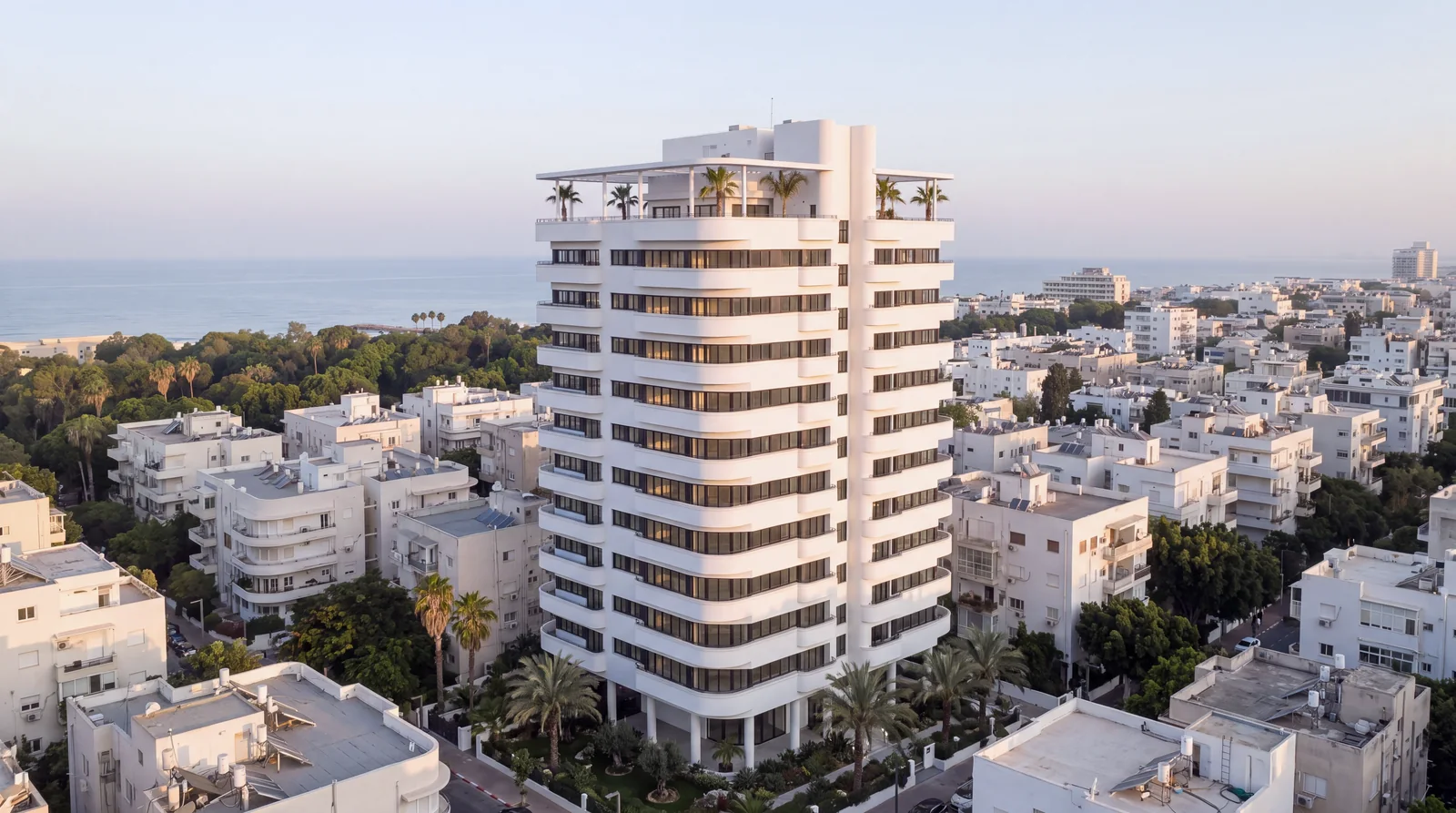
A new residential development is marketed in phases, starting before the permit and ending when the last buyer gets the keys: research and positioning, pre-marketing that builds a register of interest, a launch with the brand, renders, website and sales gallery, a sales period of campaigns and disciplined lead follow-up, marketing during construction, and handover. Each phase has its own assets and its own goal, and what ties them together is one system that measures the cost of a lead, a visit and a reservation.
This guide lays out that process from a developer’s point of view: what to build in each phase, why, in what order, and what to measure. It describes how off-plan residential projects are marketed in general, with Israel, the market we work in, as the source of the legal examples. Where the journal has a separate article on a topic, such as renders, the project website or the CRM, you get the essentials here and a link. The examples come from ALBA, a fictional residential tower we built as a concept to show the level: a launch page, renders, 3D residences, brand guidelines, a deck and a CRM.
When should marketing for a new development start?
Earlier than most developers plan. The decisions that shape sales most are made before a single ad runs: who the project is for, which unit types it offers, what it is called and how it looks. If marketing only arrives once the drawings are frozen, it ends up selling a unit mix that was never designed for the buyers who actually turn up.
There are three common entry points. The first is during design, while the mix and the specification can still change. The second is a few months before sales open, to build the brand, renders and website and to collect a register of interest. The third, and the most expensive, is the day sales open with nothing ready. The later marketing starts, the more of the budget goes on ads that send people to assets that cannot yet receive them.
Before anything goes public, and especially before you ask anyone for money or a commitment, check with the project’s lawyer what is allowed at the stage you are in: registering interest, publishing prices, reservation agreements or contracts. It depends on the jurisdiction, the permits and the financing, and nothing here is legal advice.
The marketing phases of a residential project at a glance
The table summarises each phase, the assets built in it, the goal and the main measure. The order matters more than the dates: every asset rests on the one built before it.
| Phase | Main assets | Goal | What to measure |
|---|---|---|---|
| 1. Research and positioning (pre-permit) | Competitor review, buyer personas, unit mix, name and message | Decide who you are selling to and why here | Written decisions: audience, mix, price band |
| 2. Pre-marketing | Basic identity, a first render, a landing page with a registration form, site hoarding | Build a register of interest and test demand | Registrations, cost per registration, source of each |
| 3. Launch and sales opening | Brand guidelines, full renders, a film, the project website, a sales deck, the sales gallery | Turn registrations into visits and first reservations | Visits, reservations, lead-to-visit rate |
| 4. Sales period | Search and social campaigns, ongoing content, agents and brokers, CRM, enquiry handling | A steady sales pace by unit type | Cost per lead, per visit and per reservation; remaining stock |
| 5. During construction | Progress updates, site photography, a show apartment, buyer events | Sell the remaining stock and keep buyers’ trust | Sales by floor and type, buyer enquiries |
| 6. Handover | Resident handbook, maintenance and use instructions, photography of the finished building | An orderly handover and a portfolio for the next project | Handover complaints, referrals, registrations for the next project |
On a small project some phases shrink; on a large one with several buildings the cycle repeats for each phase of construction. The principle holds: do not advertise before there is somewhere to send the people who respond, and do not build beautiful assets without a system that measures what they bring in.
Before sales open: research, positioning and pre-marketing
Who is the buyer?
The same tower can sell to first-time buyers, families moving up, investors and buyers from abroad. Each asks different questions, arrives through a different channel and decides at a different speed. Before designing anything, write two or three personas: who they are, what they ask, what worries them about buying something that does not exist yet, and which unit type suits them. Every later decision rests on this: what the renders show, what the website says and where you advertise.
Competitors and positioning
Go through the projects selling in the same area and price band: what they promise, how they look, the prices they publish and what they leave out. The aim is not to copy but to find one sentence your project can say and the others cannot: location, architect, specification, unit sizes, shared amenities, view. A sentence you can prove in a render, a specification or a map. “Luxury” and “quality of life” are not positioning, because every project says them.
Pre-marketing and the register of interest
Pre-marketing does two jobs: it builds a list of people who are interested, and it tests whether the positioning, the mix and the price speak to them. The assets at this stage are modest: a name and logo, one good exterior render, a landing page with a registration form and hoarding on the site. Every registration goes into the CRM with its source and what the person selected: unit type, bedrooms, budget band. When sales open, this list gets the first invitation.
- A short form: name, phone, email, number of bedrooms, and one question about purpose (to live in or to invest).
- A separate, unticked consent box for marketing updates.
- An automatic confirmation email that says what happens next and when they will hear from the project.
- Every registration tagged by source: hoarding, Google, Meta, agent, referral.
- A short update every few weeks, even without big news, so the list does not go cold.
Building a brand for a residential development
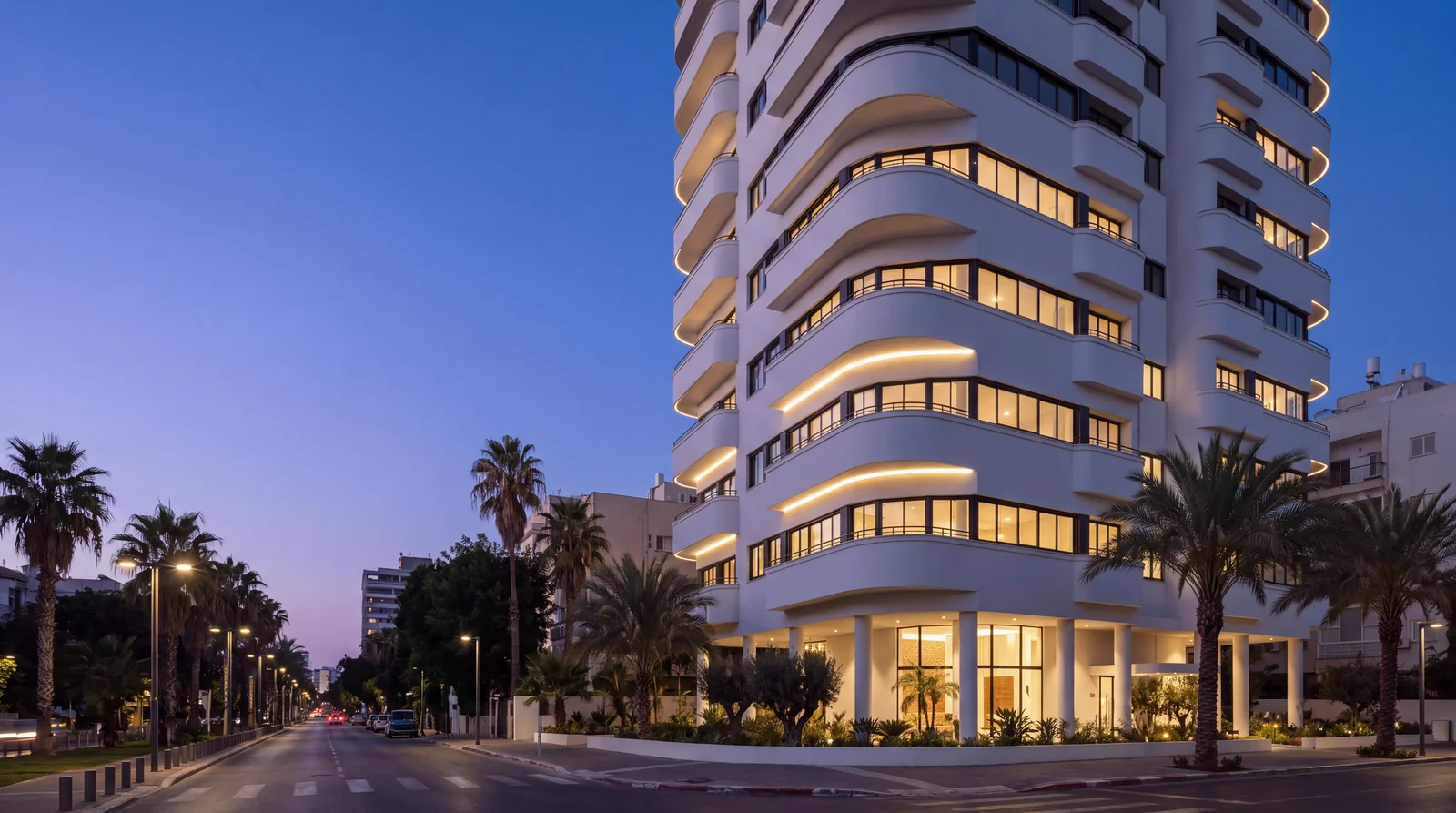
A residential project needs its own identity, separate from the developer’s: a name, logo, colours, typography, a photographic and rendering style, and a tone of voice. It will appear on the hoarding, the landing page, the sales gallery, the deck, the resident handbook and dozens of ads, so it should be documented in short brand guidelines any supplier can work from. The ALBA brand guidelines are an example: logo, colour, type, signage and sales material for a fictional residential tower, in one place.
The name has to work in every language you sell in, be easy to spell in a search box and not resemble another project nearby. The identity has to work small, in an ad headline on a phone, and large, on a hoarding several metres wide. What an identity includes, when a business needs one and what it costs are covered in our business branding guide.
Renders, films, 360° tours and 3D residences
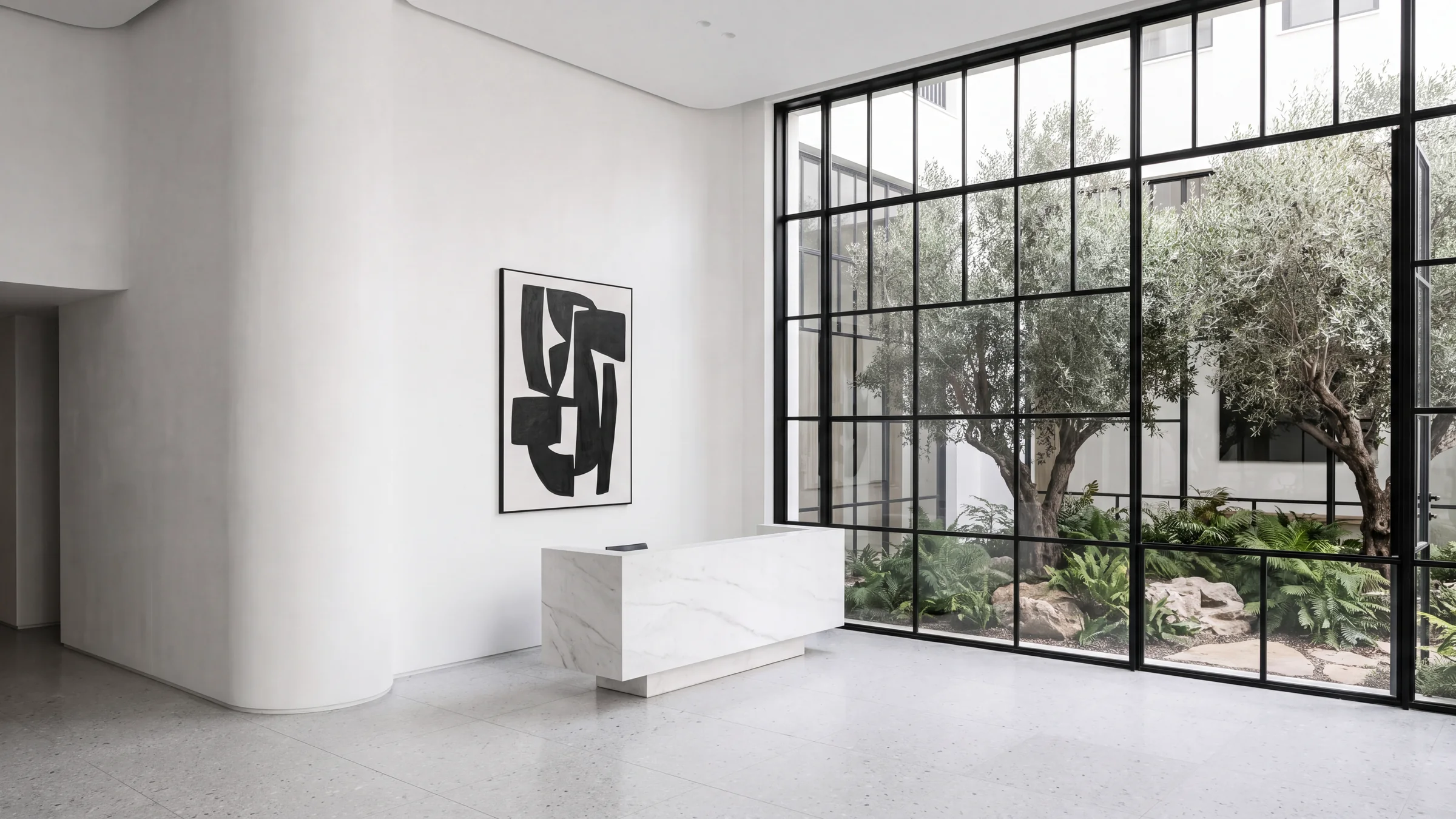
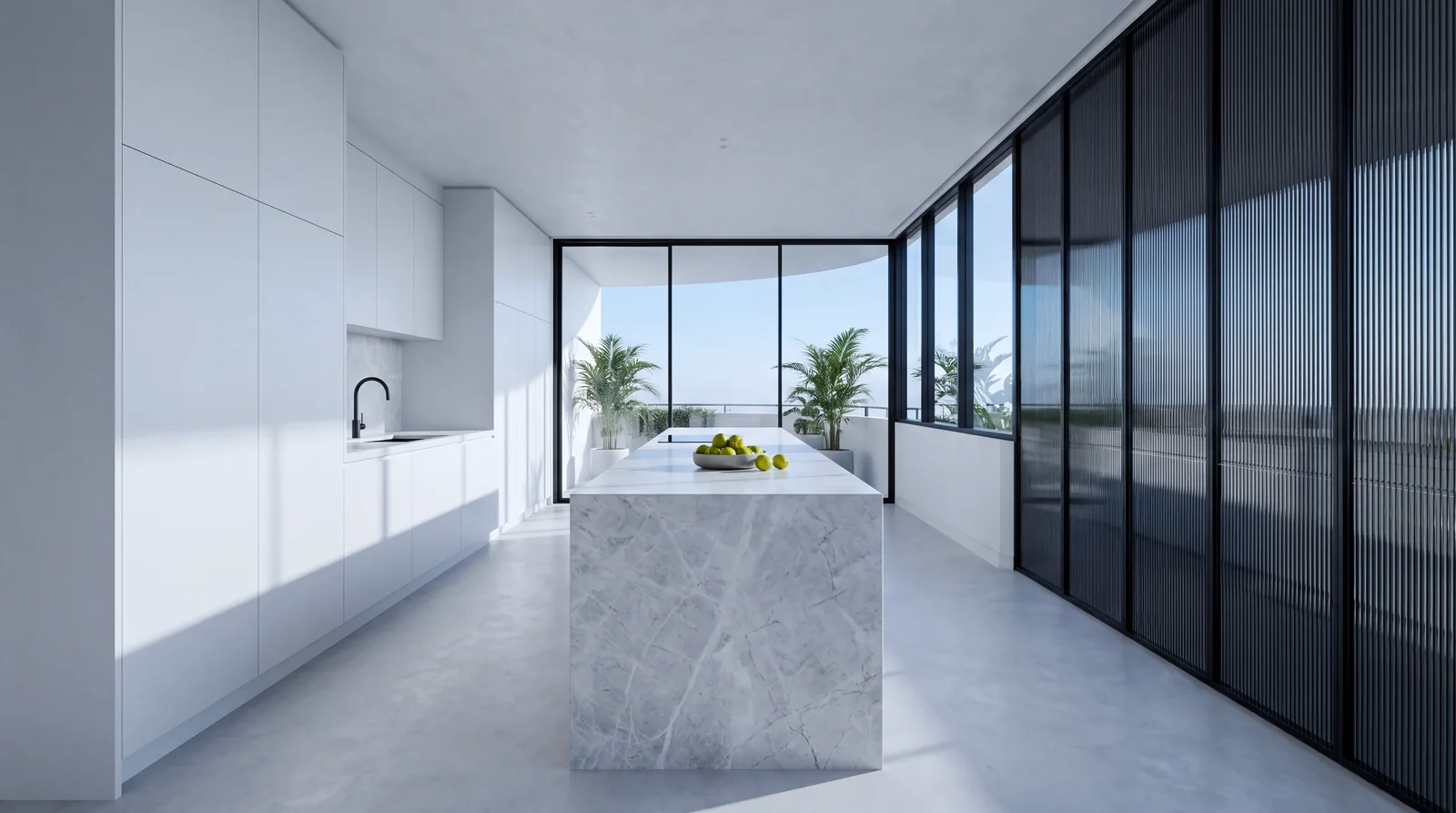
When a project sells off-plan, the renders are the product. Buyers cannot stand in the living room, so every decision they make rests on what they see. That means two things: the renders have to be good enough to create desire, and accurate enough that what is handed over looks like what was sold. Materials, ceiling heights, views and the direction of light should follow the drawings and the specification.
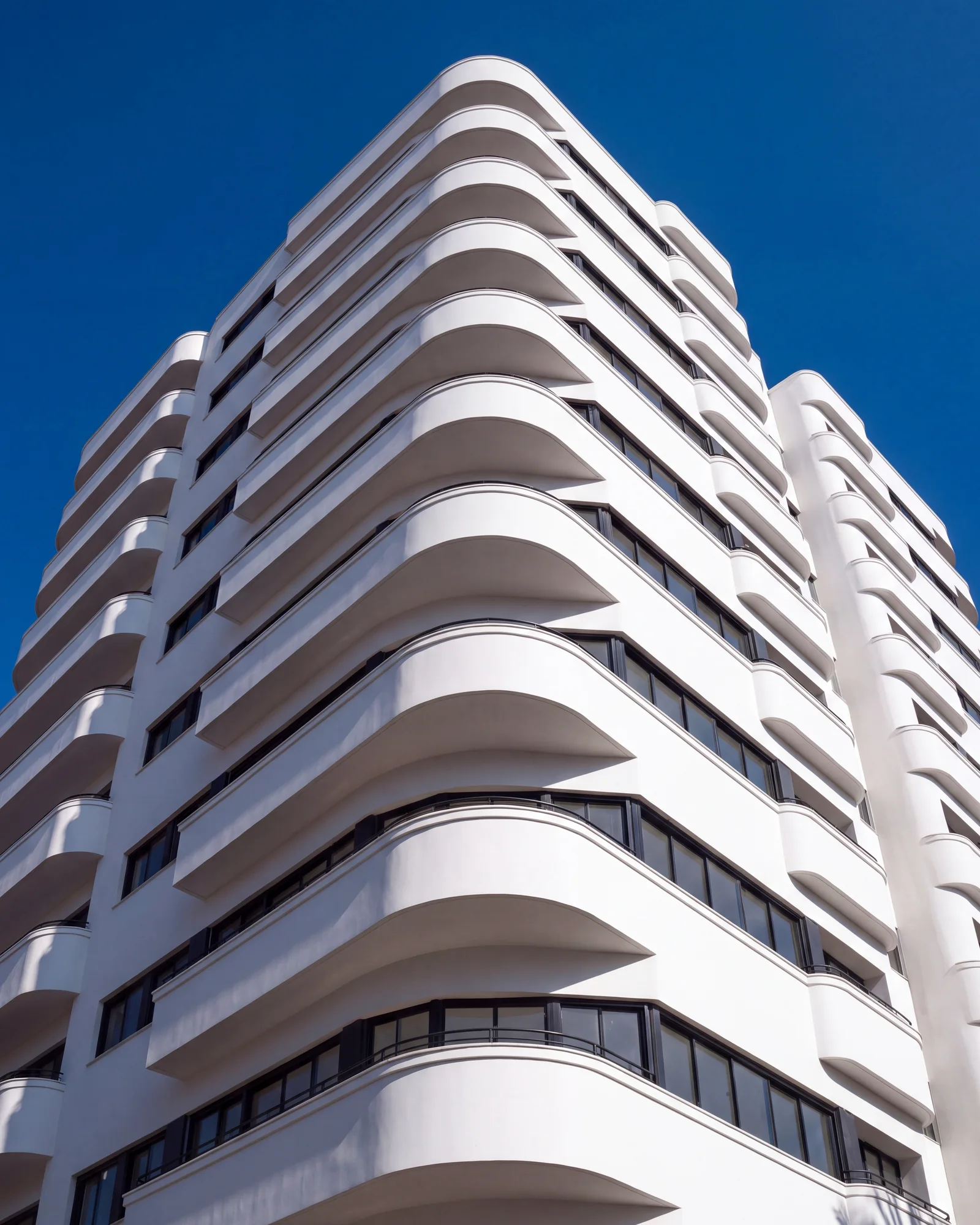
The core set is an exterior by day and at dusk, the lobby, one or two interiors and the view from typical floors. On top of that you can add a film of the project, 360° tours of the apartments and 3D residences buyers can walk through themselves. The ALBA visuals show this: the tower by day and by night, a film and 360° tours, before the building exists. The 3D residences show every apartment as a furnished model, from above and at eye height.
The types of visuals, what to send the studio and how to check a render against the drawings are covered in our guide to real estate 3D visualisation. What it costs and what the price depends on is in 3D rendering cost. Keep the 3D model: new campaign images, phase two and fresh ads can all come from it without starting again.
The project website and launch page
Most projects start with one landing page where every section leads to the form, then grow into a fuller project website. The launch page answers the first questions: where, what, for whom, when, and how to register. The project website adds what a serious buyer checks before visiting: unit types with floor plans, the specification, location and neighbourhood, the developer and architect, construction progress and FAQs.
The ALBA launch page is an example: a 3D model of the tower, with every section leading to the registration form. It is a concept we built; the project is fictional. What goes into a development website, how to show available units and what to connect to the CRM is covered in our article on real estate development websites. How to build a landing page that converts, with its structure, form and tracking, is in the landing page guide.
A few points apply to every project. The site has to load fast on a phone, because that is where most ad traffic comes from. The form should be short. Every page needs a disclaimer on the renders in wording the lawyer has approved. And if the project also targets overseas buyers, each language needs copy written for that audience, not a word-for-word translation. In the Israeli market we see a landing page at roughly $800–$4,000 and a project website at roughly $2,000–$11,000, depending on design, languages, 3D and integrations; these are rough conversions of local ranges, not a price list.
The sales gallery
Most deals close in the sales gallery, not on the website. The people who arrive there have already left their details, and they need what the website cannot give them: real materials to touch, a large screen with the 3D residences, a physical or digital model of the building, printed plans and a salesperson who knows the project. The gallery is also a brand asset: the same colours, type and tone.
Plan in advance how visits are booked, what the visitor sees at each step, how what happens in the visit gets into the CRM, and what they take home. Screens in the gallery can run the same models and renders as the website, so there is only one version of the project. We cover the design, the screens and the visitor’s route in our article on the real estate sales gallery.
Decks for investors and buyers
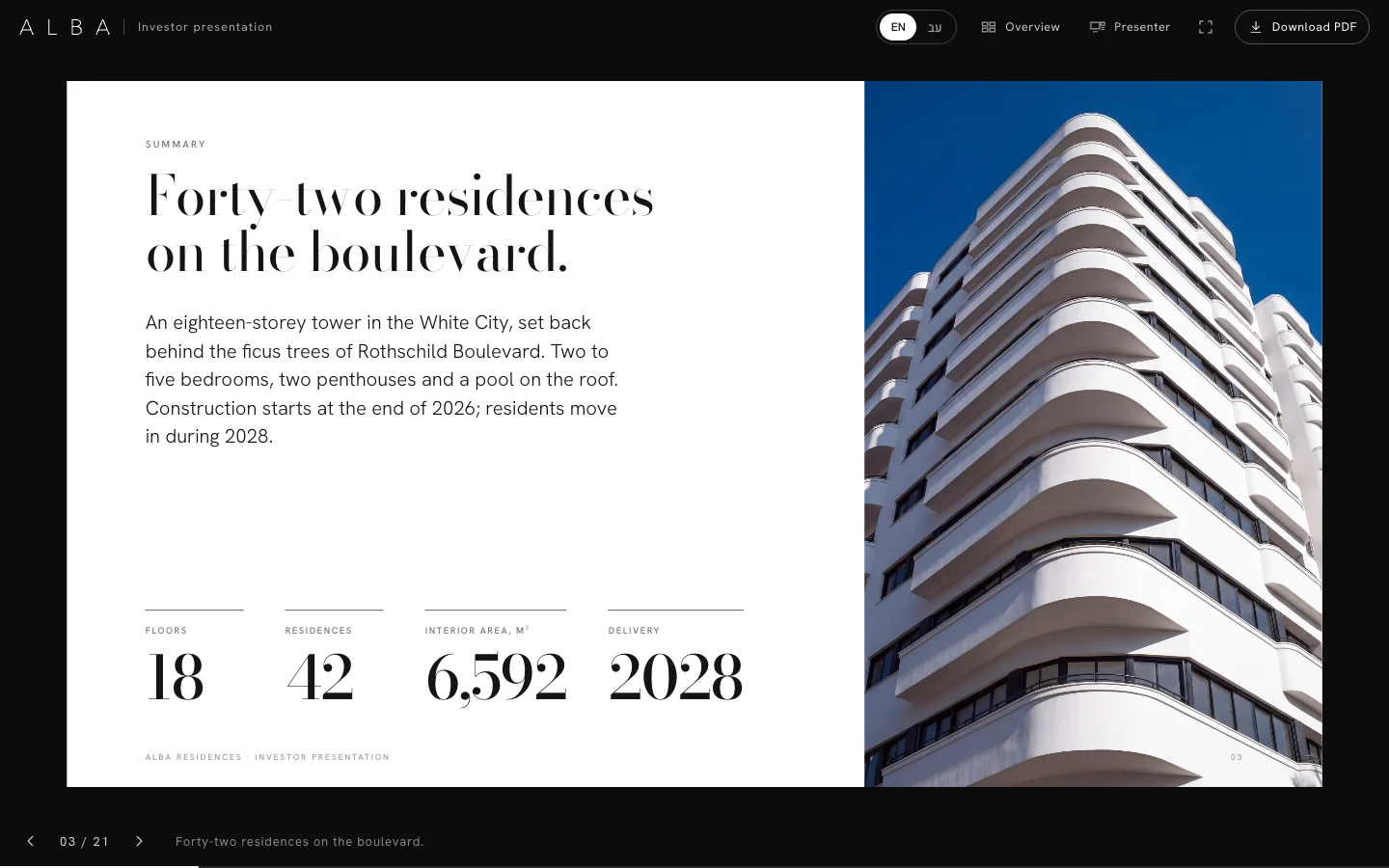
A project usually needs two decks. An investor or lender deck is about the economics: costs, expected revenue, schedule, risks and the team. A buyer deck is about life in the apartment: the neighbourhood, the architecture, unit types, the specification and the timeline to handover. Build both from one slide system and the same renders, so the project looks the same everywhere.
The ALBA deck is an example that works on screen and as a PDF. What goes on each slide, how to show numbers without promising returns, and what investors ask are in our real estate investor deck guide.
Handling enquiries: CRM, WhatsApp and AI agents
Most of the money lost in property marketing is lost between the lead and the visit. An enquiry answered a day later, a lead that lives in one salesperson’s spreadsheet, or a prospect who gets three different answers from three people: each is ad spend thrown away. So before the first campaign there should be one system every enquiry flows into, from the website, the phone, WhatsApp, agents and the gallery.
A CRM for a residential project needs to know more than a general CRM: the unit inventory, which apartments are reserved and which are sold, what each buyer asked for, and where they are on the way from lead to reservation to contract. The ALBA CRM brings every lead from the website, the phone agent and WhatsApp into one place, alongside the inventory and the sales pipeline. How to build one and what it should include is in our guide to a real estate CRM.
Enquiries arrive in the evening and at weekends, when the gallery is closed. An AI agent on the phone or on WhatsApp can answer at once in several languages, answer basic questions from the project’s approved information, book a visit in the calendar and hand anything about price, contracts or anything sensitive to a person. The phone agents we built show how that sounds, with a fictional clinic and with ALBA. What such an agent does and where it does not fit is covered in our article on AI phone agents.
Marketing messages to your list are regulated almost everywhere. In Israel, section 30A of the Communications Law prohibits sending an advertisement by email, SMS, fax or automatic dialling without the recipient’s explicit prior consent, and the recipient can withdraw it at any time (the amendment as enacted, in Hebrew). The consent box on the form, its record in the CRM and the unsubscribe link in every email are not technical details.
Which channels sell a new development?
No single channel sells a project. Each does a different job, so choose by audience and measure each one through to the reservation, not just the lead.
| Channel | What it does well | What to watch |
|---|---|---|
| Google Search | Catches people already searching for new homes in the area, or for the project by name | Keywords by city and neighbourhood, a campaign on the project name, a matching landing page for each ad |
| Facebook and Instagram | Creates demand among people not yet searching, with renders and films | Rotating creative, forms that go straight into the CRM, measurement through to the visit |
| Property portals | Reach buyers comparing projects | Up-to-date images and plans, the same prices in every channel |
| Agents and brokers | Bring buyers who already know the area | A written commission agreement, ready-made materials, every referred buyer logged |
| Site hoarding and outdoor | Local, seen every day for years | Project name and web address large and legible, a QR code to the landing page |
| Register of interest and past buyers | The cheapest and warmest audience | Consent to email, content that fits the phase, not only offers |
| Events and open days | Many visits in a short time, a sense of demand | Pre-registration, enough staff, follow-up with every visitor within a day |
On Facebook and Instagram, the creative is most of the difference: the same render can work as a still, a 15-second film or a carousel of apartments. How to build ads for those platforms and what to test is in our article on Meta ads creative.
If you target buyers abroad, check the platforms’ housing rules before planning audiences. Meta requires housing advertisers based in the US or reaching the US, Canada or Europe to declare a special ad category, which fixes age and gender and restricts location targeting (Meta’s documentation). Google does not allow housing ads in the US and Canada to target by gender, age, parental status, marital status or ZIP code (Google Ads policy). Campaigns for those buyers should be built around broad audiences and strong creative from the start.
Marketing during construction and at handover
After the first wave of sales, marketing does not stop; it changes job. There is unsold stock, usually the units that are harder to sell, and there are buyers who have paid and will wait years for their keys. The two audiences need different content.
- For the remaining stock: renders and films focused on the unit types still available, campaigns by floor or aspect and, where possible, a show apartment.
- For construction progress: regular site photography, drone footage, updates on the project website. A building that visibly rises is evidence, not just a message.
- For buyers: a periodic email update, information on choices and changes, and one point of contact who answers. A buyer who feels informed recommends the project to friends.
- Before handover: a resident handbook, information on the building’s management and maintenance, and a well-organised handover. In Israel the Sale Law already requires maintenance and use instructions to be attached to the contract; it helps when they arrive in the project’s design and voice.
- After handover: photograph the finished project. It is the developer’s portfolio for the next one, and the comparison between render and reality is the strongest evidence a developer has.
How to measure: cost per lead, per visit and per reservation
Cost per lead on its own misleads. A channel that brings cheap leads who never visit costs more than one that brings a few leads who reserve. So measure the whole path, by channel and by campaign, and join the ad data to the CRM data. We do not give benchmark numbers here, because they vary widely by city, price point, phase and season; what to measure we can spell out.
| Metric | How to calculate it | What it tells you |
|---|---|---|
| Cost per lead | Spend in a channel divided by leads from it | What it costs to get someone to leave their details |
| Response rate and speed | How many leads were answered, and how fast | Whether the team and the system keep up with the campaign |
| Cost per visit | Spend divided by visits from the channel | Whether the leads are real and a good fit |
| Lead-to-visit rate | Visits divided by leads | The quality of the audience and of the response |
| Cost per reservation | Spend divided by reservations from the channel | The measure closest to revenue |
| Sales pace by unit type | Units sold per month, by type and floor | Where the mix or the price is not working |
| Source of the reservation | The first and last channel the buyer came from | Which channel opens and which one closes |
Three basics make this work: every ad link is tagged with source and campaign parameters, the form stores those parameters in the lead record in the CRM, and the sales team updates the status after every visit. Without the last one, no dashboard can tell you what a reservation costs.
Legal limits on property marketing materials
Rules differ by country, and this is where mistakes are easiest to make. Wherever you sell, the same principle applies: marketing materials for an off-plan project must not promise something the contract and the specification do not deliver. In Israel, where we work, we checked these points against the text of the law; for everything else, ask the project’s lawyer.
- The specification: under the Sale Law (Apartments), in Hebrew, a seller must attach a specification and maintenance and use instructions to the sale contract, on a form set by the minister. An apartment that differs from the specification is a non-conformity under the law. For marketing, that means what appears in the render, on the website and in the deck should match the specification.
- Misleading claims and advertising: Israel’s Consumer Protection Law, in Hebrew prohibits a business from doing anything, in writing, orally or otherwise, that could mislead a consumer on a material aspect of a transaction, including the measure, form and components of an asset. Section 7 extends this to misleading advertising and to the party it was made for.
- Protecting buyers’ payments: under the Sale Law (Assurance of Investments), in Hebrew, a seller who receives more than 7% of the price must secure the buyer’s money in one of the ways the law lists, such as a bank guarantee, an insurance policy or a registered caveat. When a deck or website mentions guarantees or bank financing, the wording should come from the lawyer.
- “Illustration only” disclaimers: nearly every piece of off-plan marketing carries one, but it does not excuse a render that shows something that will not be built. Take the wording and placement from the project’s lawyer, and keep the renders true to the drawings and the specification.
- Email and SMS: explicit prior consent before sending advertising, and a way to opt out, as described in the CRM section.
Common mistakes when marketing a new development
- Launching a campaign before there is a landing page, a CRM and someone to answer the phone.
- Renders that show materials, views or heights that will not exist.
- A generic brand that could belong to any project in the area, with no sentence that sets it apart.
- Measuring only cost per lead, with no idea which channel brings reservations.
- Different prices or terms on the website, the portal and with the agent.
- Every salesperson keeping their own list, with no single view of stock and buyers.
- Spending everything on the launch and forgetting buyers during the years of construction.
- An English site that is a machine translation of the local one, for buyers abroad.
Who does what: developer, sales agency and studio
A typical project has several parties: the developer, who decides the mix, the price and the budget; a sales agency or in-house team, who handle leads, the gallery and closing; the lawyer, who approves wording and contracts; and whoever produces the assets themselves: brand, renders, website, deck and ads. The usual problem is that each asset comes from a different supplier, in a different style and at a different time, and nobody is responsible for making it all connect.
The advantage of one house for the assets is that the 3D model, the brand and the copy are built once and used everywhere: the same render on the website, in the deck, in the gallery and in the ad, and the same form feeding the same CRM. If you are writing a brief for a supplier, our guide to briefing a studio helps you decide what to include.
What Libra builds for residential projects
At Libra we build a project’s assets from the brand to the system: renders, films and 3D residences under AI content and visualisation, the launch page and project website under websites and landing pages, and the CRM, sales dashboard and AI agents for enquiries under apps and systems. Every example mentioned here is a concept we built around the fictional ALBA project, and you can see them all on the examples page.
If you have a project in design or approaching its sales launch, send a brief with what you already know: location, number of units, stage and what already exists. We reply by email with a direction, a written price and a date.
No term matches.
More on Real estate marketing
- 3D rendering cost: what architectural renders cost, and whyWhat 3D rendering costs per exterior and interior still, aerial, film, 360° tour and 3D residence, what drives the price, and how to compare rendering quotes.
- Real estate sales gallery: the space, the screens and the visitor’s routeWhat a sales gallery for a new development needs: a model, screens with renders and 3D residences, unit selection on live inventory, a materials wall and a digital gallery.
- Real estate development website: pages, units, the form and speedWhat a website for a new residential development needs: location, architecture, units and floor plans, 3D, a form wired to the CRM, languages, speed and cost.
- A CRM for a real estate developer: what the system must know about a projectWhy a generic CRM struggles with selling a residential project, and what works instead: unit inventory, lead sources, sales-office visits, reservations and a weekly report for the developer.
- Real estate 3D visualisation: selling residences before the building existsWhich visuals a residential project needs for pre-sales: exterior and interior, day and night, a film, 360° tours and furnished 3D residences. What the architect must supply and how long each stage takes.
- An investor presentation for a residential project: what goes in, in what orderThe structure of an investor and sales deck for a residential project: the story, location, architecture, unit mix, numbers and timeline, and what investors ask when something is missing.
A short picker
What fits you?
What is closest to what you need?
Where are you now?
Questions
When should you start marketing a new residential development?
Start research and positioning during design, and build the brand, a render and a landing page a few months before sales open to collect a register of interest. What you may publish or ask buyers for at each stage depends on the jurisdiction, permits and financing, so check with the project’s lawyer.
What do you need before opening sales on an off-plan project?
At minimum a brand, exterior and interior renders, a landing page or website with a form, a sales deck, a place to receive visitors and a CRM every enquiry flows into. You also need the legal documents your jurisdiction requires and wording your lawyer has approved.
Which marketing channels bring buyers to a new development?
Usually a mix of Google Search, Facebook and Instagram, property portals, agents, site hoarding and the register of interest. No channel wins on every project, so measure each one through to the reservation, not just the lead.
How do you measure a property marketing campaign?
By cost per lead, cost per visit and cost per reservation, by channel and campaign, and by the sales pace of each unit type. That requires the form to store the lead’s source in the CRM and the sales team to update the status after every visit.
Do renders need an “illustration only” disclaimer?
It is standard on almost all off-plan marketing, but the wording and placement should come from the project’s lawyer. It does not replace the need for renders to match the drawings and the specification of what is actually sold.
Are there targeting limits on housing ads?
Yes, in some markets. Meta requires a special ad category for housing ads reaching the US, Canada or Europe, and Google does not allow housing ads in the US and Canada to target by age, gender, parental status, marital status or ZIP code.
What does Israeli law require from a developer selling off-plan?
The Sale Law (Apartments) requires a specification on a prescribed form and maintenance and use instructions attached to the contract, and a separate law requires a seller who receives more than 7% of the price to secure the buyer’s money, for example with a bank guarantee. The project’s lawyer should review all marketing wording.
Getting started
Want this for your business?
Send a short brief: three required questions, the rest only if you like. We reply by email with a direction, a written price and a date.