An AI agent that answers the phone: how it works for a clinic and a sales office
What an AI phone agent can do in Hebrew and English, how it books appointments and viewings, when it must hand over to a person, and what to prepare before it goes live.
Part of the guide: Business automation with AI: a practical guide for small and mid-sized businesses

An AI phone agent for business answers incoming calls by voice, understands what the caller wants, replies only from information the business has approved, books or moves appointments in the real calendar, and writes a summary of each call into the CRM. In a clinic it handles the questions that come in every day and books treatments. In a property sales office it qualifies the caller and books a viewing. Anything medical, sensitive, exceptional or angry goes to a person, and so does any caller who asks for one.
What an AI phone agent is, in plain terms
It is four parts working in a chain, in real time, on every turn of the conversation:
- Speech-to-text. The caller’s voice becomes text. Most testing effort goes here: treatment names, street names, phone numbers read out quickly, accents, noise.
- A language model limited to the business’s knowledge. It decides what to say, answering only from a document the business has signed off: hours, treatments or units, pricing policy, rules. If something is not in that document, the agent says it will check and passes it on.
- Text-to-speech. The reply is spoken in a natural voice, in English or Hebrew, at a pace that suits a phone line.
- Tools. What makes an AI receptionist useful: calendar access to book, CRM access to open or update a lead, and the ability to transfer a call or message staff.
Unlike an old “press 1 for bookings” phone tree, there is no menu; the system works out intent from free speech. That only works when the limits are clear: what the agent may do, when it stops, and who it hands over to.
What an AI voice agent does well
AI phone answering suits repetitive work with one right answer, often when nobody is free to pick up:
- Answering common questions around the clock. Hours, address and parking, what a treatment involves, what to bring, which unit types a development offers.
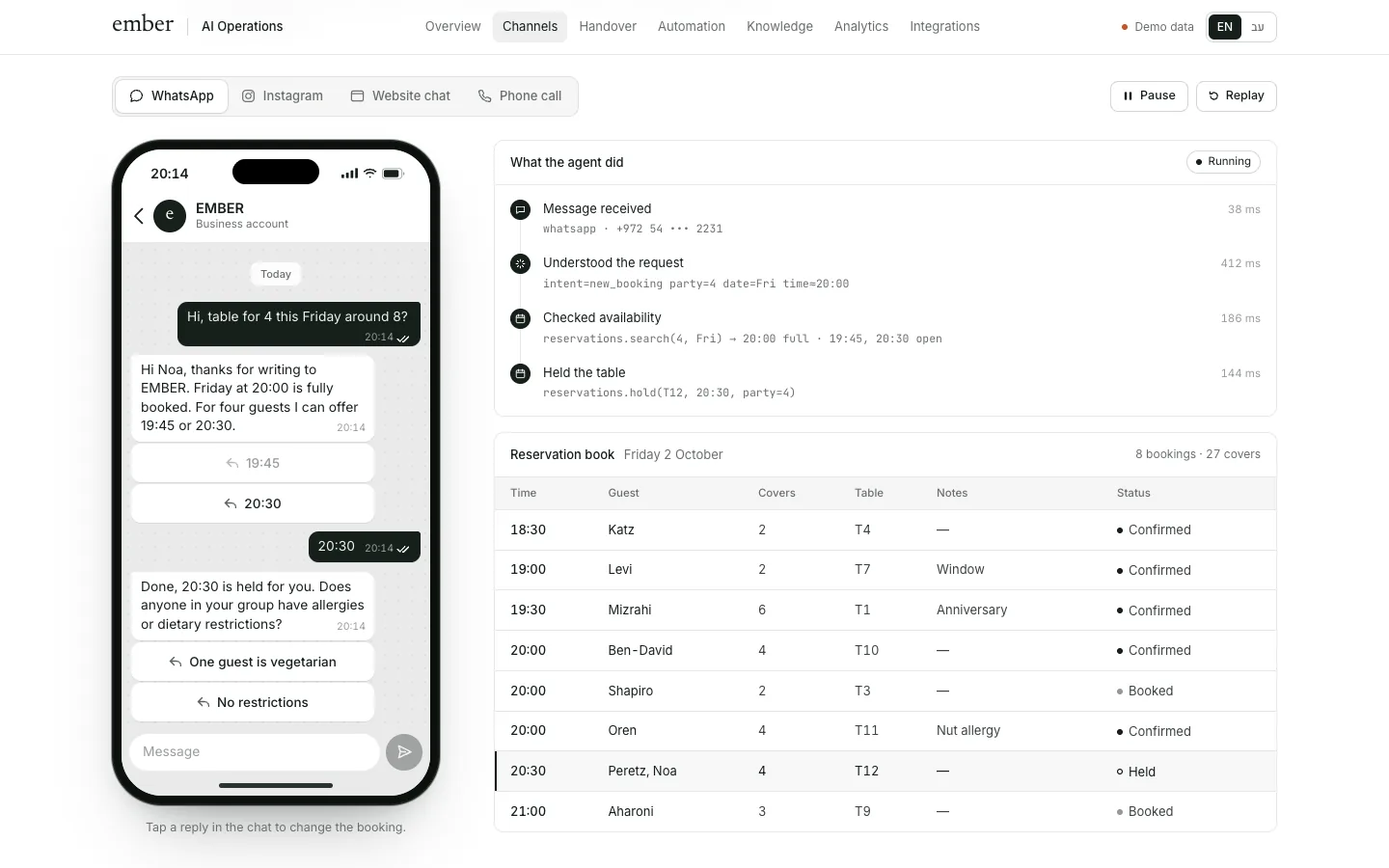
- Booking, rescheduling and cancelling. The agent checks the real calendar, offers slots, and sends a confirmation by text.
- Qualifying a lead. For real estate: bedrooms, budget range, move-in date, mortgage status. The questions a salesperson would ask.
- Logging the call. The CRM gets who called, what they wanted, what was agreed and what is still open.
- Two languages. The agent recognises the caller’s language and answers in it, which matters for clinics with international patients and developments sold to overseas buyers.
The limit: the agent is good at work that is already written down. If the answer lives only in the manager’s head, it should not guess.

What it must hand to a person
The most important rule in any voice agent is the handover rule. These cases are fixed handovers, not left to the model’s judgement:
- Medical questions. Is this treatment right for me, what about this reaction, is it safe in pregnancy. The agent records the question and passes it to clinical staff.
- Complaints. The agent apologises, takes the details and transfers straight away.
- Pricing exceptions. Discounts, special payment terms, the price of a specific unit that has not been published. The agent knows the policy; it does not decide it.
- Anything sensitive. Personal circumstances, finances, anything the business itself handles with care.
- A caller who asks for a human. No persuading. If nobody is free, the agent says when someone will call back and records it in the CRM.
An agent that knows when to stop is worth more than one that tries to answer everything.
Clinic flow and sales-office flow, side by side
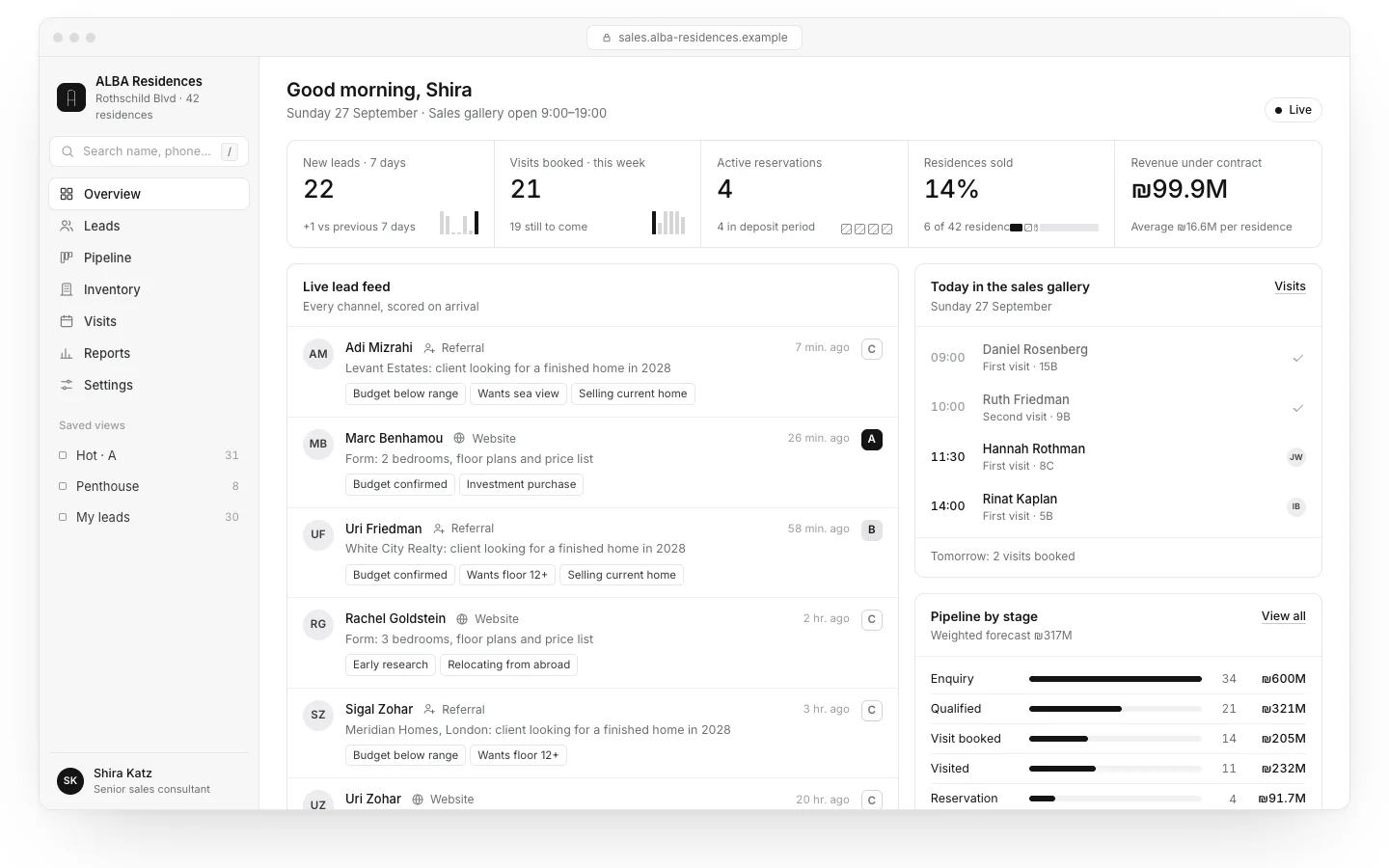
In our voice agent demo, one agent answers for Névé, an aesthetic clinic, and another for the sales office of ALBA, a residential tower. Both businesses are fictional; it is a concept we built. Both agents speak Hebrew and English, book appointments and viewings, and pass anything sensitive to a person. The technology is the same; the script is not:
| Caller intent | What the agent does | Handover rule |
|---|---|---|
| Clinic: book a treatment | Checks the calendar, offers slots, confirms, sends a confirmation with preparation notes | A first treatment that needs a clinical consultation gets a consultation booked instead |
| Clinic: move or cancel | Finds the booking by phone number, offers another slot, updates the calendar | A late cancellation that carries a fee goes to the front desk |
| Clinic: price question | Gives the published price range and what it depends on | Requests for discounts or custom packages go to a person |
| Clinic: reaction after a treatment | Does not answer on substance; records and transfers at once | Always to clinical staff; if it sounds urgent, directs the caller to medical help |
| Real estate: interested in a unit | Asks about bedrooms, budget and timing, opens a lead in the CRM | A request for the price of a specific unit goes to a salesperson |
| Real estate: book a viewing | Checks the sales calendar, books a show-flat or office visit, sends address and directions | Large groups or investors buying several units go to the sales manager |
| Any business: asks for a human | Transfers, or records the request with a call-back time | Always |
In a sales office, what pays off is what happens after the call. In the ALBA CRM demo, each inbound call becomes a record with budget, unit type, source and next step, read by the salesperson before calling back; more in a CRM for real estate sales. For a clinic, the agent sits alongside the website and booking system; the Névé clinic site shows what a patient sees before calling.
What to prepare before you start
Most of the effort is knowledge, not technology. The agent is exactly as good as the material it is given. Prepare:
- A knowledge document. Hours, address, parking, treatments or unit types, durations, preparation, cancellation and pricing policy (what may be said), and recurring questions with your team’s current answers.
- Calendar access. Which calendar, appointment types and durations, which staff, which hours are blocked.
- Escalation numbers. Who takes each kind of call, in and out of hours.
- Call scripts. How the agent opens, closes, and what it says when it does not know.
- Forbidden topics. Diagnoses, competitor comparisons, final price commitments, promises about results.
- Tone. A calm, precise clinic does not sound like a sales office; the agent should sound like its own business.

Telling callers it’s an AI, and handling their data
We recommend that the agent introduces itself as a digital assistant in its first sentence. It is fair, and it works better: callers who know speak more clearly, ask for a person when they need one, and do not feel tricked. A plain line is enough: “You’ve reached the clinic. I’m the digital assistant. I can book, answer a question, or put you through to the team.”
A recorded, transcribed call is personal data, and in a clinic it may include health information. Rules that hold up:
- Say at the start that the call is recorded, and why.
- Keep only what is needed: the summary and contact details in the CRM, not necessarily the full recording forever. Set a deletion period.
- Do not ask for medical or financial details on the phone beyond what the booking needs.
- Check where each provider stores the data and who can access it.
Privacy law applies to data collected by an automated system as it does to staff; in Israel, the Protection of Privacy Law and its data-security regulations. We do not give legal advice; before launch, your privacy adviser should review the opening script, what is stored and for how long.

Testing on real scenarios, then the metrics to watch
A voice agent does not go live because it “sounded fine” on a few test calls. We run a list of real scenarios repeatedly:
- Every common question, each phrased several ways, in both languages.
- Booking, moving and cancelling, including when there is no availability.
- Every handover rule: a medical question, a complaint, a discount request, “I want to talk to a person”.
- A question the knowledge document does not answer. The right outcome is “I’ll check and get back to you”, not an invention.
- Attempts to get something the agent must not give: a final price, a comparison with a competitor, a promise about results.
In the first weeks, someone on the team listens to a sample of calls. Track calls answered, confirmed bookings or viewings, handovers and why, and errors (a wrong booking, an inaccurate answer, a missed handover). There is no universal “good” number; your first month is the baseline. A high handover rate usually means gaps in the knowledge document, not a bad agent.
What drives the cost
There is no single price for an AI phone agent, because the cost has three separate parts:
- Call minutes. Speech recognition, the model and voice generation are billed by use.
- Telephony. A number, routing from your phone system, transfers to staff.
- Setup. Knowledge document, scripts, calendar and CRM connections, testing. One-off, growing with tools, integrations and languages.
A business wanting only after-hours cover pays far less than one routing every call to the agent. Start with a defined scope: one script, two tools, set hours. For written enquiries, the same agent can work there too; see a WhatsApp AI agent for restaurants and hotels.
The full service is described under automation and AI agents, and you can hear the Névé and ALBA agents in the demo. For a written direction, price and date, send a brief and we will reply by email.
No term matches.
Questions
What is the difference between an AI phone agent and a standard IVR?
A standard IVR relies on keypad menus and fixed recordings. An AI phone agent understands free speech, answers from the business’s own knowledge document, and can book in the calendar and log a summary in the CRM.
Can an AI receptionist answer medical questions for a clinic?
No. Medical questions are set as a fixed handover to clinical staff. The agent records the question and transfers it, and directs the caller to medical help if it sounds urgent.
Should callers be told they are speaking with an AI?
Yes, we recommend saying so in the first sentence. Callers who know speak more clearly and ask for a person when they need one, and it is the fair way to work.
Does AI phone answering work for real estate sales offices?
Yes, for qualifying enquiries and booking viewings. The agent asks about unit type, budget and timing, opens a lead in the CRM, and hands pricing on specific units and investor enquiries to a salesperson.
What does an AI phone agent cost?
The cost has three parts: call minutes, telephony, and one-off setup of the knowledge, scripts and calendar and CRM connections. A business with few calls and a defined scope pays much less than one that routes every call to the agent.
Getting started
Want this for your business?
Send a short brief: three required questions, the rest only if you like. We reply by email with a direction, a written price and a date.