A WhatsApp AI agent for restaurants and hotels: what it answers, and what it doesn’t
How a WhatsApp AI agent answers guests, books a table or a room and hands over to staff. What you need from the WhatsApp Business Platform, how Meta charges, and what it should never do alone.
Part of the guide: Business automation with AI: a practical guide for small and mid-sized businesses
A WhatsApp AI agent for restaurants and hotels replies to guests in writing, at any hour, about what they ask every day: hours, menu and allergens, availability, parking, room types, check-in. It can also write a booking straight into the venue’s reservation system. What it does not do is decide on its own about an allergy with medical risk, a complaint, a large group or event, or a special request. Those go to staff.
Three things make it work: an account on the WhatsApp Business Platform rather than the ordinary app, a connection to the real reservation system, and clear handover rules. Each is covered below.
WhatsApp Business app vs WhatsApp Business Platform
Two products share a similar name, and the difference decides whether an AI agent is possible at all:
| WhatsApp Business app | WhatsApp Business Platform (API) | |
|---|---|---|
| For | A small business replying by hand from a phone | A business connecting systems, a team and an AI agent |
| Who replies | A person, with saved replies and an away message | Software, or a team through a shared inbox |
| Reservation system link | None | Yes, through an API |
| Team size | A few devices | A whole team in one inbox |
| How you get it | Download from the app store | Through a Meta Business Solution Provider, or directly with Meta |
An AI agent needs the platform. It cannot sit on top of the ordinary app, which has no interface for software to work with. In practice most businesses connect through a provider that manages the Meta connection, the number and the message templates. One practical point: a number moved to the platform generally can no longer be used in the ordinary app at the same time, so decide early which number moves.
What Meta charges
Since 1 July 2025 Meta has charged per message: each delivered template message is billed, and the rate depends on its category and the country. The categories are marketing, utility and authentication. Non-template messages, and utility templates sent inside an open customer-service window, are free. The window opens when a guest messages the business and lasts 24 hours from their latest message.
For a restaurant or hotel, that means most of what a WhatsApp chatbot does, replying to guests who wrote first, falls inside the service window. Meta’s charges come mainly from messages the business starts: a booking reminder after the window has closed, a marketing message, a verification code. On top of that are the provider’s fee, the language model billed by use, and setup. Country rates change, so check Meta’s current table rather than relying on a figure in an article.
What guests ask, and what the agent does
Anyone who has worked a hotel front desk or a restaurant phone knows most questions repeat. That is exactly what a WhatsApp chatbot for hotels and restaurants handles well, as long as the answers are written in one place and kept current:
| Guest question | Agent action | Hands over when |
|---|---|---|
| What time do you open? Is there parking? | Answers from the knowledge document, sends a map pin | Never needed |
| Do you have a table for four tonight? | Checks the reservation system, offers times, books, sends a confirmation | Fully booked and the guest asks for an exception |
| Any gluten-free dishes? What about nuts? | Says what the menu marks, notes that the kitchen handles allergens too | An allergy with medical risk goes to staff before the booking is confirmed |
| We are 25 people for a birthday | Collects date, headcount and budget, opens an enquiry | Always. Events and large groups are handled by a person |
| Which room suits a couple with a baby? | Describes room types, size, bed, cot availability | A special request outside policy |
| When is check-in? Can we arrive early? | Answers per policy, checks early availability in the system | When a duty manager must approve |
| The food last night was cold | Apologises, takes details, offers no compensation itself | Immediately. Complaints always go to a person |
| Can I cancel my booking? | Finds the booking, cancels per policy, updates the system | A cancellation that carries a fee |
Note the allergen row. An agent can say what the menu states. It cannot promise there is no cross-contact in the kitchen, so a serious allergy is always a conversation with a person.

Booking into the real reservation system
The most common mistake in a WhatsApp booking bot is that it keeps its own list. The guest gets a confirmation, the host never sees it, and the table goes to someone else. The rule is simple: the agent checks availability in, and writes bookings to, the reservation system the venue already uses, or the hotel’s property management system. If that system has no API, that is the first thing to check before anything else.
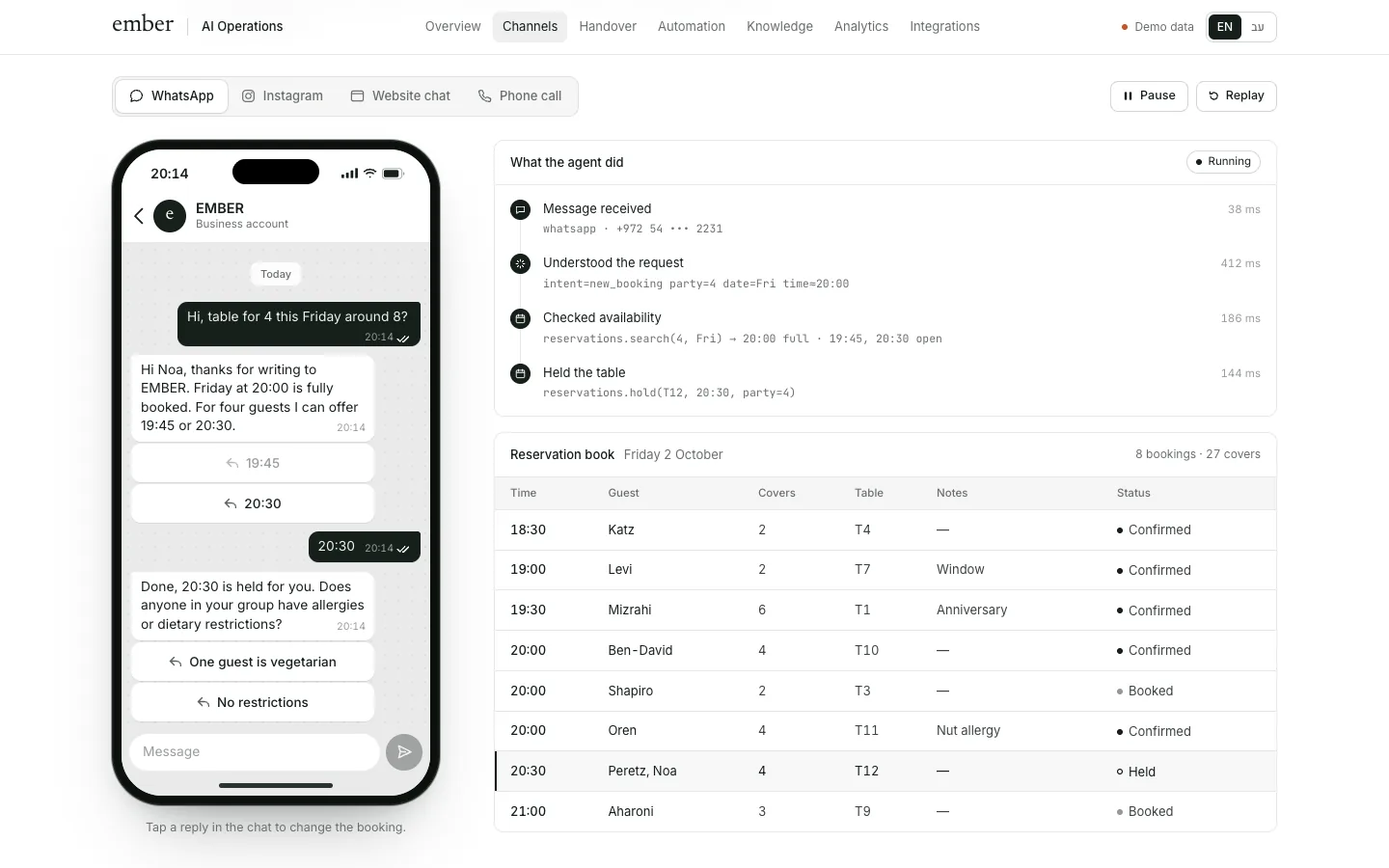
The EMBER agent demo shows the full loop: a guest writes on WhatsApp, the agent checks free times, books the table and sends a confirmation with the details. EMBER is a fictional chef’s restaurant; it is a concept we built to show the flow end to end. The EMBER website is the other side of the same business, where guests read the menu before they message.
Languages, brand tone and handover to staff
Venues in tourist cities get messages in several languages. The agent detects the language and replies in it. Decide in advance which languages it answers fully, and what it says when a language arrives that has not been tested.
Tone matters as much. A boutique hotel does not write like a chain, and a chef’s restaurant does not write like a canteen. We give the agent real examples of how the business writes: how it opens, how short it keeps things, whether it uses first names, how it signs off. No emoji if the venue does not use them, and no phrases the owners would not say themselves.
Handover rules should be written down, not left to the model’s judgement:
- Allergies with medical risk. Go to staff before the booking is confirmed.
- Complaints. Go immediately, with no compensation offered by the agent.
- Large groups and events. The agent collects the details and opens an enquiry; a person closes it.
- Special requests. A proposal, a cake with an inscription, connecting rooms, anything not in the policy.
- A guest who asks for a person. Always. Outside staffed hours, the agent says when someone will reply.

Opt-in and marketing messages
Replying to a guest who wrote is service. Sending them a Thursday offer is marketing, and the rules differ. Meta requires opt-in before a business starts conversations, and marketing must go out as approved marketing templates. Local law adds its own layer: in Israel, for example, section 30A of the Communications Law, known as the spam law, requires prior explicit consent before advertising by email or SMS, and the safe reading is to treat WhatsApp marketing the same way. Other countries have their own rules; check the ones that apply to you.
- Ask for consent separately and in plain words; do not assume it because a guest once messaged.
- Keep a record of when and how consent was given.
- Offer an opt-out in every marketing message and honour it at once.
- Use Meta-approved marketing templates, and never pass marketing off as a service message.
If the venue already sends marketing email, plan WhatsApp as part of the same system rather than a separate channel. We wrote about that in email automation for online stores; consent, timing and frequency work the same way.

One agent across every channel
Guests do not think in channels. They see an ad, message on Instagram, then write on WhatsApp, then call. If each channel runs a different system with different knowledge, they get three different answers. So we build one agent with one knowledge document and one connection to the reservation system, and connect it to WhatsApp, Instagram, website chat and phone. In the EMBER demo the same agent books tables across all four. The voice side is covered in an AI phone agent for clinics and sales offices.
It also helps to think about where guests come from. In the Hôtel Marée launch campaign, a fictional boutique hotel in Jaffa that we built as a concept, some ads open a WhatsApp conversation instead of a form. That only works if someone, person or agent, replies within minutes at any hour. When an ad leads to a page instead, the page has to do the work; see a landing page that converts.
Testing and metrics
Before launch, run every question in the table above in several phrasings and every supported language, including voice notes, photos, typos and questions the knowledge document does not answer. Test every handover rule. Check that a booking made on WhatsApp appears in the reservation system with every detail intact.
After launch, track: conversations answered, how many ended in a booking, how many were handed to staff and why, how long staff took to reply after a handover, and how many errors were found. There is no universal right number for any of these. Your first month is the baseline, and a high handover rate usually points to missing information rather than a faulty agent.
The service is described under automation and AI agents, and you can try the EMBER agent in the demo. For a written direction, price and date, send a brief and we will reply by email.
No term matches.
Questions
Can an AI agent run on the ordinary WhatsApp Business app?
No. An AI agent needs the WhatsApp Business Platform, which has an API that software can work with. Most businesses connect to it through a Meta Business Solution Provider.
How much do WhatsApp business messages cost?
Since 1 July 2025 Meta charges per delivered template message, by category and country. Non-template messages and utility templates inside an open 24-hour customer-service window are free, so replying to guests who wrote first is relatively cheap.
Can a WhatsApp chatbot for hotels handle special requests?
It can collect the details and check what policy allows. Anything outside policy, such as connecting rooms or a surprise arrangement, is handed to staff to confirm.
Should a WhatsApp booking bot keep its own list of reservations?
No. It should check availability in, and write bookings to, the venue’s existing reservation or property management system, so staff see every booking in one place.
Can the agent send marketing messages on WhatsApp?
Only to guests who gave explicit prior consent, using Meta-approved marketing templates, with an opt-out in every message. Local spam laws, such as Israel’s, add their own consent requirements.
Can one agent answer on WhatsApp, Instagram and the phone?
Yes. We build one agent with one knowledge document and one reservation-system connection and connect it to each channel, so guests get the same answer wherever they write or call.
Getting started
Want this for your business?
Send a short brief: three required questions, the rest only if you like. We reply by email with a direction, a written price and a date.