Email automation for an online store: the flows to build first
The automated emails an online store needs: welcome, abandoned cart, post-purchase, care, replenishment and win-back, how to measure them, and the consent rules to respect.
Part of the guide: How to start an online store: the complete guide, with notes for Israel

Ecommerce email automation starts with seven or eight flows that send themselves based on what a customer did: a welcome series, browse and cart abandonment, order confirmation and shipping, a post-purchase email with care instructions, a review request, a next-piece suggestion and a win-back for dormant customers. Build them in roughly that order, before any newsletter calendar, because each one arrives at the moment the customer is already paying attention.
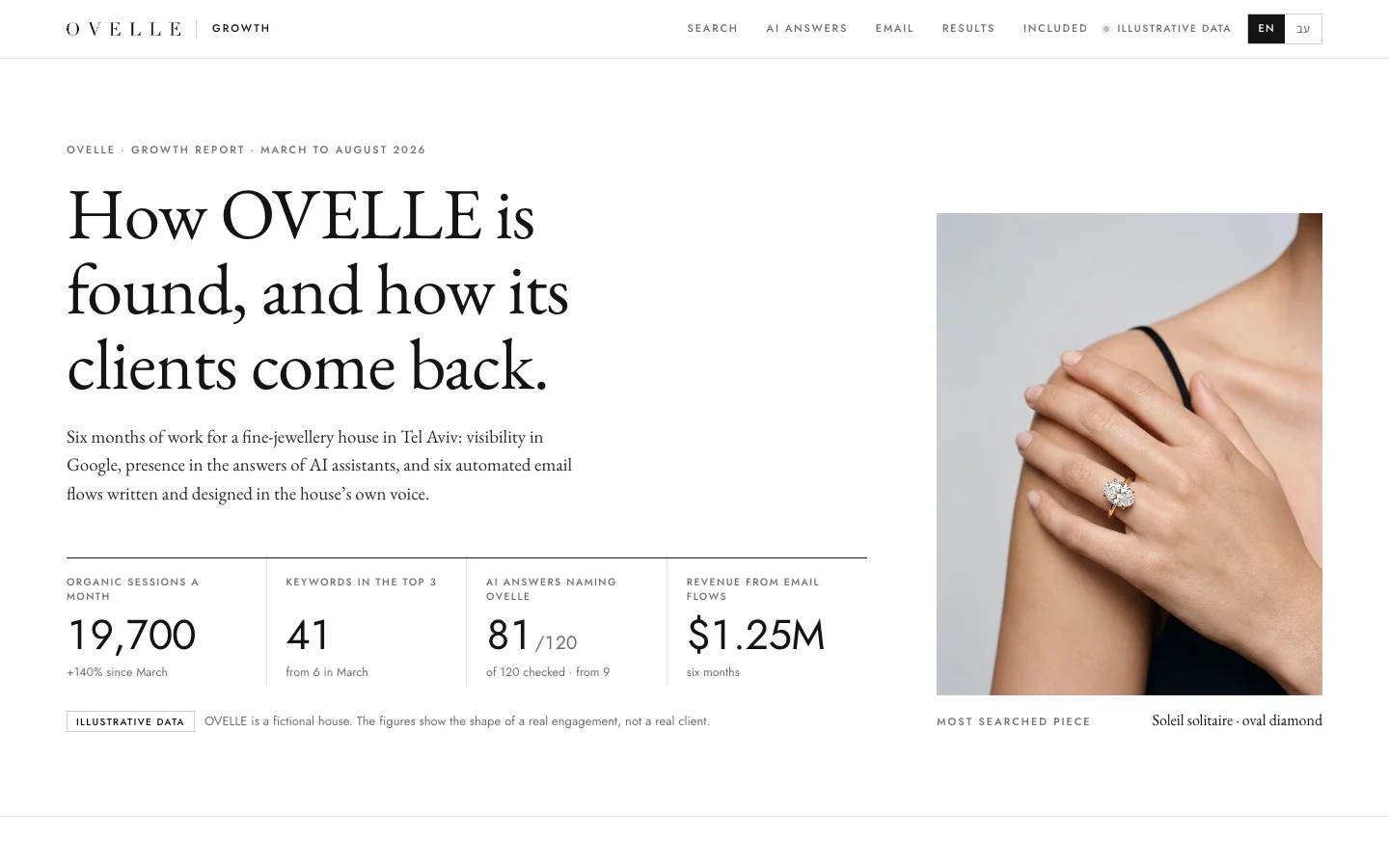
Each flow has its own trigger, timing and content, and each has to look like the brand, respect consent rules and reach the inbox rather than spam. A working example is the OVELLE growth setup, a jewellery house we built as a concept. The business is fictional; the automatic emails that follow each customer are built and working.
Automated flows versus campaigns
A campaign is one email sent once to a list on a date you choose: a launch, a new collection, an event. A flow is a sequence sent to each person individually when they do something: sign up, leave a cart, buy, go quiet for six months. A campaign depends on someone remembering to write it. A flow is built once and works every day.
For a small or mid-sized store, flows are usually the steady part of email revenue and campaigns are the addition. So we recommend building the flows first, and planning a newsletter calendar after.
The first flows, in priority order
| # | Flow | Trigger | Typical timing |
|---|---|---|---|
| 1 | Welcome series | Subscribing with consent | First email immediately; 2–3 more over 7–14 days |
| 2 | Cart and browse abandonment | Item in cart without purchase; repeat product views | 1–4 hours after abandonment; second reminder after about a day |
| 3 | Order confirmation and shipping | Purchase; dispatch; delivery | Immediately at each step |
| 4 | Post-purchase and care | Order delivered | 1–3 days after delivery |
| 5 | Review request | Time since delivery | 2–4 weeks after delivery |
| 6 | Replenishment or next piece | Expected usage time; category bought | Depends on the product; for jewellery, 2–4 months |
| 7 | Win-back | No purchase for a long period | Tied to the buying cycle, often 6–12 months |
| 8 | Birthday or anniversary | A date given with consent | About a week before |
The timings are reasoned ranges, not rules. They depend on price and on how long the decision takes. People think about an expensive ring for days and decide on a small skincare item in minutes. Start with the range, measure, then adjust.
1. Welcome email series
This is the one chance to introduce the brand to someone who asked to hear from you. The first email confirms the subscription and says in two lines who you are and what makes the products distinct. The next ones present one category at a time, the story of the materials or the workshop, and what to know before buying: sizing, shipping, returns. If you promised something for signing up, deliver it in the first email, plainly.
2. Abandoned cart email and browse abandonment
According to the Baymard Institute, the average documented cart abandonment rate is about 70%, based on 50 studies. Many of those shoppers were only comparing or not ready, and no email changes that. Some, though, got stuck on a question: size, delivery time, return policy. A good abandoned cart email shows the product with its image, answers those questions and returns to the cart in one click. A discount in the first email teaches customers to abandon on purpose, so we do not recommend it as a default.
Both cart and browse flows only work when the visitor is identified, meaning subscribed or logged in. Another reason to get the sign-up form right.
3. Order confirmation and shipping
These are transactional emails, not marketing: order confirmation, dispatch with tracking, delivery. They are almost always opened, so they should look like the brand, not like the platform’s default template. Keep them transactional, without promotional content that turns them into marketing.
4. Post-purchase email flow and care instructions
For jewellery, cosmetics, textiles or furniture, an email explaining how to look after the product is a real service. It also reduces support requests. This is where the exchange or return link goes, along with how to get in touch.
5. Review request
Ask for a review once the customer has had time to use the product. Do not tie an incentive to a positive review, and do not filter who receives the request by satisfaction. Review platforms and search engines have rules on this, and it is worth checking them before building the flow.
6–8. Next piece, win-back, personal dates
A consumable gets a reminder before it runs out. A non-consumable such as jewellery gets a suggestion that completes what was bought: earrings for the necklace, the same line in another metal. Dormant customers get one or two emails showing what is new, and if there is no response, stop sending. A birthday email goes out only if the customer gave the date voluntarily and agreed to that use.
Designing emails in the brand
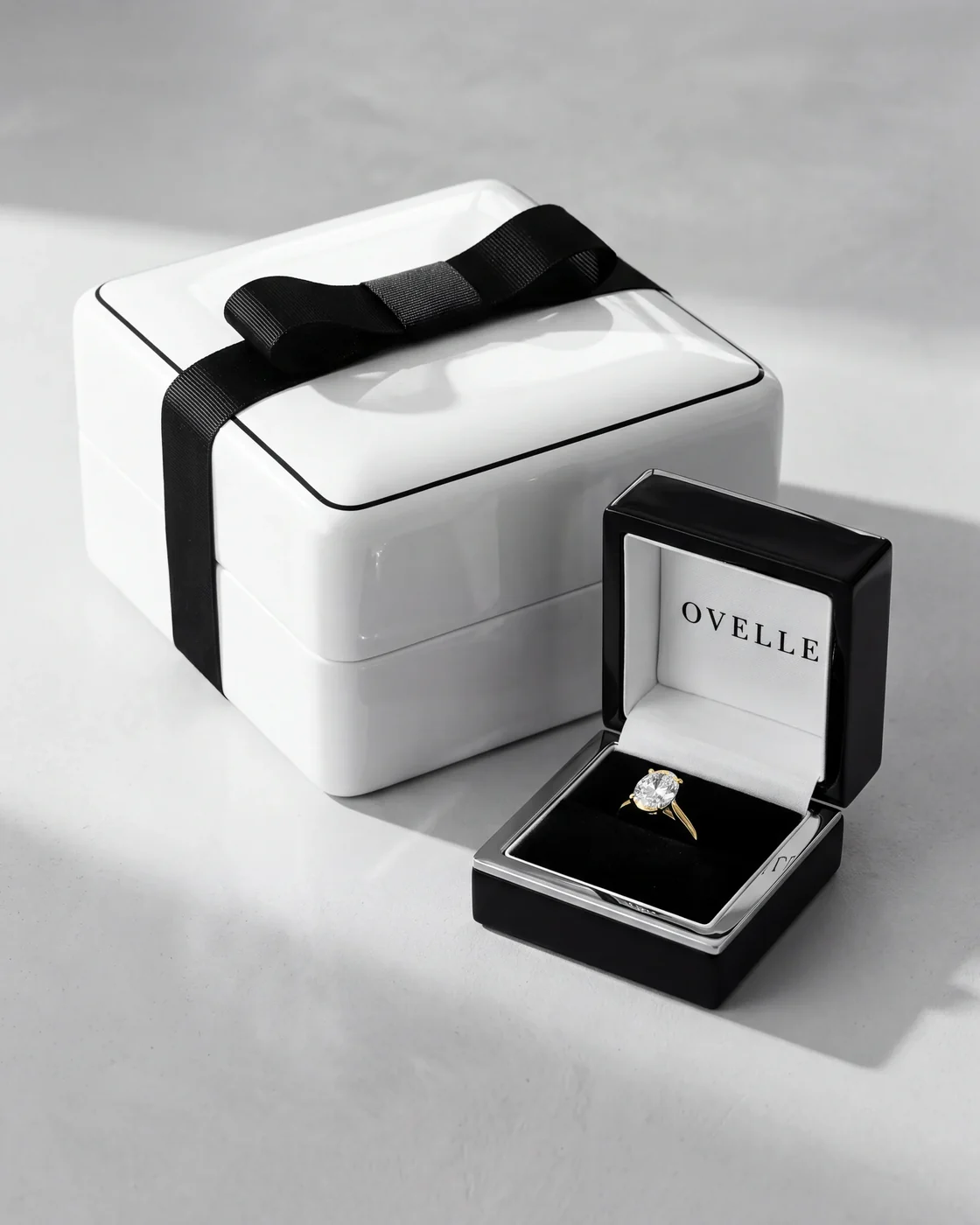
Not every email needs to be designed. A plain-text email from a real person’s name suits personal moments such as a review request or a win-back. A designed email suits product presentation. In both cases, the OVELLE identity and packaging show how one visual language moves from the box to the inbox.
- Mobile first. Most email is opened on a phone. One column, readable type, one clear button.
- Images. Never build an email as one large image. Some clients block images by default and the reader sees nothing. Live text, images with alt text.
- Dark mode. A logo on a transparent background must work on both white and black. Test before sending.
- Right-to-left languages. If you send in Hebrew or Arabic, every element needs correct direction, including buttons and prices, tested in Gmail, Outlook and Apple Mail.
- Consistency with the store. Images, typefaces and tone should match the store itself, so the click from email feels like the same place.
Consent: marketing versus transactional
Rules differ by country, and a store selling internationally has to respect the strictest one that applies to each recipient. In Israel, for example, section 30A of the Communications Law, known as the spam law, requires the recipient’s prior explicit consent before advertising by email or SMS. A safe baseline everywhere:
- An unticked sign-up checkbox, separate from accepting terms.
- A record of when and how each address subscribed.
- A working unsubscribe link in every marketing email, honoured immediately.
- Clear identification of the sender.
The distinction between transactional and marketing email matters. Order confirmation and shipping updates go to everyone who bought, because they are part of the service. Welcome, cart abandonment, next piece and win-back are marketing, and go only to people who agreed. This is not legal advice; have your wording checked by a lawyer in each market you sell to.

Deliverability basics
A well-built flow is worth nothing if it lands in spam. The fundamentals:
- Your own sending domain, ideally a dedicated subdomain for marketing mail, not the email platform’s shared address.
- SPF, DKIM and DMARC set up in DNS. Large mailbox providers now require them from bulk senders; see Gmail’s sender guidelines.
- List hygiene: remove bouncing addresses, never buy lists, and stop mailing people who have not opened or clicked for a long time.
- Consistent volume: a new domain starts small and ramps up gradually.
- One-click unsubscribe in the email headers, as the large mailbox providers require.
Measuring ecommerce email automation
Open rate is no longer a reliable metric. Privacy features in some email clients preload messages, so they count as opened even if nobody read them. Measure what happens next instead:
- Revenue per recipient for each flow and each email in it.
- Click rate on the main button.
- Conversions: purchases attributed to the flow within a defined window.
- Unsubscribes and spam complaints: a sudden jump means something in the content or timing is off.
Review each flow monthly and change one thing at a time: subject line, timing or hero image. For how email fits with search and AI discovery, see SEO and GEO for AI search.
A luxury tone: restraint, not discounts
For a luxury brand, the email is a continuation of the store. If the store is quiet and the email shouts about sales, the customer meets two brands. The rules we work by: a plain subject that says what is inside, one or two products per email, the material’s name and one number that is a fact, no countdown timers and no capitals. A discount, if ever, is for rare moments. How the store itself is built this way is in a luxury online store, and the channel that carries the conversation on after email is covered in a WhatsApp AI agent.
We build these flows as part of our automation service, connected to the store and its inventory. You can see all of them in the OVELLE example. When you want this for your store, send a brief and you will receive a written direction, price and date by email.
No term matches.
Questions
What is the difference between email automation and a newsletter?
A newsletter is sent once to the whole list on a chosen date. Automated flows are sent to each customer individually when they take an action such as subscribing, abandoning a cart or buying.
Which email flows should an online store build first?
A welcome series and cart abandonment, then branded order confirmation and shipping emails. After those: post-purchase care, review requests and win-back.
When should an abandoned cart email be sent?
A common range is one to four hours after abandonment, with a second reminder after about a day. For expensive, considered purchases, the gaps can be longer.
Do I need consent to send marketing flows?
In many countries, yes. Israel, for example, requires prior explicit consent for advertising by email under section 30A of the Communications Law. Transactional emails such as order confirmations are not advertising.
Why are email open rates unreliable?
Privacy features in some email clients preload messages, so they are counted as opened even when unread. Revenue per recipient, clicks and conversions are more dependable.
What are SPF, DKIM and DMARC?
DNS records that verify an email really comes from your domain. Without them, mail is more likely to land in spam or be rejected.
Getting started
Want this for your business?
Send a short brief: three required questions, the rest only if you like. We reply by email with a direction, a written price and a date.