Running a Shopify store in Hebrew: RTL themes, checkout, payments and invoices in Israel
Running a Shopify store in Hebrew: admin language, RTL themes, translating checkout, Israeli payment providers, Shopify’s extra fee, invoices and shipping.
Part of the guide: How to start an online store: the complete guide, with notes for Israel

You can run a Shopify store fully in Hebrew, but it takes deliberate work. The admin is available in Hebrew, some themes support right-to-left layout, and the checkout has to be translated and tested because Hebrew is not one of its pre-translated languages. Businesses based in Israel cannot use Shopify Payments, so they connect a local payment provider, and tax invoices come from that provider or from an accounting app, not from Shopify.
This article is for Israeli businesses setting up on Shopify and for foreign brands adding a Hebrew storefront for Israeli customers. It goes through each point in the order you meet it. The wider process of opening a store in Israel, from registration to marketing, is in our guide to starting an online store in Israel; here we stay on what is specific to Shopify and Hebrew.
Does Shopify support Hebrew?
Yes, but separate three layers, because each has a different answer:
| Layer | Hebrew status | What to check |
|---|---|---|
| Shopify admin | Available in Hebrew | Each staff member picks their own language. Help articles and many apps remain in English. |
| Storefront (theme) | Depends on the theme | Whether the theme supports RTL: mirrored layout, arrows, galleries, menus and forms. |
| Checkout | Needs translating | Hebrew is not among the languages checkout comes pre-translated in, so every string needs translating and testing. |
| Customer emails | Need translating | Order confirmation, shipping, password reset and abandoned cart, each template separately. |
The admin in Hebrew
Shopify lists the languages the admin can be shown in, and Hebrew is one of them. That helps an Israeli team uploading products and handling orders, but the admin language changes nothing customers see. A store can be run in Hebrew and sell in English, or the other way round.
A theme that supports right-to-left
This is where most projects stumble. According to Shopify’s help centre, the latest versions of themes in the Horizon family support right-to-left languages such as Hebrew, and with any other theme you need to confirm support yourself. A theme not built for RTL needs fixes wherever there is direction: image galleries that scroll the wrong way, arrows that point backwards, dropdowns that get clipped, prices that break mid-line. There are apps that flip a store to the right; they are quick, but they add code on top of the theme and do not always cover every component. A theme that is right from the start saves work on every update.
Fonts are the other easy miss. Many theme fonts have no Hebrew characters, so the browser falls back to a default that looks foreign to the design. Choose a Hebrew typeface that sits well next to the brand’s Latin one and check it in headings, prices and buttons. We cover working in two scripts and two directions in our article on bilingual Hebrew–English websites.
A Hebrew checkout
Shopify’s checkout ships with professional translations for 33 languages, and according to Shopify’s language list Hebrew is not among them at the time of writing. So checkout text, field labels, error messages and buttons have to be translated by you or with an app, and then every checkout step tested on a phone, in Hebrew, with a real test order. Address fields deserve extra care: street, house number, apartment, floor and city must make sense to an Israeli courier.

Payments: why you need a local provider
Shopify Payments is available only in certain countries, and Israel is not on the list of supported countries. A store run by an Israeli business therefore connects an external payment provider. Several Israeli providers state on their own sites that they offer a ready connection to Shopify, among them Cardcom, Tranzila, PayPlus, Grow (formerly Meshulam), Pelecard and Hyp. How card processing works and what to compare between providers is in our guide to payment gateways in Israel.
Shopify’s additional transaction fee
When you take payments through a third-party provider instead of Shopify Payments, Shopify charges its own transaction fee on top of the provider’s. According to Shopify’s pricing page at the time of writing, it is 2% on Basic, 1% on Grow, 0.6% on Advanced and 0.2% on Plus. In practice, a store with high sales can pay less overall on a more expensive plan, so work it out from expected revenue rather than from the subscription price alone.
Instalments, Bit and wallets
Israeli shoppers expect to be able to split a card payment into instalments, and for expensive products that can decide the sale. Instalments, Bit (a widely used Israeli payment app), Apple Pay and Google Pay come through the payment provider, not through Shopify, so check with each provider what works inside Shopify’s checkout, what sends the customer to an external payment page, and how it looks on a phone.
Tax invoices and receipts
Shopify does not issue tax invoices or receipts in the form Israeli rules require. That comes either from the payment provider, which issues a document after each transaction, or from an app that connects the store to Israeli accounting software. Either way, confirm that the document is emailed to the customer, stored on your side, and that refunds produce a matching credit document. Check the current Israel Tax Authority requirements with your accountant before launch.
Shekels, prices and VAT
The store currency is set in settings, and for a store selling mainly in Israel it is the shekel (ILS). Decide before the first order: Shopify warns you when you change the store currency after orders exist. Decide too whether prices are shown including VAT, as is usual for consumers in Israel, and configure the store’s taxes once, correctly. Selling abroad in other currencies, with other taxes, is a separate piece of planning.
Shipping in Israel
Shopify’s shipping settings cover most needs: zones, rates by weight or price, free shipping over a threshold and local pickup. The work is in connecting a courier: creating the shipment, sending a tracking number to the customer, and pickup points. Israeli couriers offer apps or integrations for Shopify; test one with a real order before committing. Two constants: show an estimated delivery time on the product page, and never surprise the customer with a shipping cost at the last step.
Apps: what you actually need
A typical Israeli Shopify store collects apps for payments, invoices, RTL or translation, shipping, email, reviews and accessibility. Each has its own subscription, its own code loaded on the storefront and its own access to your data. Before installing one, ask three questions: does the theme or Shopify already do this, what does it cost per year rather than per month, and what happens to the store if you remove it. Apps that leave code behind after removal are a common reason stores slow down.
Accessibility on a Shopify store
A store serving the public in Israel has to meet accessibility requirements like any other website. A good theme gives you a base, but accessibility also depends on content: alt text on every product image, enough contrast on prices and buttons, variant pickers that work with a keyboard, and checkout errors that screen readers announce. An accessibility widget does not replace any of that. The requirements and what to test are in our article on website accessibility law in Israel.
Shopify or WooCommerce for a Hebrew store
In short: Shopify suits a store that wants to start quickly with no server and no security patching, and accepts working inside the platform’s structure for a subscription and a fee. WooCommerce on WordPress suits a store that needs full control of code and hosting, unusual local integrations or an unusual product structure, in exchange for ongoing maintenance. For Hebrew, in both cases the theme decides most of the quality. The full comparison, including Webflow and custom code, is in WordPress vs Webflow vs Shopify.

Checklist for a Shopify store in Hebrew
- An RTL-capable theme, tested on phone and desktop, with a deliberately chosen Hebrew typeface.
- All checkout text in Hebrew, including error messages and address fields.
- Customer emails translated: order confirmation, shipping, cancellation, abandoned cart.
- An Israeli payment provider connected, with instalments and wallets tested on a real order.
- A tax invoice or receipt sent automatically, and refunds producing a credit document.
- Store currency in ILS, prices including VAT, shipping zones with delivery times.
- Terms, privacy policy and a cancellation and returns policy in Hebrew, linked from checkout.
- Alt text on every product image and an accessibility check of the product page and checkout.
- A list of apps with the yearly cost of each, and nothing installed that is not in use.
- Domain, Shopify account and payment provider account registered to the business.
The product page itself, from images to the button, is covered in our article on the product page that sells. For a luxury brand there is another layer of photography, packaging and service, covered in our article on online stores for luxury brands.
What it looks like in practice
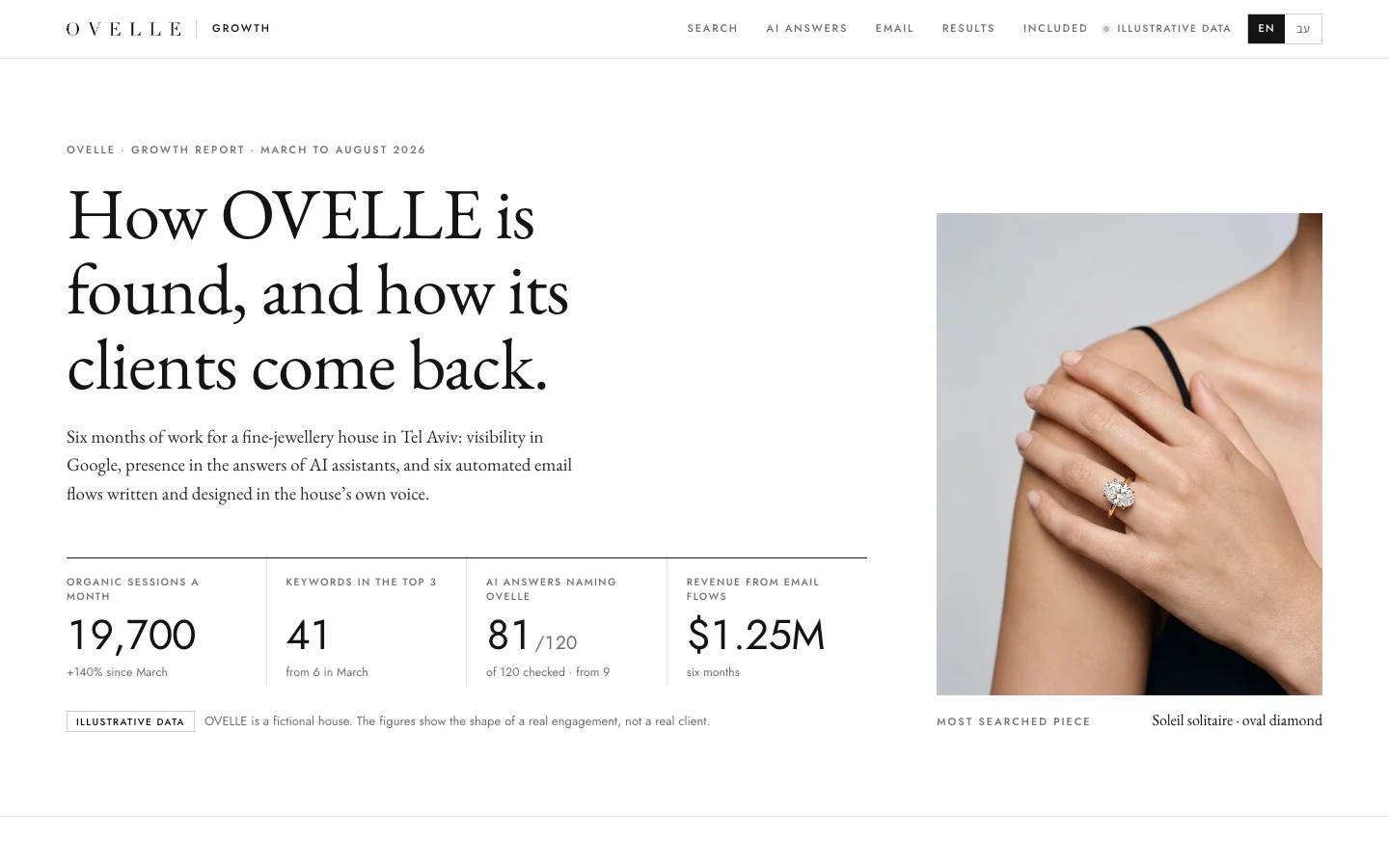
The OVELLE store is a store we built for a jewellery house: collections, product pages, a shopping bag, a campaign film and a ring in 3D. OVELLE’s growth page shows what happens after launch: visibility in Google and in AI answers, and the automatic emails that follow each customer. These are concepts we built to show the level of the work; the brand is fictional.
At Libra we build online stores in Hebrew and English, on Shopify or in custom code, including design, AI product imagery, payment and invoicing integration and automated email, described on our websites, landing pages and stores page. For a quote on your store, send a brief with a rough product count, the languages and your payment provider if you already have one. We reply by email with a direction, a written price and a date.
No term matches.
Questions
Can a Shopify store be in Hebrew?
Yes. The admin is available in Hebrew, and some themes, such as the latest versions of the Horizon family, support right-to-left layout. Checkout text and customer emails need to be translated and tested.
Is Shopify Payments available in Israel?
No. Israel is not on Shopify’s list of countries supported by Shopify Payments, so an Israeli business connects a local payment provider that integrates with Shopify.
What fee does Shopify charge when using an Israeli payment provider?
According to Shopify’s pricing page at the time of writing, the additional transaction fee is 2% on Basic, 1% on Grow, 0.6% on Advanced and 0.2% on Plus. The provider’s own processing fee comes on top.
Does Shopify’s checkout support Hebrew?
The checkout layout can work right to left, but Hebrew is not among the 33 languages its text comes pre-translated in, so you translate it yourself or with an app and test every step.
How do Israeli Shopify stores issue tax invoices?
Through the payment provider, which issues a document after each transaction, or through an app connecting the store to Israeli accounting software. Confirm the current requirements with your accountant.
Should a Hebrew store use Shopify or WooCommerce?
Shopify is simpler to run and needs no server maintenance, but has a subscription and a fee. WooCommerce gives full control in exchange for ongoing maintenance. In both, Hebrew quality depends mostly on the theme.
Getting started
Want this for your business?
Send a short brief: three required questions, the rest only if you like. We reply by email with a direction, a written price and a date.