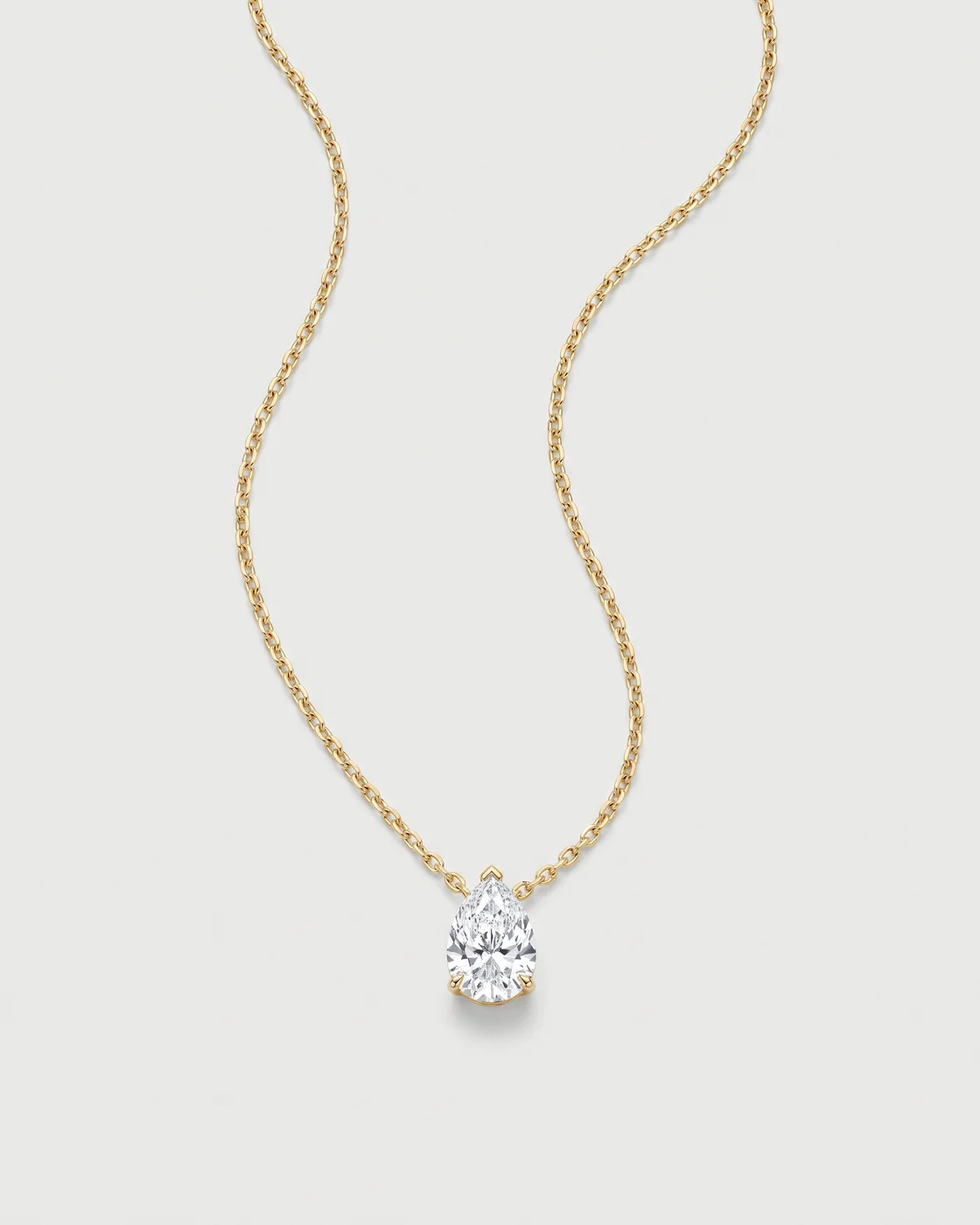
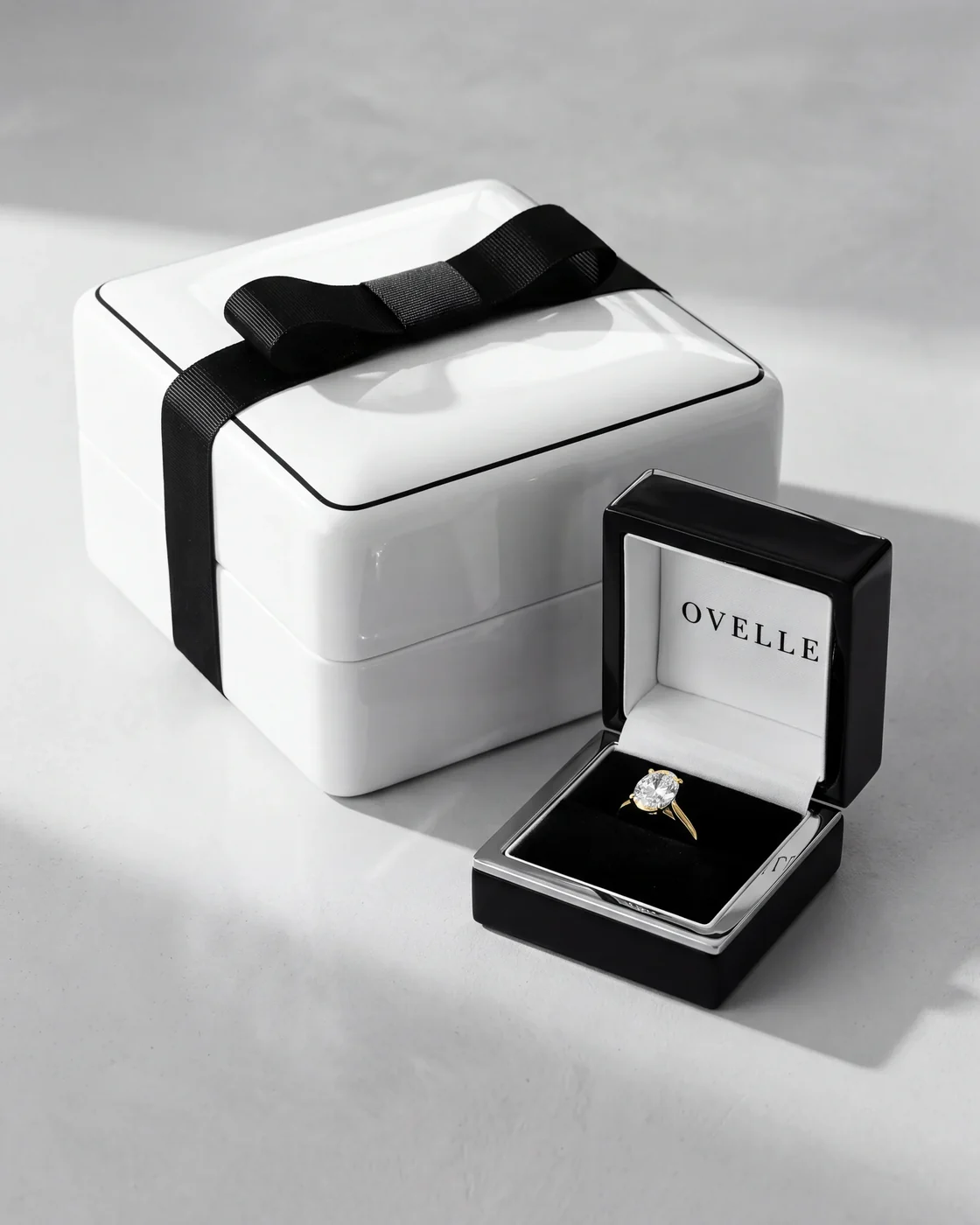
Building an online store for a luxury brand
How a luxury online store is built: product imagery, product pages, checkout, client service and packaging, and when a platform is enough versus a custom build.
Part of the guide: How to start an online store: the complete guide, with notes for Israel

A luxury online store differs from a regular one in three ways: fewer products with more attention on each, imagery that is exact to the real piece, and service that continues after payment. The fundamentals are the same as any shop: a short checkout, secure payment, a fast site and written delivery and returns terms. The difference is restraint. Luxury ecommerce website design sells through precision and facts, not through banners, countdown timers and discount codes.
Below is what each part of the store needs, from the product page to the email sent after delivery. The running example is OVELLE, an online jewellery store, a concept we built; the business is fictional, but every decision in it is one we make on real projects.
What makes a luxury online store different
Luxury customers buy less often, spend more per order and take longer to decide. So every page has to answer questions before they are asked, and never push.
- Fewer products, more depth. Dozens of pieces rather than thousands, each with several images, exact copy and full technical detail.
- Visual restraint. Clean grounds, quiet type, generous space. No discount pop-ups, no countdowns, no “only 2 left” unless it is true.
- Service as part of the product. Engraving, sizing, gift wrapping, an appointment at the boutique or studio, a personal reply on WhatsApp.
- One brand everywhere. The same language in the store, the packaging, the email and the social feed. A customer should recognise the brand without seeing the logo.
Most of the work here is content, not code: photography, copy, size and material data, service policies. A store built before its content is ready looks empty.

Product imagery that matches the real piece
On a jewellery ecommerce website, the photograph is the product. The customer cannot hold the ring, so the image has to show exactly what will arrive in the box: the same shade of gold, the same stone cut, the same band width. An image that flatters the piece beyond reality produces returns and costs trust, even if it is prettier.
Much of the imagery can now be produced with AI, including on-model shots and mood scenes, but only when the starting point is a real, approved photograph of the piece. We work from a clean packshot, build a product sheet from it, and generate every scene from that sheet so the design does not drift. The full process is in our article on AI product photography.
- Front, side and back on a consistent ground, in the same light across the catalogue.
- Close-ups of the details that justify the price: hallmark, clasp, setting, finish.
- An on-body image on the hand, neck or ear to show scale.
- A short video of the piece turning in the light, with no music or effects.
- A check of every image against the physical piece before it goes live.
Anatomy of a luxury product page
The product page is where the decision is made. In a luxury store it is longer than usual, but ordered so the essentials sit at the top and the technical detail is one tap away. This is the order we use:
- Name, price and main image. The full price, with no struck-through “was” price.
- Materials. Metal and karat, stone type, weight, origin where known. Facts, not adjectives.
- Sizes. A real size chart, a guide to measuring at home, and a way to request resizing.
- Engraving and personalisation. An engraving field with a character limit and a preview, and the extra lead time stated plainly.
- Delivery and returns. Delivery time, cost, insured shipping, and what happens when an engraved piece is returned.
- Care. How to clean it, how to store it, and what service the house offers over time.
- Appointment or question. A button to book a boutique appointment, and a WhatsApp handover with the piece’s name already in the message.
Note what is missing: star ratings. In a small catalogue with few purchases per piece, ratings look empty or fabricated. Trust is built another way, covered below.
Collection pages and navigation
For a luxury brand, the collection is the unit of storytelling. A good collection page opens with one image and a short paragraph on what connects the pieces: material, form, inspiration. Then a clean product grid with name and price only. Filters should be few and relevant: type, metal, price range. Twenty filters on a catalogue of fifty pieces is noise.
The main menu works best on two axes: by type (rings, earrings, necklaces) and by collection. New customers browse by type; returning customers by collection.
Checkout, payment and cart abandonment
According to the Baymard Institute, the average documented cart abandonment rate across studies is about 70%. Some of that is natural: people save a piece to think about it. The rest is caused by checkout problems, and that part can be fixed.
- Hidden costs. Shipping, insurance or engraving fees that appear only at the last step. Show every cost in the cart.
- Forced sign-up. Guest checkout should be the default, with an option to create an account after payment.
- Long forms. Unneeded fields, no address autocomplete, details lost between steps.
- Payment doubt. A payment page that looks nothing like the store, or an unexpected jump to another site.
Choose a payment provider that handles local cards and currencies in your main markets, supports the digital wallets your customers already use, and offers an embedded payment page styled like the store. At high order values, instalments are an expectation rather than an extra. Check how it handles invoices, partial refunds and cross-border orders.
Trust through facts, packaging and service
Luxury trust is not built with stars and “secure checkout” badges. It comes from facts a customer can verify: a physical address, the name of the maker or atelier, stone certificates, a written warranty, a clear returns policy, company details. An About page with a real photograph of the workshop does more than any security seal.
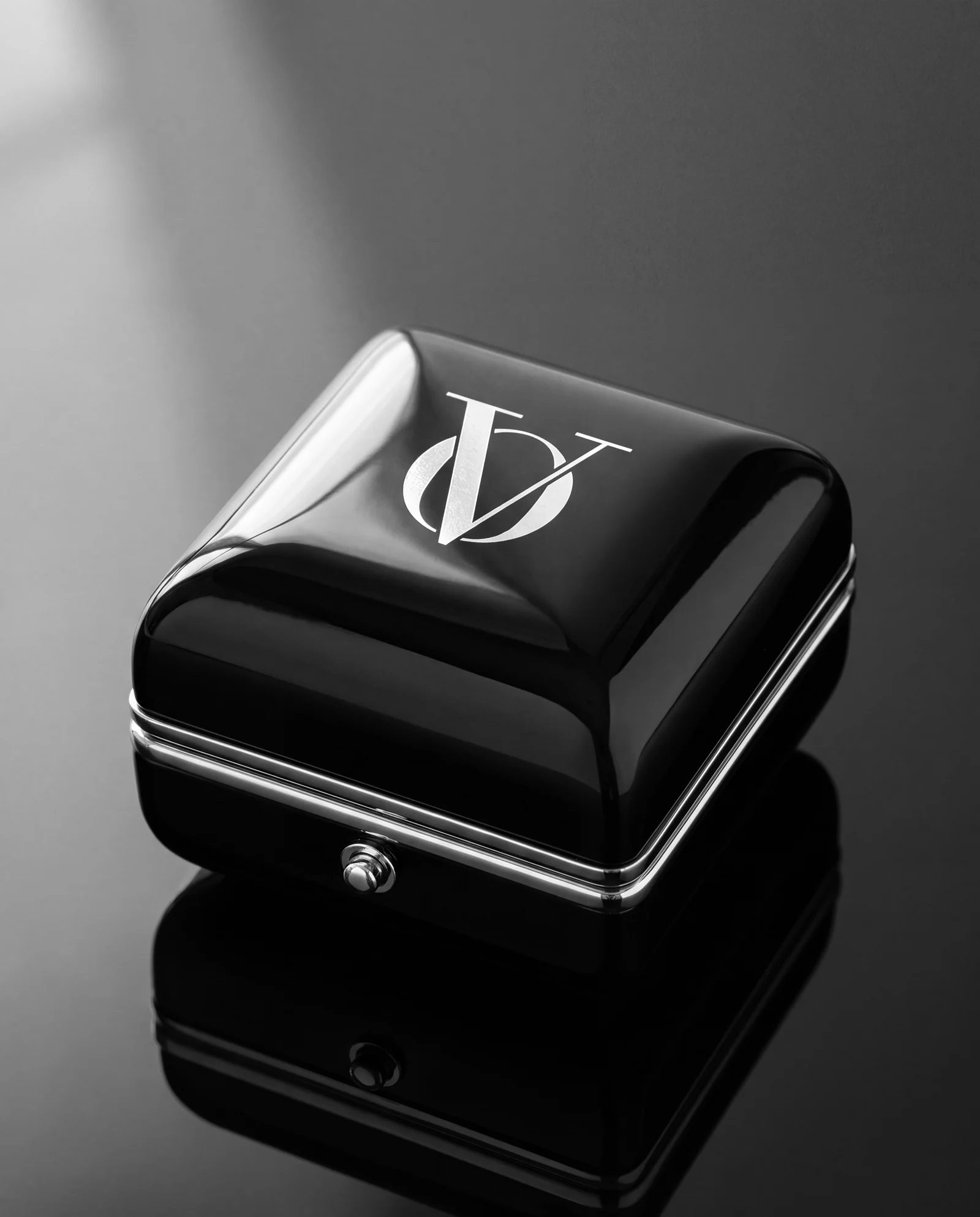
Packaging is part of the store. The moment the box is opened is the moment the brand enters the home, and it is the moment that gets photographed and shared. For OVELLE’s identity and packaging we built a black-and-white system with platinum foil: box, bag, care card and invoice sleeve in one language. The store shows the packaging, so customers know what they will receive.
Service completes it: appointment booking, and a WhatsApp reply that hands over to a real person with the full conversation history when needed.
Platform or custom build
There is no single right answer, only a fit between catalogue size, budget, the team that will run the store and how distinctive the brand needs to be:
| Topic | Platform (Shopify-type) | Custom build |
|---|---|---|
| Time to launch | Shorter, the infrastructure exists | Longer, every part is built |
| Upfront cost | Lower | Higher |
| Running cost | Monthly plan and apps, sometimes fees | Hosting and maintenance, no platform plan |
| Design freedom | Wide, within the theme structure | Complete, including page structure and checkout |
| Checkout | The platform’s checkout, limited flexibility | Fully tailored |
| Day-to-day admin | Familiar, easy for the team | An admin panel built to the need |
| Dependency | On the platform and third-party apps | On the development team |
| Best for | Most brands at launch | Brands with a special sales process or complex integrations |
For most brands starting out, a platform with a tailored design is the right call: faster, cheaper, and the team can manage it alone. A full custom build makes sense when there is a requirement the platform cannot meet, such as a configurator for bespoke jewellery, stock synced across several boutiques, or an ordering process that includes an appointment and a deposit. What drives cost on each route is covered in what a website costs.
Speed, product SEO and post-purchase email
Speed with heavy imagery
A luxury store is made of large images, which is exactly what slows sites down. Google sets “good” thresholds for Core Web Vitals: Largest Contentful Paint within 2.5 seconds, Interaction to Next Paint within 200 milliseconds, Cumulative Layout Shift under 0.1. To meet them: modern formats such as WebP or AVIF, several sizes per image served by screen, lazy loading below the fold, fixed dimensions on every image so the page does not jump, and video that loads only when it is reached.
SEO for product pages
Every product page needs a unique title, a description written for it (not the supplier’s text), images with accurate alt text, and product structured data with price and availability. Collection pages need a real opening paragraph, not just a grid. The same fundamentals shape how a store appears in AI answers; see SEO and GEO for AI search.
Email after the purchase
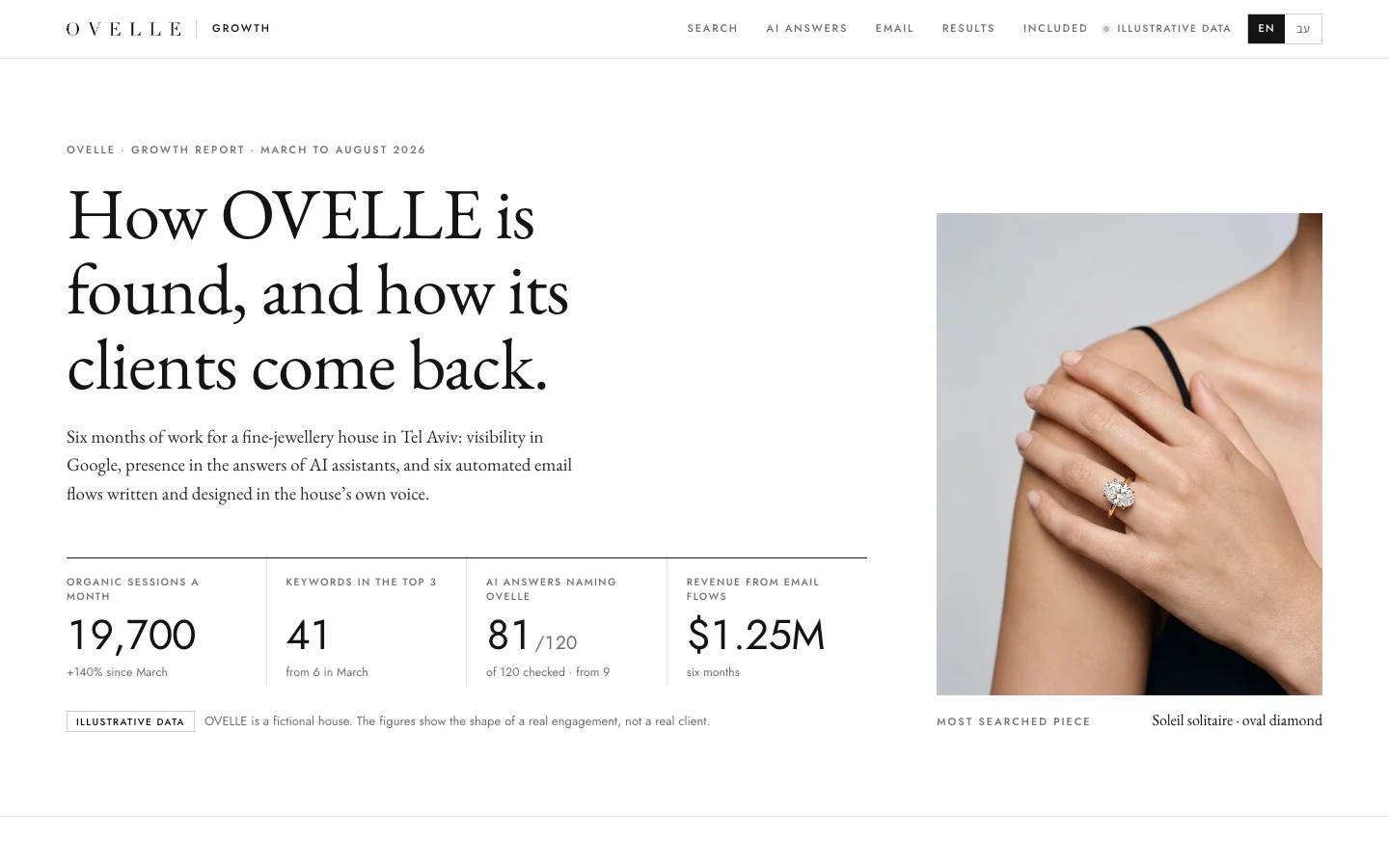
The first order is the start of the relationship. After it come an order confirmation that looks like the brand, a shipping update, a care email a few days after arrival, and an invitation to cleaning or resizing service a few months later. Abandoned-cart reminders go only to people who gave consent, and in a quiet tone. In OVELLE’s growth example we built these flows together with the SEO; the full walkthrough is in ecommerce email automation.
If you are planning an online store for your brand, send a brief with what already exists and what is missing. The reply comes by email, with a written direction, price and date. You can also look at our websites and stores service and the OVELLE store first.
No term matches.
Questions
How many products does a luxury online store need at launch?
There is no fixed minimum. One collection of 10 to 20 pieces, each with full imagery and exact information, is enough to launch and works better than a large catalogue of thin pages.
Can a jewellery store use AI-generated product images?
Yes, as long as they are built from a real, approved photograph of the piece and checked against it. An image that changes the design, colour or proportions of the jewel will cause returns and cost trust.
Is Shopify or a custom build better for a luxury brand?
For most brands at launch, a platform with a tailored design is faster and cheaper. A custom build fits when there is a need the platform cannot meet, such as a bespoke jewellery configurator or stock synced across several boutiques.
Does a luxury store need star ratings?
Not necessarily. In a small catalogue with few purchases per piece, ratings look empty. Trust is better built from facts: an address, certificates, a written warranty and a clear returns policy.
How do you reduce cart abandonment in a luxury store?
Show every cost in the cart, allow guest checkout, shorten the form and embed a payment page styled like the store. Reminder emails go only to customers who gave consent.
How long does it take to build a luxury ecommerce website?
It depends mainly on content readiness: photography, copy and product data. Once content is ready, a platform store is quicker to build than a custom one, and the exact timeline is set in the written proposal.
Getting started
Want this for your business?
Send a short brief: three required questions, the rest only if you like. We reply by email with a direction, a written price and a date.