How to appear in ChatGPT answers and Google: SEO and GEO without the myths
What GEO means, how AI engines such as ChatGPT and Google’s AI Overviews pick their sources, what Google itself says, and what to do on your site this week.
Part of the guide: Digital marketing for small business: the whole system, in the order to build it
To appear in ChatGPT answers, Gemini and Google’s AI Overviews, you mostly need what it takes to appear in Google: pages whose text is in the HTML rather than injected by JavaScript, clear answers to the questions people actually ask, precise facts about the business, and structured data. Generative engine optimization (GEO) is not a separate discipline from SEO. It is the same fundamentals with a few technical differences: which crawlers you let in, how each paragraph is written, and how consistent your business information is across the web. Nobody can promise a mention, but you can remove every technical and editorial reason for being left out.
What GEO is, and why it is mostly SEO
GEO is the name that stuck for work aimed at getting AI answer engines to cite your site. These engines run a search, read a handful of pages and write an answer with links. If your page is not in the results, or looks empty to the crawler, it will not be in the answer.
Google states this plainly: there are no additional requirements or special optimisations needed to appear in AI Overviews or AI Mode, and normal SEO best practices apply (Google’s documentation on AI features in Search).
There are still differences worth knowing. An answer engine quotes a paragraph, not a page. It prefers a sentence that answers the question on its own, with a number, a name or a condition. And it leans on what is said about you elsewhere: your Google Business Profile, directories, press.
| Topic | Classic SEO | GEO / AI search |
|---|---|---|
| How the site is found | Googlebot crawls and indexes | The same Google index, plus crawlers such as OpenAI’s OAI-SearchBot |
| Unit of result | A page in a list of results | A paragraph or fact quoted inside an answer |
| JavaScript | Google renders JS, sometimes with delay | Many AI crawlers do not run JS at all |
| Structured data | Helps with rich results | Helps engines understand who you are and what you sell |
| Measurement | Search Console: impressions, clicks, position | Search Console (includes AI Overviews), referrals from chatgpt.com, manual prompt checks |
| What cannot be promised | Position one | A mention in any given answer |

How AI engines find sources: OAI-SearchBot, GPTBot and robots.txt
OpenAI runs three separate crawlers, and the difference matters (OpenAI’s crawler documentation):
- OAI-SearchBot crawls sites so they can be surfaced in ChatGPT search results. Block it in robots.txt and your site will not appear as a source in those answers.
- GPTBot collects content for model training. That is a separate decision: you can block GPTBot and still allow OAI-SearchBot.
- ChatGPT-User fetches a page when a user asks ChatGPT to open a specific link. It does not crawl the web in general.
The mistake we see most often: someone ticks “block AI bots” in a hosting panel or a firewall service and forgets about it. Open yoursite.com/robots.txt today and read what it says, then check your CDN or firewall for rules that block bots by user agent.
Content that gets cited: answer first, facts after
An answer engine is looking for a paragraph it can lift as it is. What works in practice:
- An opening paragraph that answers the question in two to four sentences, before any preamble. Like the first paragraph of this page.
- Specific facts: starting price, lead time, service area, materials, dimensions, opening hours. “From 1.00 ct, set in 18k gold” beats “high-quality diamonds”.
- Headings that describe what follows, phrased the way people search: “how much does”, “how long does”, “what is the difference between”.
- Facts about the business and the author: who you are, where you are, what experience you have, an address, a licence where relevant. Engines are cautious with content that has no identifiable source.
- Questions and answers at the end of important pages, where each answer stands on its own instead of saying “see above”.
What does not work: keyword repetition, slogans without information and pages generated in bulk. A product page that states material, dimensions and warranty will be quoted long before three lines of poetry. We go into this in the piece on building a luxury online store.
An answer engine quotes a sentence that stands on its own. If the whole page is needed to understand it, it will not be quoted.

The technical side: server-rendered HTML, structured data, sitemaps and hreflang
Text that lives in the HTML
This is the easiest item to miss. Many sites send the browser an almost empty page and let JavaScript fill it with text. Google can render JavaScript, sometimes with a delay. Many AI crawlers do not run JavaScript at all, so to them a site built that way looks empty. A simple test: open the page, choose “View source” (Ctrl+U or Cmd+Option+U) and search for a sentence from the text. If it is not there, the crawler does not see it. On Libra’s own site we moved to prerendering: at build time every page is written out as complete HTML, so the words are in the file before any script loads.
Structured data
Structured data (schema markup) describes a page in a form machines read: this is an organisation, this is a product with a price and stock status, these are questions and answers. Google explains how it works in its introduction to structured data, and the questions-and-answers type is defined at schema.org/FAQPage. For most businesses this is enough: Organization or LocalBusiness on the home page, Product on product pages, Article on articles, and FAQPage wherever there are real questions. The markup must match what the page says.
Sitemap, hreflang and speed
- An up-to-date sitemap.xml, submitted in Search Console, listing every page you want found, and only those.
- hreflang for bilingual sites: each page points to its counterpart in the other language, so Google shows each reader the right version and does not treat the two as duplicates.
- Speed: Google’s “good” thresholds are LCP within 2.5 seconds, INP within 200 milliseconds and CLS of 0.1 or less (web.dev).
llms.txt
llms.txt is a plain text file at the root of a site that summarises for language models what the site contains and where. It is a proposal by Jeremy Howard from September 2024, not an official standard, and no major engine has committed to using it. Adding one is cheap, a few dozen lines, so we do. Do not expect it to change anything on its own.

Entity consistency: the same name, address and description everywhere
AI engines build a picture of a business from several sources. If your site says one name, your Google profile another, your social pages an old address and a directory a different description, the engine is less sure who you are and less likely to mention you. What to check:
- The business name is written the same way everywhere, including any transliteration.
- Address, phone number and hours match across the site, the Google profile, social accounts and directories.
- One factual description sentence, repeated across profiles: what you are, where, for whom.
- Links from the site to the official profiles, and a sameAs field in the structured data pointing to them.
- Genuine third-party mentions: press, professional guides, partners.
Measuring presence in AI search
Some caution is needed here. There is currently no tool that fully measures how often ChatGPT mentions you, and anyone presenting such a chart as precise fact is estimating. What you can measure:
- Google Search Console: according to Google’s documentation, appearances in AI Overviews and AI Mode are counted in the regular Performance report. They are not broken out, but the trend is visible.
- Referrals in analytics: visits from chatgpt.com, perplexity.ai and gemini.google.com show up as referral sources, and links from ChatGPT often carry utm_source=chatgpt.com.
- Regular manual checks: a fixed list of 20 to 40 questions a real customer would ask, run every month in several assistants, noting whether the business was named and linked. Answers vary between runs, so read the trend, not a single check.
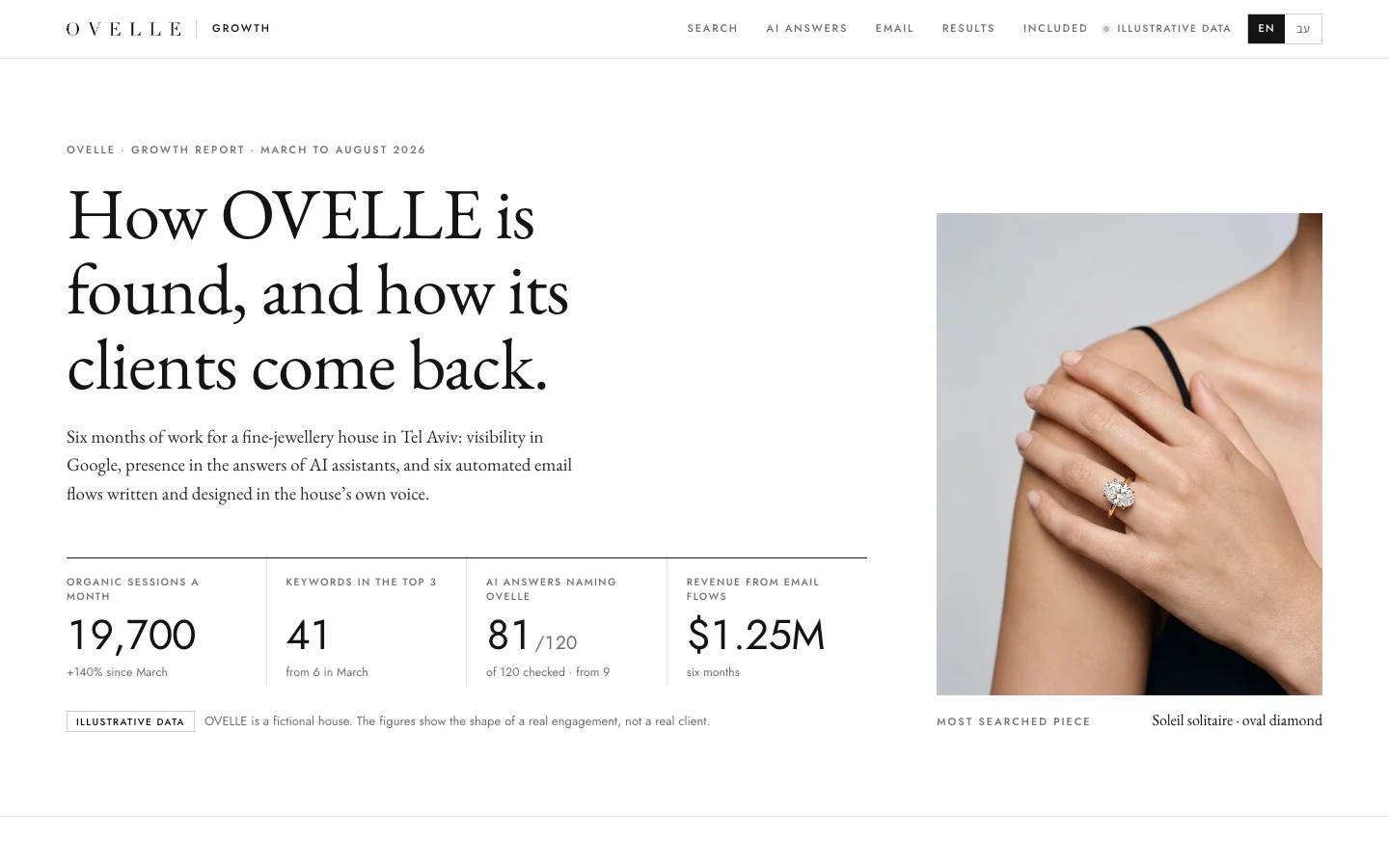
In the OVELLE growth example we built exactly this kind of report: Google positions by keyword cluster, 40 buyer questions checked monthly in three assistants, and the email flows alongside. It is a concept we built; OVELLE is a fictional jewellery house, and the figures show the shape of the work, not a client’s results. The shop itself is in the OVELLE store example.
What nobody can promise
No provider controls what ChatGPT, Gemini or Google writes in an answer. Nobody can guarantee position one in Google, and nobody can guarantee a mention. What can be committed to: the site is open to crawlers, the text is in the HTML, the content answers the right questions, the structured data is valid and the business information is consistent. That raises the odds. The rest depends on competition in your field, the age of your domain and what others say about you.
Search traffic is only the start; the next steps are covered in a landing page that converts and email automation for online stores.
We build sites whose text is in the HTML from day one, with structured data, hreflang and measurement in place; the details are on our websites service page. For a direction on your own site, send a brief and you will get a written reply by email with a direction, a price and a date.
No term matches.
Questions
What is the difference between GEO and SEO?
SEO is the work that gets a site into search results; GEO is the work that gets it quoted in AI answers. Most of it is shared: a fast site, text in the HTML, content that answers questions and structured data. GEO adds emphasis on self-contained paragraphs, AI crawler access and consistent business information.
Do I need to do anything special to appear in Google AI Overviews?
No. Google’s documentation says there are no additional requirements or special optimisations, and normal SEO fundamentals apply. A page that is indexed and eligible for regular results can also appear there.
Should I block GPTBot in robots.txt?
That is a business decision. GPTBot collects content for model training and can be blocked. If you want to appear in ChatGPT search, do not block OAI-SearchBot, which is the crawler that surfaces sites in results.
Does llms.txt help me appear in ChatGPT answers?
llms.txt is a proposal, not an official standard, and major engines have not committed to using it. It is cheap and harmless to add, but it is no substitute for good content and a site crawlers can read.
How can I tell whether ChatGPT mentions my business?
Check referrals from chatgpt.com in your analytics, and run a fixed list of customer questions in the main assistants every month. Answers vary between runs, so look at the trend over several months.
How long before results show?
Technical fixes such as opening robots.txt or server rendering take effect after the next crawl, usually within weeks. Content and third-party mentions build presence over months and depend on competition in your field.
Getting started
Want this for your business?
Send a short brief: three required questions, the rest only if you like. We reply by email with a direction, a written price and a date.