SEO for small business: what to do, in what order, and what nobody can promise
How SEO works for a small business: how Google crawls and ranks, keyword research, service pages, technical basics, local SEO, links, measurement and timelines.
Part of the guide: Digital marketing for small business: the whole system, in the order to build it

SEO for a small business is the work that gets your site into Google’s regular, unpaid results. In practice it comes down to four things: a site Google can crawl and understand, a clear page for every service people search for, a complete Google Business Profile, and mentions and links from other sites. Results usually take months rather than weeks, and nobody can guarantee position one.
This article covers classic Google SEO. Appearing in answers from ChatGPT and Google’s AI Overviews has its own guide, SEO and GEO for AI search, and where SEO fits among all your channels is covered in digital marketing for small business. We work in Israel, so some examples involve Hebrew; the method is the same in any language.
How Google works: crawling, indexing and ranking
Google describes Search in three stages (Google Search Central). Crawling: automated programs download text, images and videos from pages they find. Indexing: Google analyses the page and stores it in its index. Serving results: when someone searches, Google returns what it judges relevant. The same page states that Google does not accept payment to crawl a site more often or rank it higher.
The order of work follows from that. A page that is not crawled cannot rank. A page that is crawled but unclear will not rank for the right search. A clear page facing ten better pages will rank low. So start with the technical base, then content, and only then trust and links.
Keyword research for a small business
Keyword research is a list of what customers actually type when they look for what you do, grouped by intent. What to check:
- The words customers use, not the trade’s words. A clinic says “injectables”; patients search “botox”. Your phone calls and emails are the best source.
- Location modifiers: for a local service, “dentist in Ramat Gan” or “plumber near me” signals clearer intent than a general term.
- Intent words: “price”, “cost”, “best”, “near me”, “open now”. They separate people learning from people ready to enquire.
- Spelling and form variants: singular and plural, abbreviations, brand names. In Hebrew there are also full and defective spellings and attached prefixes, which change results more than people expect.
- Each market separately: if you sell in two languages, research each language on its own instead of translating the list. We cover the technical side in our article on bilingual websites.
Group the list by topic and give each group one page. Two pages competing for the same search weaken each other.
On-page SEO: titles, structure and content
Google’s SEO Starter Guide is the most reliable short reference. A few points from it worth knowing: a good title is unique to the page, clear and accurately describes it. Google Search does not use the keywords meta tag. Keyword stuffing is against Google’s spam policies. And keywords in the domain name or URL alone have hardly any effect beyond appearing in breadcrumbs. A good service page has:
- A title that contains the main search and the business name, short enough not to be cut off.
- One H1 that says what the service is, and subheadings that answer the questions people ask.
- An opening paragraph that answers the search in a sentence or two, with no preamble.
- Facts: what is included, who it suits, how long it takes, where, and a starting price if you publish one.
- Images with descriptive alt text, sized so they do not slow the page.
- Internal links with text that says where they lead, not “click here”.
- Real FAQs at the end, and structured data that matches what the page says.
- One clear action: a form, a booking, whatever the business counts as an enquiry.
Technical SEO: what has to work before you write a word
Most small-business sites do not need complex technical work. They need a sound base, checked once a quarter:
| What to check | Why it matters | Where to look |
|---|---|---|
| Important pages are indexed | A page outside the index appears in no search | Search Console, Page indexing report |
| An up-to-date sitemap.xml | Helps Google find new pages | Search Console, Sitemaps |
| robots.txt does not block key pages | An accidental block removes a whole site from search | yoursite.com/robots.txt |
| Speed and Core Web Vitals | User experience, especially on phones | Search Console, PageSpeed Insights |
| The site works well on a phone | Most local searches happen on phones | Check by hand on a phone |
| HTTPS on every page | Security and trust | The browser |
| 301 redirects from old URLs | Keeps the value of replaced pages | Test old addresses |
| The text is in the HTML | Crawlers read what is in the code | View source and search for a sentence |
On speed, Google defines three Core Web Vitals. The “good” thresholds are LCP within 2.5 seconds, INP within 200 milliseconds and CLS of 0.1 or less, measured at the 75th percentile of page loads, separately for mobile and desktop (web.dev). On small-business sites the cause of slowness is almost always heavy images and unnecessary plugins, not hosting. Keeping this base healthy over time is covered in our article on website maintenance and hosting.

Content: service pages first, articles second
The common mistake is to start with a blog. For a business with five services, five complete service pages usually bring more enquiries than twenty general articles. The order we recommend:
- A page per service, answering the commercial search: what it is, who it is for, the process, how long, the price or what it depends on.
- A page per area only if you genuinely serve it and have something specific to say. Identical pages with only the town name swapped do not help.
- Articles that answer questions customers ask before they enquire, each linking to its service page.
- Topic clusters: one comprehensive guide on a broad topic, with focused articles around it linking to and from it. This journal is built that way.
Who writes? Someone who knows the work. Google does not object to content made with the help of tools, but using generative AI to produce many pages without adding value for users is listed in its spam policies as scaled content abuse. A page that explains how a treatment really works, with details only a practitioner knows, beats a generic page written for a keyword.

Local SEO and your Google Business Profile
For a business serving a specific area, the Google Business Profile is often what brings the first enquiries, through Maps and local results. Google says local ranking rests mainly on relevance (how well the profile matches the search), distance from the searcher, and prominence (how well known the business is, including links and reviews), and that there is no way to request or pay for a better local ranking (Google Business Profile Help). What you control:
- The right primary category, and services listed in full.
- Name, address and phone identical to your site and everywhere else online.
- Current opening hours, including holidays.
- Real photos of the place, the team and the work.
- A factual reply to every review, negative ones included. Never buy reviews or write them yourself.
- A link from the profile to the matching page, not always the home page.
Links and mentions from other sites
A link from another site signals that someone outside the business thinks your page is worth pointing to. For a small business, the links that work are the ones with a real reason to exist: suppliers and partners, professional associations, local press, events you took part in, trade directories. Packages of “a hundred backlinks” look to Google like what they are, and buying or selling links for ranking purposes is against its spam policies. The risk is lower rankings or removal from results.
Measuring SEO in Search Console
Search Console is Google’s free tool and the only place that shows what really happens in search. The Performance report shows clicks, impressions, click-through rate and average position, grouped by queries, pages, countries and devices (Search Console Help). What to look at every month:
- Impressions and clicks for your service pages, not only the site as a whole.
- Searches where you appear in positions 8 to 20: that is where the nearest gains are.
- Pages with many impressions and few clicks: a title or description that does not persuade.
- New indexing errors after every change to the site.
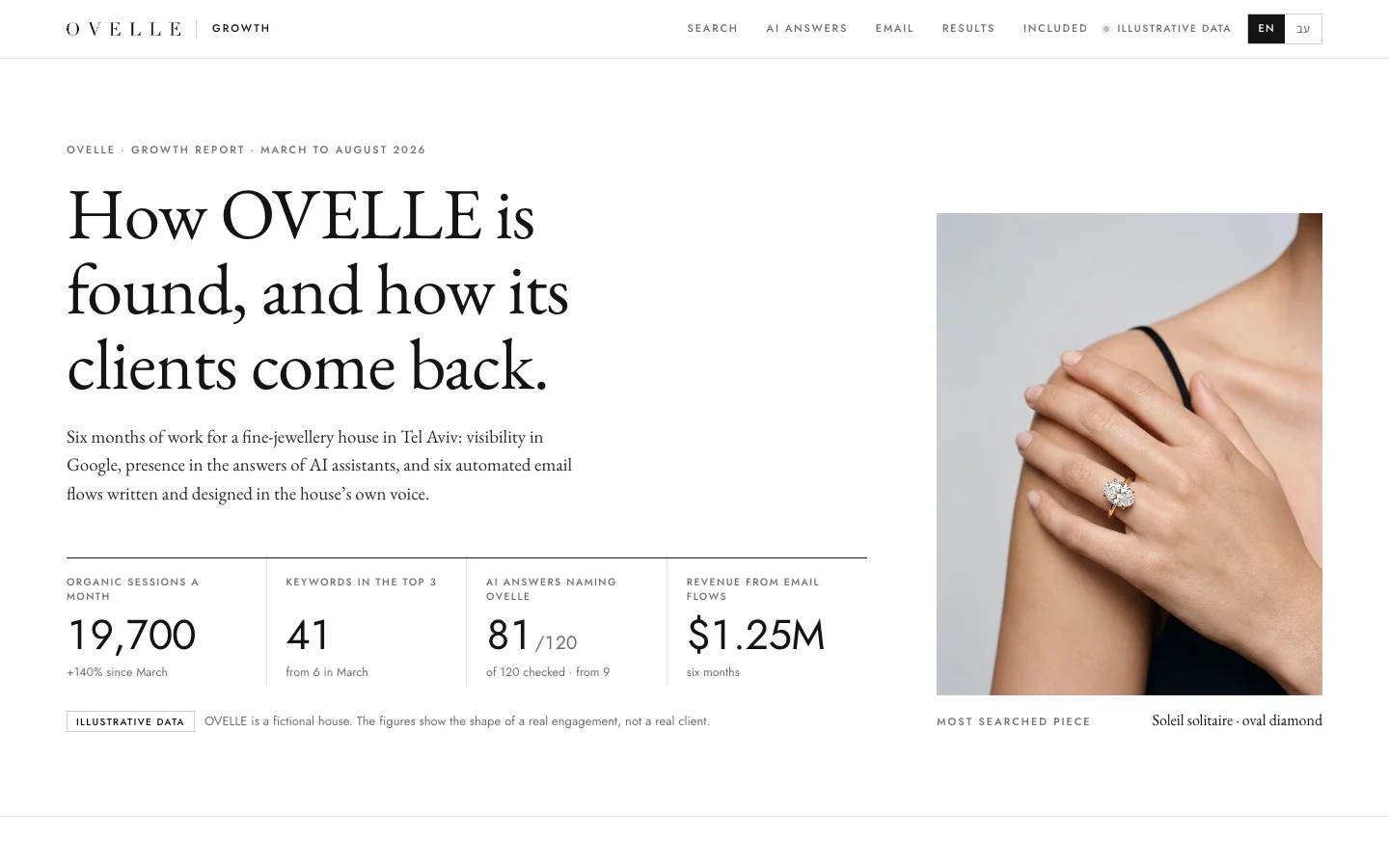
Most important: connect search to enquiries. A ranking that brings no enquiries is not a result. In the OVELLE growth example, a fictional jewellery house, we built a board that shows positions by keyword cluster next to the automatic emails that follow each enquiry. It is a concept that shows the shape of the work; the figures are not a client’s results.
How long does SEO take?
Google’s own starter guide says some changes take effect in a few hours and others can take several months. From our work, a reasonable estimate looks like this, depending on competition, the age of the domain and the state of the site when you start:
| What | Reasonable range | Depends on |
|---|---|---|
| Technical fixes and indexing | Weeks | Crawl frequency, site size |
| A complete Google Business Profile | Weeks to months | Local competition, reviews |
| New service pages, low competition | Two to six months | Page quality, internal links |
| Competitive fields (law, aesthetics, real estate) | Six months to a year or more | Competitors, links and mentions |
| A brand-new site | Usually longer than an existing one | No history and no links yet |
That is why a business that needs enquiries this month usually runs a paid campaign while organic search builds. How to set one up for a local business is in our guide to Google Ads for local business.
What SEO companies promise and nobody can deliver
Google says plainly that no one can guarantee a #1 ranking, and warns against SEOs who claim to guarantee rankings, allege a “special relationship” with Google or advertise a “priority submit” (Do you need an SEO?). Questions to ask any provider before signing:
- What exactly will you do in the first month, and in each month after?
- What results do you expect, in what timeframe, and how will you measure them?
- Will every change to the site be documented and explained?
- Where will links come from, and can you show one?
- Do Search Console and Analytics stay in our accounts?
- What happens to the pages and content if we stop working together?
On price: in Israel, the market we work in, a monthly SEO retainer for a small business typically runs roughly 2,000–6,000 ₪ (about $550–$1,650) and more in competitive fields, depending on content volume, technical work and competition. These are rough ranges we see, not a price list, and agencies in the US or Western Europe often charge more. A very cheap retainer with no breakdown of monthly work is usually a warning sign, not a bargain.
What we build at Libra
Most organic work can be done right while the site is built: a page per service, text in the HTML, structured data, speed and measurement from day one. That is how the Névé clinic website is built, a concept we made for a fictional clinic, with treatment pages, a team page and FAQs. The whole process of building a business site is in how to build a business website, and what we build is on our websites, landing pages and stores page.
If you have a site and want to know what holds it back in Google, or a new site that should be built right from the start, send a brief with your address and list of services. We reply by email with a direction, a written price and a date.
No term matches.
Questions
What is the difference between SEO and Google Ads?
With Google Ads you pay for each click and the ad appears immediately while budget lasts. With SEO you do not pay per click, but building a position takes months, and it stays when you stop paying for ads.
How long does SEO take for a small business?
Technical fixes usually register within weeks. New service pages typically start to appear after two to six months, and in competitive fields it can take a year or more.
Can anyone guarantee first place on Google?
No. Google states that no one can guarantee a #1 ranking and warns against providers who promise rankings or claim a special relationship with Google.
How much does SEO cost for a small business?
In Israel, the market we work in, a monthly retainer typically runs roughly $550–$1,650 and more in competitive fields; agencies elsewhere often charge more. Ask for a written breakdown of what is done each month.
Can I do SEO myself?
The basics, yes: a complete Business Profile, a clear page for every service, good titles and a monthly look at Search Console. Technical work, content at volume and competitive fields usually need someone doing it consistently.
Is local SEO different from regular SEO?
Local SEO adds the Google Business Profile and the map results. Google ranks local results by relevance, distance and prominence, and there is no way to pay for a better local ranking.
Do I need a blog for SEO?
Not first. For most small businesses, a complete page for each service brings more enquiries than general articles. Articles help once they answer real customer questions and link to the service they relate to.
Getting started
Want this for your business?
Send a short brief: three required questions, the rest only if you like. We reply by email with a direction, a written price and a date.