Google Ads for local business: building a search campaign that brings enquiries
Google Search campaigns for a local service business: structure, match types, negative keywords, location settings, ads, landing pages, tracking and budget.
Part of the guide: Digital marketing for small business: the whole system, in the order to build it

Google Ads for a local business is mostly a Search campaign: text ads shown to people searching right now for your service in your area, paid per click. To bring enquiries rather than just clicks it needs four things: keywords with clear intent and a list of negative keywords, the right location setting, a landing page that matches the search exactly, and every enquiry tracked as a conversion. Without tracking, Google’s system learns from clicks, not from what matters to the business.
This guide is for businesses that serve a defined area: a clinic, a law office, a restaurant, a trade. Where Google fits among all your channels is covered in digital marketing for small business, and the organic side that runs alongside it in SEO for small business.
Account structure: campaign, ad group, ad
A Google Ads account has three layers. A campaign sets budget, location and bidding. An ad group gathers keywords on one topic. An ad is what the searcher sees. For a local business with several services, the simple structure that works:
- One Search campaign per area that has its own budget, or a single campaign if you serve one area.
- One ad group per service: “injectables”, “laser hair removal”, “first consultation”. Not one group with every keyword.
- Each ad group sends people to the page about exactly that service, not the home page.
- A separate campaign for searches on your business name, so they do not blur the data for generic searches.

Keywords and match types
Google defines three match types (Google Ads Help). Broad match can show ads on searches related to your keyword, including ones that do not contain its direct meaning. Phrase match, written in quotes, shows ads on searches that include the meaning of the keyword. Exact match, in square brackets, shows ads on searches with the same meaning or intent.
For a local business with a limited budget we usually start with phrase and exact match on searches with clear intent, and open broad match only once tracking works and there are enough conversions for the system to learn from. Searches with clear intent look like this:
| Type of search | Example | What it tells you |
|---|---|---|
| Service + place | dentist in Ramat Gan | Needs the service, in a specific area |
| Service + price | laser hair removal cost | Comparing, close to a decision |
| Service + action | book physiotherapy appointment | Ready to enquire |
| Service + urgency | emergency plumber | Needs it today |
| General research | what is botox | Learning. Usually expensive per enquiry |
Negative keywords: where budgets burn
Negative keywords exclude searches from a campaign. They behave differently from keywords: Google states that negative keywords do not match close variants, so your ad can still show on searches containing a close variation of a term you excluded (Google Ads Help). Add singular and plural forms and common misspellings yourself. A starting list for most local businesses:
- Jobs and training: “jobs”, “hiring”, “salary”, “course”, “certification”.
- Free and DIY: “free”, “DIY”, “at home”, “how to”.
- Areas you do not serve.
- Services you do not offer, and competitor names if you do not intend to bid on them.
- General information searches that brought no enquiries in the search terms report.
The list grows mainly from data: the search terms report shows what people actually typed before clicking, and reviewing it is the most important part of the weekly routine.
Location targeting
This setting surprises many businesses. Google’s default, which it also recommends, reaches people who are in, regularly in, or have shown interest in your target locations. The alternative reaches only people who are in or regularly in them (Google Ads Help). For a business that serves people physically in a defined area, such as a clinic or a tradesperson, consider the second option so you do not pay for clicks from people who will never come. For a business whose customers plan from a distance, such as a hotel or a destination restaurant, the default makes more sense.
Ads and assets
The standard search ad is now a responsive search ad: up to 15 headlines and 4 descriptions, headlines up to 30 characters and descriptions up to 90, which Google combines. If a line must appear in every ad, pin it to headline position 1, headline position 2 or description position 1 (Google Ads Help). What belongs in the headlines:
- The service as people searched for it, and the area.
- A distinguishing fact: years of practice, licence, availability, what is included.
- The price, or a starting price, if you publish one. It filters in advance.
- The action: “book online”, “send your details”.
- No promises you cannot keep and no empty superlatives.
Beyond the text there are assets (formerly extensions): sitelinks, callouts, structured snippets, prices, location, lead forms, images, and a call asset that adds a phone number or call button to the ad. Google notes that even an approved asset will not always show; it appears when the system predicts it will improve performance (Google Ads Help). Which assets to use depends on how the business wants to receive enquiries; if yours arrive through a form on the site, the ad should lead to the form.

The landing page
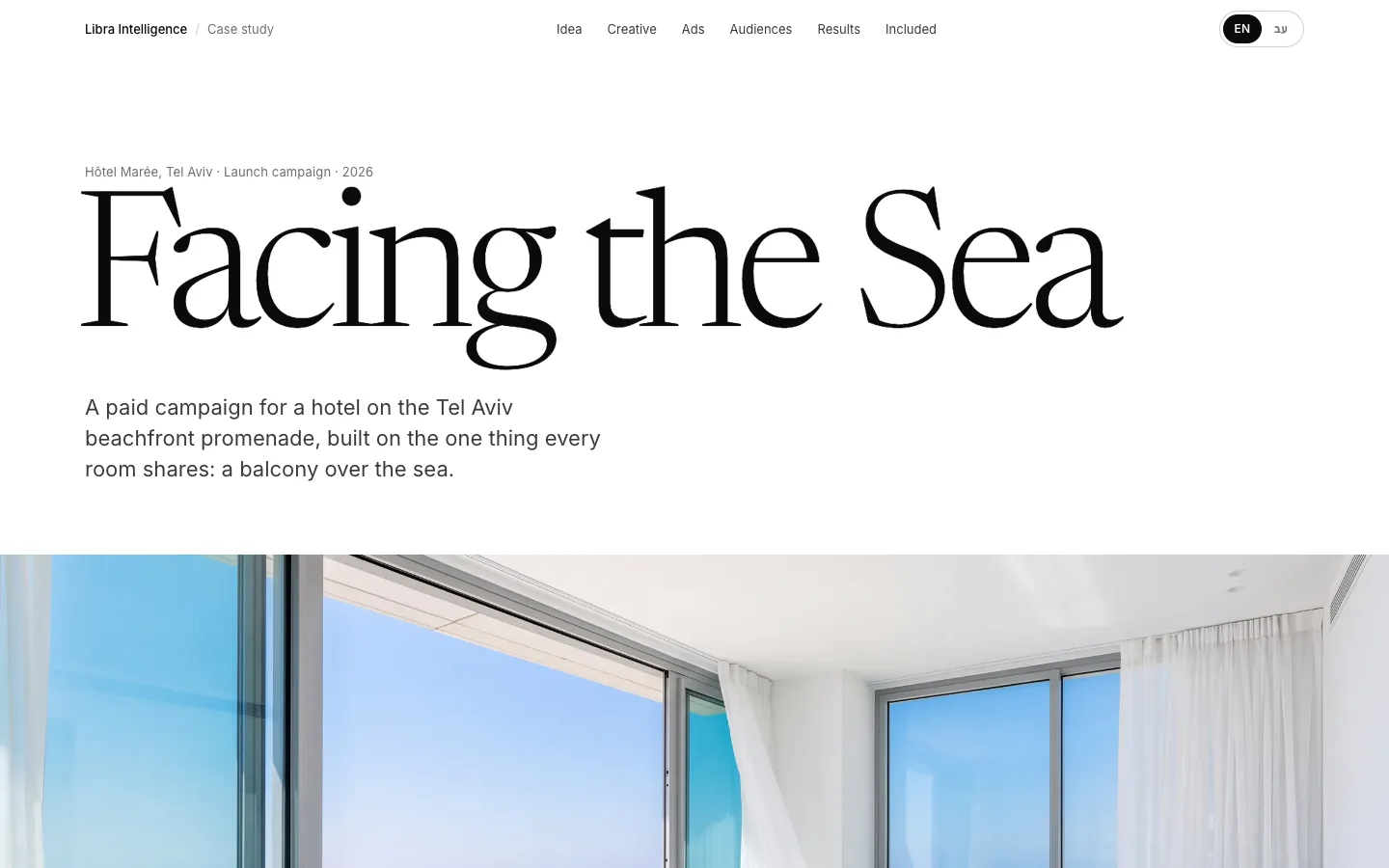
The click is only the start. Someone who searched “laser hair removal in Holon” and landed on the clinic’s home page has to search again inside the site, and many will not. A good page for a local campaign repeats the search in its headline, shows where the business is, answers the three questions everyone asks and offers one action with a short form. We explain the structure in how to build a landing page that converts, and the pages a clinic site needs in our article on clinic website design. The ALBA launch page, for a fictional residential project, and the Névé clinic website, for a fictional clinic, are two concepts we built where every section leads to one action.
Conversion tracking
Conversion tracking tells Google which click led to an action that matters to you. Google Ads can measure website actions (a form sent, a sign-up, a purchase), phone calls, app actions, and offline conversions imported from your own system (Google Ads Help). For a local business that means:
- Set as primary conversions only what is truly an enquiry: a form sent, an appointment booked.
- Do not count a page view or a button click that led nowhere as a primary conversion.
- Check that each conversion is recorded once, by sending a test form.
- Connect enquiries to your CRM, and later import back to Google which enquiries became customers.
- Tag every link with UTM parameters so analytics also sees where each enquiry came from.
Only when tracking works can automated bidding aimed at conversions learn anything. Before that, it learns from noise.
Performance Max: when, and when not yet
Performance Max is a goal-based campaign type that reaches all Google Ads inventory, YouTube, Display, Search, Discover, Gmail and Maps, from one campaign. Google presents it as a complement to keyword-based Search campaigns (Google Ads Help). For a small local business we usually start with Search, where you see exactly which searches you pay for. Performance Max is worth testing once tracking is reliable, there are enough conversions, and you have good images and video for the system to use.
How much budget do you need?
There is no single right number, and cost per click varies widely between fields and areas. Instead of guessing, work backwards:
- What an average customer is worth to the business over time, and how much you will pay to win one.
- How many enquiries it takes you today to close one customer.
- From that, how much you will pay for one enquiry.
- In the first weeks you learn what a click costs in your field and how many clicks bring one enquiry.
- The monthly budget should cover at least a few dozen clicks in each ad group you want to learn from. Less than that, and you cannot tell luck from a real difference.
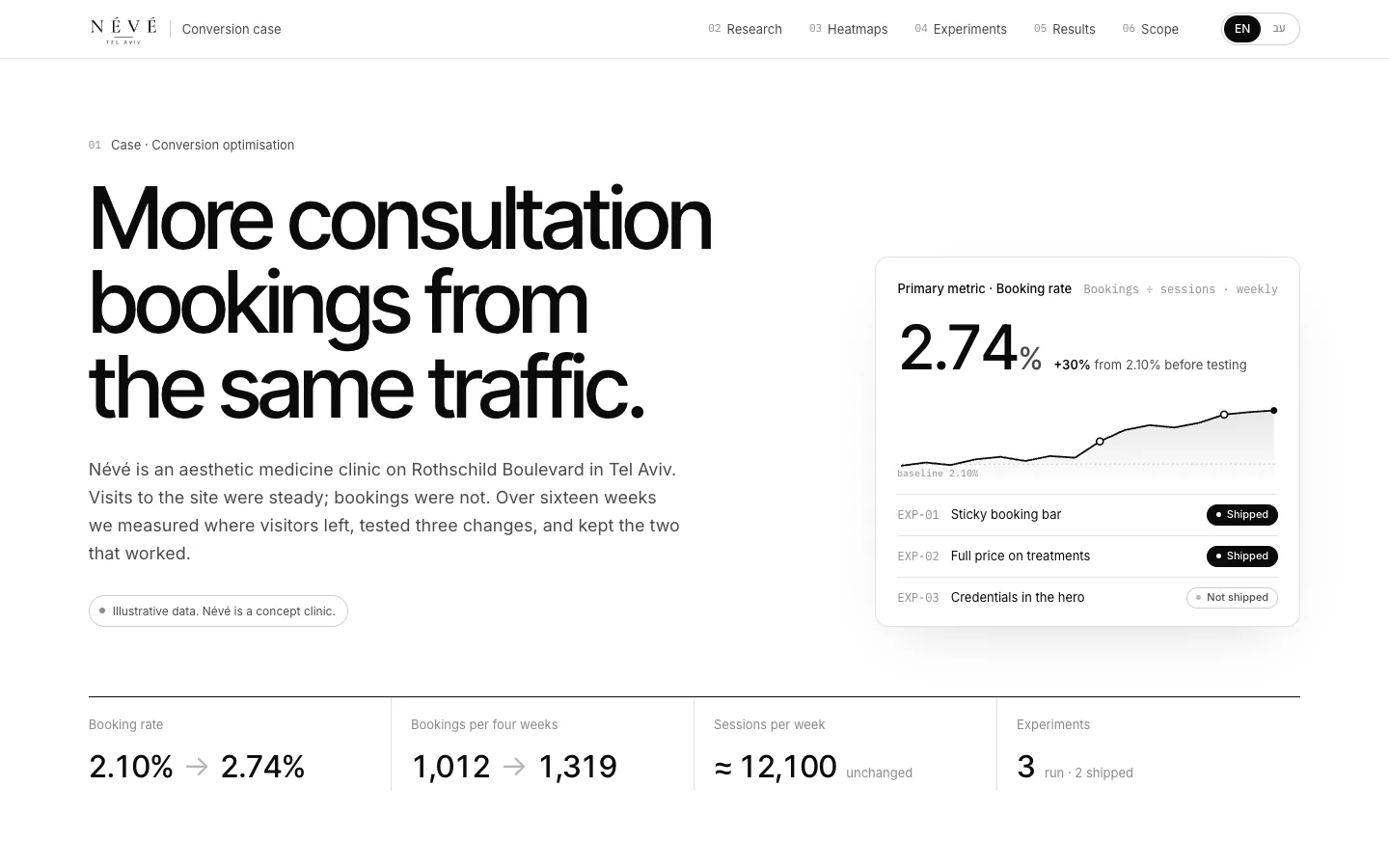
With a small budget, one focused campaign on two services in one area beats ten services across a whole country. And if traffic is too low to A/B test your pages, there are other ways to improve them; we cover them in our article on A/B testing and CRO, and the Névé conversion case, a concept we built for a fictional clinic, shows what that looks like.

A weekly routine for a local campaign
| What to check | What to look for | What to do |
|---|---|---|
| Search terms report | Irrelevant searches that got clicks | Add negative keywords |
| Conversions | Every form recorded, no suspicious spikes | Send a test form, check the tag |
| Lead quality in the CRM | Which ad group the customers came from | Move budget to groups that bring customers |
| Spend pacing | A campaign that runs out of budget early in the day | Tighten keywords or move budget |
| Ads and assets | Disapproved ads, weak headlines | Fix, and replace one headline at a time |
| The landing page | Loads fast on a phone and the form works | Check by hand on a phone |
Yourself, a freelancer or an agency
A small business can run a simple search campaign itself, as long as someone gives it time every week. More important than who runs it: the account is registered to the business with your payment method, you have admin access, and reports show enquiries and customers, not just clicks and impressions. A provider who wants to run your campaigns from their own account, or refuses access, is a warning sign.

What we build at Libra
We build the side a campaign depends on: a landing page for each service, forms that feed the CRM, tracking for every enquiry, and images and video for the ads. The details are on our websites, landing pages and stores page. If you are planning Google Ads and want the page and tracking ready before you spend anything, send a brief with your services and area. We reply by email with a direction, a written price and a date.
No term matches.
Questions
How much should a small local business spend on Google Ads?
There is no single figure: you pay per click, and costs vary widely by field and area. Work backwards from what you will pay for a customer and an enquiry, and start with a budget that covers at least a few dozen clicks per ad group.
What is the difference between broad, phrase and exact match?
Broad match can show ads on related searches, phrase match on searches that include the keyword’s meaning, and exact match on searches with the same meaning or intent. With a limited budget, start with phrase and exact.
What are negative keywords?
Terms that exclude searches from a campaign, such as “jobs” or “free”. They do not match close variants, so add plurals and spelling variations yourself.
Where should a Google ad send people?
To the page about exactly what was searched, with one action and a short form. Sending people to the home page makes them search again inside the site.
Is Performance Max good for a local business?
For a small local business it is usually better to start with a Search campaign, where you see which searches you pay for. Performance Max is worth testing once tracking is reliable and there are enough conversions.
How long before Google Ads shows results?
Clicks and first enquiries usually arrive within days. Knowing what actually works takes a few weeks of data, sound tracking and a weekly review of search terms.
Getting started
Want this for your business?
Send a short brief: three required questions, the rest only if you like. We reply by email with a direction, a written price and a date.