Meta ads creative: how to make Facebook and Instagram ads that stop the scroll
Creative for Facebook and Instagram ads: Meta’s sizes and ratios, the first seconds of video, text, versions to test, Advantage+, AI creative and ad categories.
Part of the guide: Digital marketing for small business: the whole system, in the order to build it

Good Meta ads creative is built for a phone and a scrolling thumb: an image or video in a vertical ratio (4:5 for Feed, 9:16 for Stories and Reels), one message understood in the first second, little text on the image, and several genuinely different versions so Meta’s system can find what works. Meta’s delivery now handles most targeting itself, so the creative is what stays in your hands, and it decides most of the result.
This article is about the creative: what to produce, in what sizes, how many versions and how to test them. Where Meta fits among all your channels is in digital marketing for small business, and the organic content that feeds many ads is in social media content for brands.
Formats and placements: where the ad appears
The same ad can appear in the Facebook Feed, the Instagram Feed, Stories, Reels and other placements. Each looks different on a phone, so produce a version for each rather than cropping one image for all. The main formats:
- Single image: the fastest to produce and test. Good for one product, one offer or one strong picture.
- Video: shows a process, movement, a space or a product in use. Needs a strong opening.
- Carousel: several swipeable cards. Good for several products, the steps of a process or the rooms of a hotel.
- Catalogue ads: for stores with a connected product catalogue, showing different products to different people.

Meta ad sizes and aspect ratios
Meta’s official Ads Guide recommends a 4:5 ratio in Feed at 1440 × 1800 pixels, with primary text of 50–150 characters and a headline of up to 27 characters (Meta Ads Guide, Facebook Feed). Stories and Reels use 9:16 at 1440 × 2560, and Meta advises keeping roughly the top 14%, the bottom 35% and 6% on each side free of text, logos and key elements, so the profile name and call-to-action do not cover them (Stories, Reels).
| Placement | Recommended ratio | What matters |
|---|---|---|
| Facebook and Instagram Feed | 4:5 | Takes more screen than a square; headline and text sit below |
| Stories | 9:16 | Full screen; keep the top and bottom clear |
| Reels | 9:16 | As Stories, plus comment and share controls at the side |
| Carousel | The same ratio for every card | The first card has to work on its own |
In practice we produce at least two versions of every concept: 4:5 and 9:16. Automatically cropping a landscape image to vertical usually cuts exactly what matters, the face or the product.
The first seconds of a video ad
In a feed, most people decide whether to keep watching before they understand what they are looking at. The opening has to work without sound and without context:
- The first frame is a picture in its own right. If the video stopped there, would it be a good post?
- The product or key moment appears early, not after a logo or an introduction.
- Movement from the first second. A static opening reads as a still, and the thumb moves on.
- Captions. Meta recommends sound and captions for Instagram Feed video ads (Meta Ads Guide), and many people watch muted.
- The message is visible, not only audible. Someone who missed the voice-over should still understand the offer.
- One action at the end, not a list of three options.
A well-built 15-second film usually outperforms a one-minute brand film cut down. How AI commercials are produced, from script to checking every frame, is in our article on AI video ads.
Text on the image and text in the ad
An ad carries two kinds of text: what is written on the image, and what sits above and below it (primary text and headline). Rules that work:
- On the image: few words, large, with good contrast. One sentence, not a paragraph.
- Primary text: the first line is what counts, because in Feed it is often all people see before “more”.
- A fact, not a slogan: what, where, from when, how much. “Sea-view room in Jaffa, breakfast included” says more than “an experience you won’t forget”.
- The same promise in the ad and on the page it leads to. Someone who clicked on a price should see it on the page.
- In right-to-left languages such as Hebrew: a typeface that reads well small on a phone, right alignment, and a check that numbers and Latin words do not flip.
How many versions, and what to vary
Meta’s system spreads budget across versions according to what works, but it can only choose from what you give it. Five versions of the same image with different headlines are really one version. A distinction that helps:
| Level | What changes | Hotel example |
|---|---|---|
| Concept | The idea and the reason to buy | A weekend escape / breakfast facing the sea / a location in old Jaffa |
| Format | How the idea is shown | Image / short video / carousel of rooms |
| Execution | Details within the same idea | A different opening frame, headline, text colour |
| Copy | The first line and the headline | With price / without price / with dates |
Start by testing genuinely different concepts, and only once one wins move on to improving its execution. Changing a button colour will not save a concept nobody cares about.
Advantage+ creative, briefly
According to Meta’s documentation, Advantage+ creative works with single image, single video, carousel, catalogue or existing-post ads; it automatically creates several variations of the ad and shows each person the variation they are most likely to respond to (Meta for Developers). It can save work, but check in the preview exactly what will change before you switch it on, especially for a brand that is strict about its look: automatic changes to image or text can drift from the brand’s language, and text in a non-English language deserves a human read.
AI-produced creative, and labelling
Small businesses now need far more versions than one shoot day delivers, so AI-produced images and video have become part of the work. It works when the product stays faithful to the original, faces stay consistent from shot to shot, and nothing in the frame is untrue, such as a view the room does not have or a dish that is not on the menu. That matters legally and for trust.
Meta labels with “AI info” ads that were created or substantially altered with its own generative AI features. The label sits in the three-dot menu, and when the image contains an AI-generated photorealistic person it appears next to the ad label. For ads about social issues, elections or politics, advertisers must disclose whether images, video or audio were digitally created or altered, including with third-party tools (Meta Help Center). These rules change, so check them before each campaign. Rights, likeness and disclosure are covered in our article on using AI images commercially.

Special ad categories: housing, employment and finance
Meta defines special ad categories for housing, employment, financial products and services, and social issues, elections or politics. For housing, employment and financial ads, targeting is limited: no gender selection, age generally fixed at 18 to 65+, no lookalike audiences, and a minimum location radius. According to the documentation, the obligation to declare these categories applies to advertisers in or reaching the United States, and in Canada and Europe (Meta for Developers). A residential project marketed to buyers abroad should plan for this in the creative, because when targeting is limited, the ad has to do more of the work. Marketing a residential project end to end is covered in how to market a new residential development.
A creative testing plan
- Pick one metric: an enquiry, a booking or a purchase, as measured by the pixel and conversions setup. Not likes.
- Produce three to five genuinely different concepts, each in 4:5 and 9:16.
- Run them under the same conditions: same audience, same budget, same landing page.
- Decide in advance when you will decide: a date or a number of enquiries, not the moment one version looks good on day one.
- Build executions from the winning concept: a different opening, headline or format.
- Replace before the ad wears out: when frequency rises and results fall, it is time for a new version, not a bigger budget.
- Write down what was tested and what came out, so the next campaign starts from what is known.
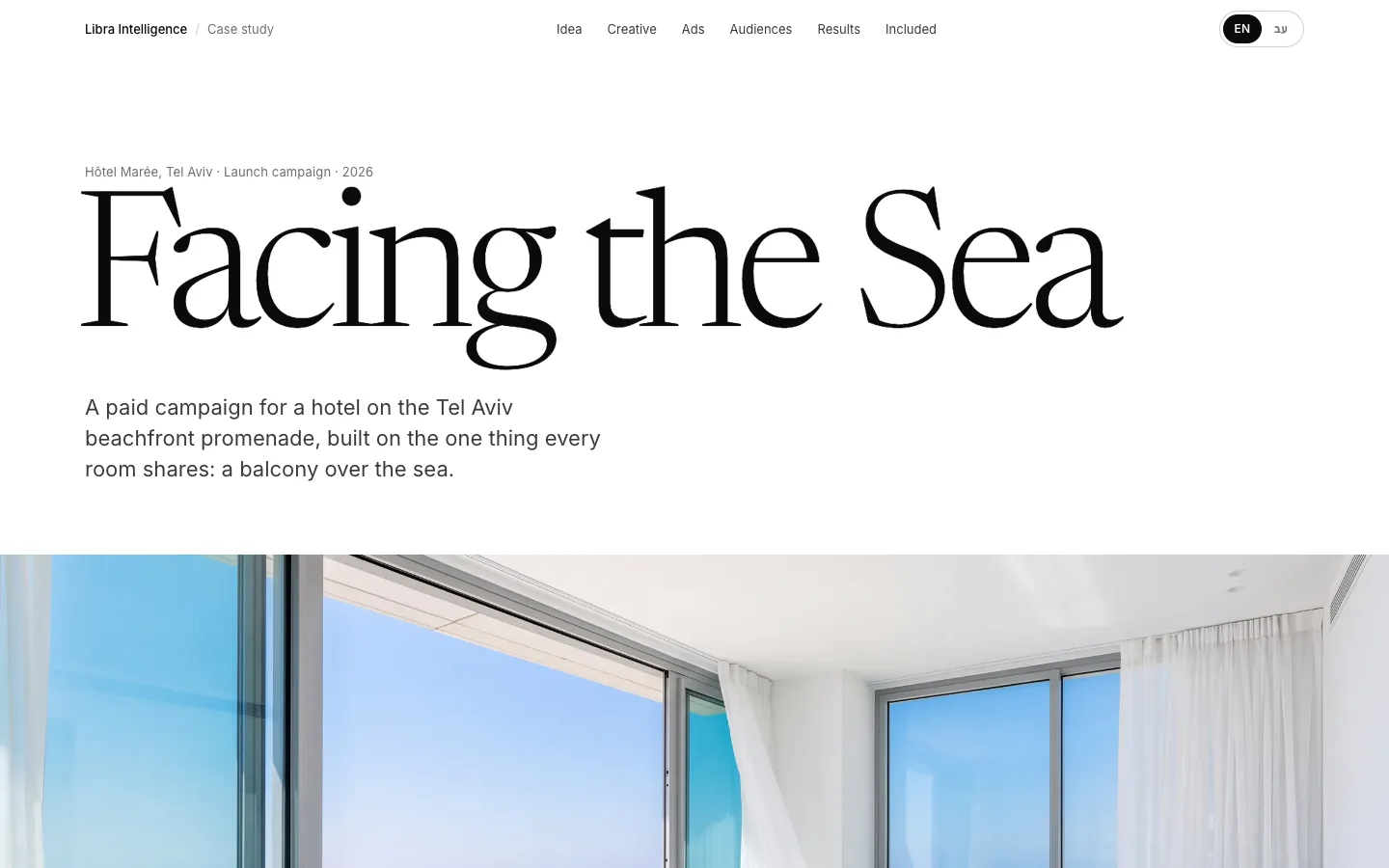
The statistics behind testing, how much data you need and why you do not stop halfway, are in our article on A/B testing. The Hôtel Marée launch campaign, for a fictional boutique hotel in Jaffa, shows the creative, the ads in every format and the weekly budget on one board. It is a concept we built; the hotel does not exist, and its numbers are a plan, not results.
A checklist before an ad goes live
- There is a 4:5 and a 9:16 version, each checked on a phone.
- No text, logo or product sits in the areas Meta advises keeping clear in Stories and Reels.
- The first frame of the video works as a picture, and there are captions.
- Text on the image is short and legible.
- The product, room or dish looks as it really is.
- The promise in the ad also appears on the landing page.
- The link carries UTM tags, and the pixel records the right action.
- You have checked whether the campaign falls into a special ad category.
- You know what will replace the ad, and when, before it wears out.
What we produce at Libra
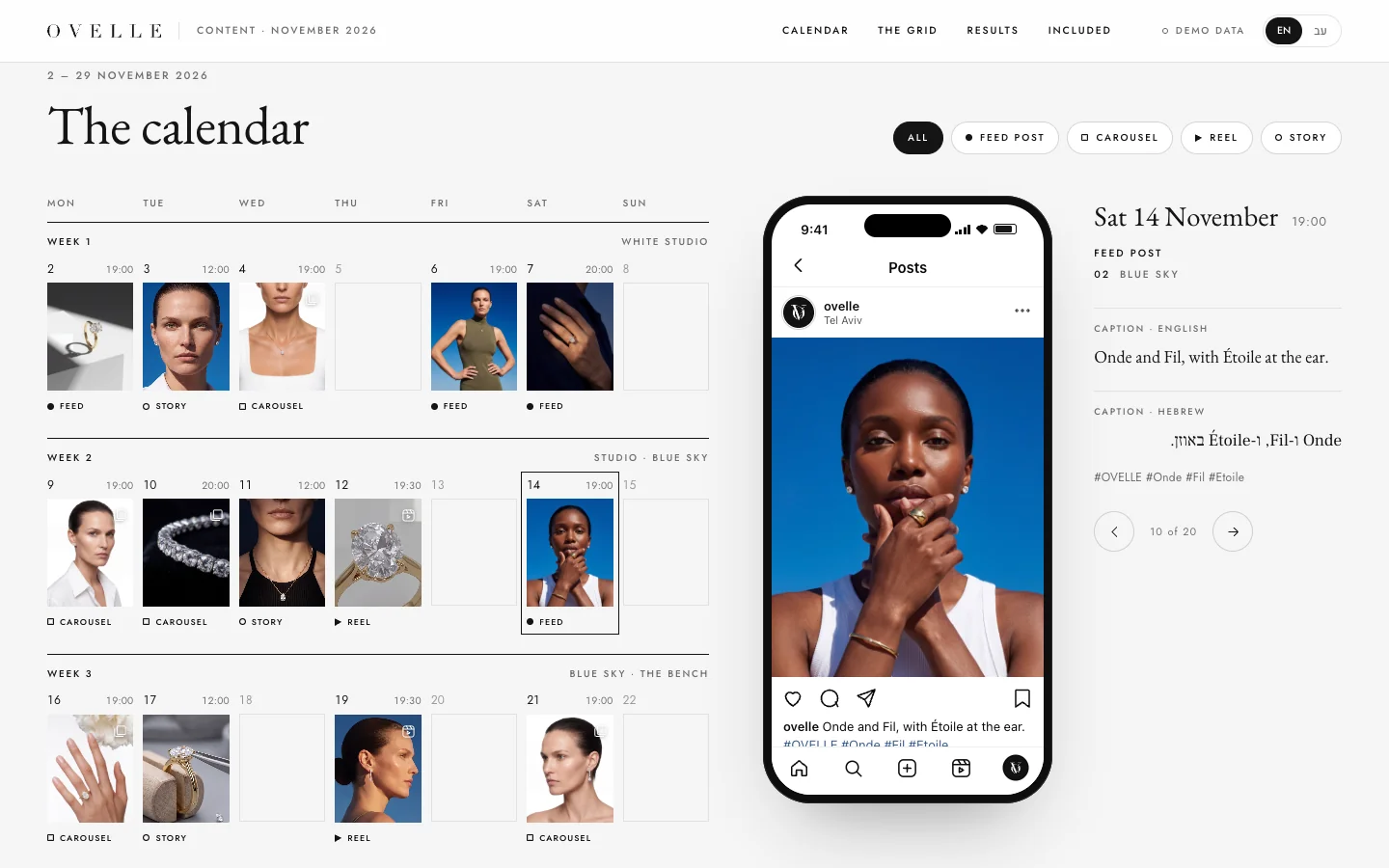
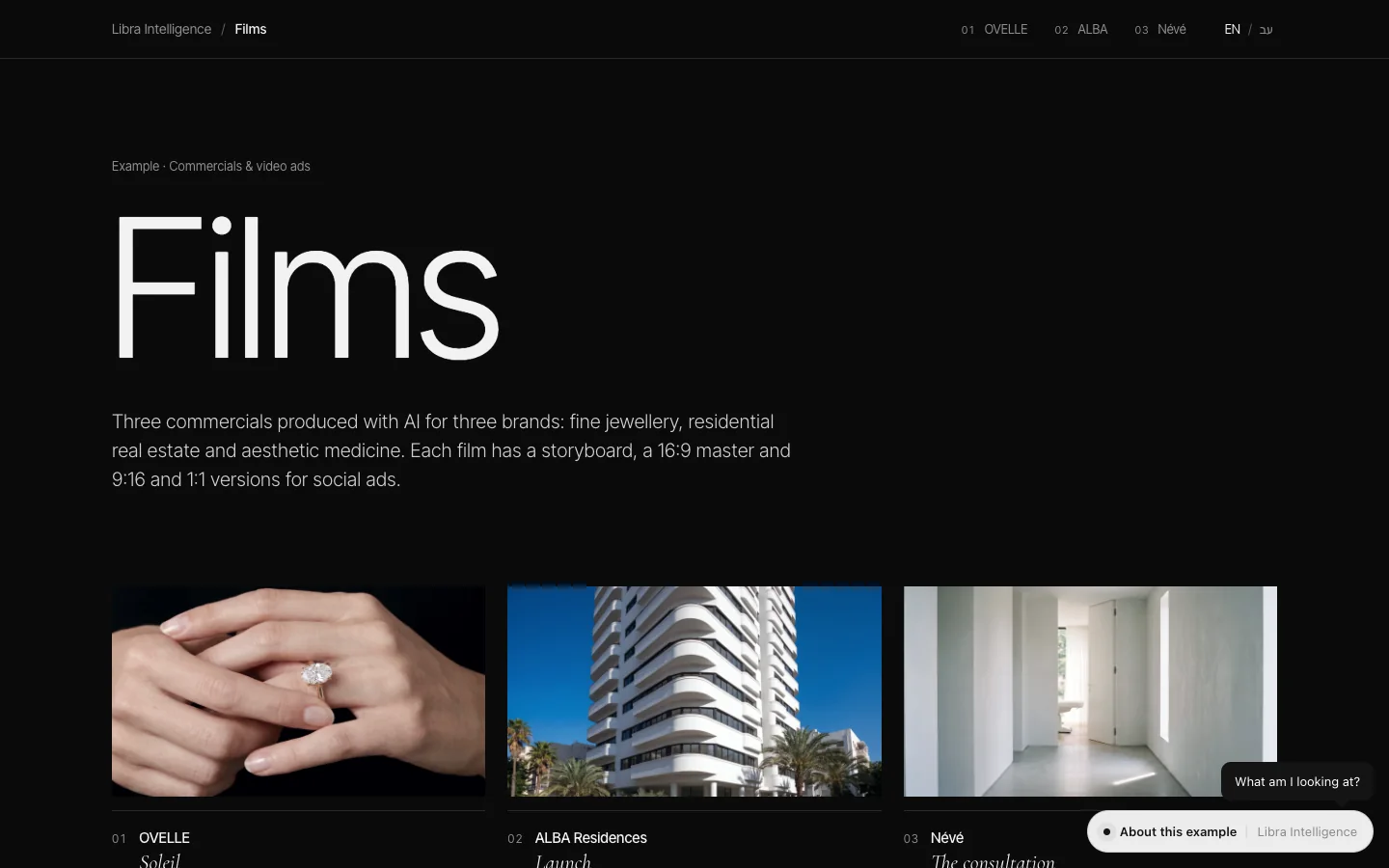
We produce ad creative: AI images and video at the level of a shoot day, with the real product and the brand’s consistent faces, in every size and in several concepts to test. The commercials we built and a month of content for OVELLE, a fictional jewellery house, show the level. The details are on our AI content, models and video page. If you have a campaign coming, send a brief with the product or service, the audience and the date. We reply by email with a direction, a written price and a date.
No term matches.
Questions
What is the best aspect ratio for Meta ads?
Meta recommends 4:5 for Feed (1440 × 1800 pixels) and 9:16 for Stories and Reels (1440 × 2560). Produce both for every concept rather than cropping automatically.
How much text should go on a Facebook or Instagram ad image?
Little: one sentence, large and legible on a phone. In Stories and Reels, keep the top and bottom clear, where the profile name and call-to-action appear.
How many ad creatives should I test?
Start with three to five genuinely different concepts, each sized for Feed and Stories. Once one wins, produce several executions of it. Versions that differ only in the headline are almost the same ad.
Can I use AI-generated images in Meta ads?
Yes, within Meta’s advertising policies. Meta labels with “AI info” ads created or substantially altered with its own AI features, and political and social-issue ads must disclose digital alteration. Either way, the product or service must look as it really is.
What is Advantage+ creative?
A Meta feature that automatically creates variations of an ad and shows each person the one they are most likely to respond to. Check the preview before switching it on, especially for a brand strict about its look.
How often should I refresh ad creative?
When frequency rises and results fall, the ad is wearing out. Prepare the next version in advance and swap it in, rather than raising the budget on an ad people have already seen.
Are real estate ads restricted on Facebook?
Housing is a special ad category on Meta, with limited targeting by age, gender and location. According to Meta’s documentation, declaring it is required for advertisers reaching the United States, Canada and Europe.
Getting started
Want this for your business?
Send a short brief: three required questions, the rest only if you like. We reply by email with a direction, a written price and a date.