AI video ads that look real: how they are made
How an AI commercial reaches the level of a shoot day: script, storyboard, a consistent character, the real product and the edit. What still breaks, and how to catch it before it runs.
Part of the guide: AI content creation for brands: what you can make, how it works, and what to check before you publish
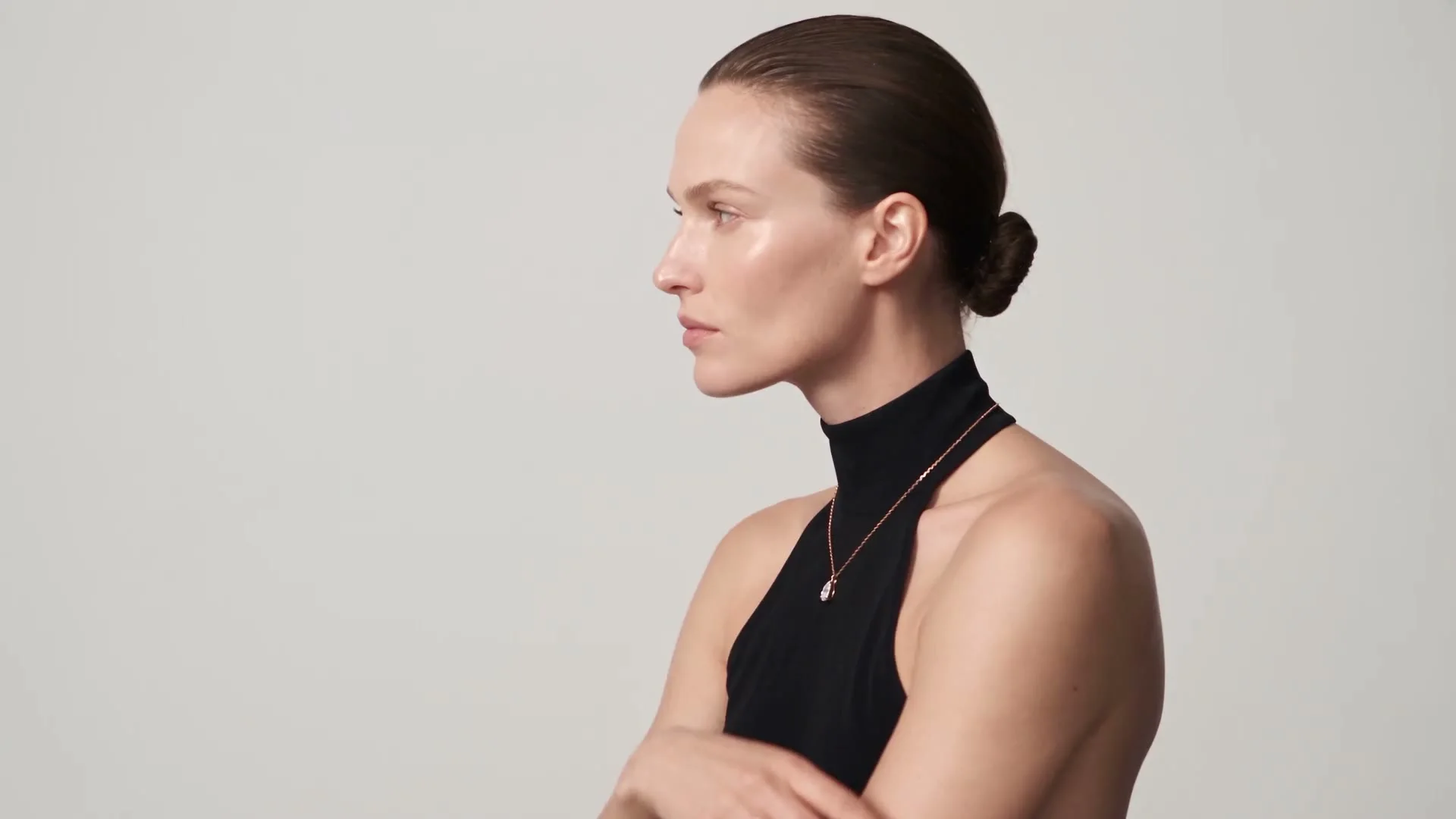
AI video ads that look real are made like any commercial, just without a shoot: a brief and one idea, a script with a hook in the first seconds, a frame-by-frame storyboard, a locked character and a locked product reference, stills first and motion second, and an edit with pacing, continuous transitions, sound and captions. What makes an AI ad believable is not the model but control: the face, the product and the room must not change between shots, and someone has to watch the full cut before it goes out.
Below: the stages in order, what still breaks and how to catch it, what an honest AI ad does not do, and how to build versions for testing.
The AI commercial production pipeline
This is how the work runs for us, from brief to upload-ready file. Each stage is closed before the next starts, because a fix early on costs minutes and a fix in the edit costs days.
- Brief and idea. What the product is, who it is for, where the ad will run and what the viewer should do afterwards. One idea comes out of this, not three.
- Script. One line per shot, with a hook in the first seconds, the moment the product is used, and the message that stays.
- Storyboard, frame by frame. Every shot gets its own image at its final angle, light and composition. This is where the film is approved before anything moves.
- Lock the character and the product. A dedicated brand character and a product sheet built from real photos, used as the reference for every frame.
- Stills. Full-resolution stills for every shot, checked at zoom: face, label, hands.
- Motion. Each approved still becomes a short clip. Several versions per shot, then a selection.
- Edit. Pacing, transitions, sound, voice-over, captions, and exports for every format.
Hook, script and storyboard
On social platforms the viewer decides within the first seconds whether to keep watching. So the hook is written first, not last: clear movement, a face, the product in the first frame, or an image that is not immediately readable and invites a second look. Opening on a logo over black is the quickest way to lose people.
A script for a short vertical ad is very short. Fifteen seconds is roughly five to eight shots, and each shot has one job. If a shot does not move the idea forward, it goes. Voice-over, if there is any, is written at the pace people actually speak and read aloud before it is approved.
The storyboard is where the most money is saved. Every frame is built on its own at high resolution, not as a collage of several images in one file. That way each frame can be inspected at zoom and the whole film approved before a single second of motion is generated.
Locked character and product: stills first, then motion
The first problem with AI generated video ads for brands is consistency. A video model working from text alone invents a different woman in every shot and a bottle that changes shape between the opening and the end. The fix is to lock two things up front:
- A fixed character. Face, hair, skin tone and build, created once and saved as a reference. It is the same character who appears in the product images, so the ads and the site tell one story.
- A product sheet. Real photos of the product from every side, with label close-ups, combined into one reference. The method is covered in our guide to AI product photography.
Stills are generated from those references first, and only once they are approved are they turned into motion. It sounds slower and is faster in practice: an image is quick to fix, a clip is expensive to fix. A clip generated from an approved still inherits its face, its label and its light.
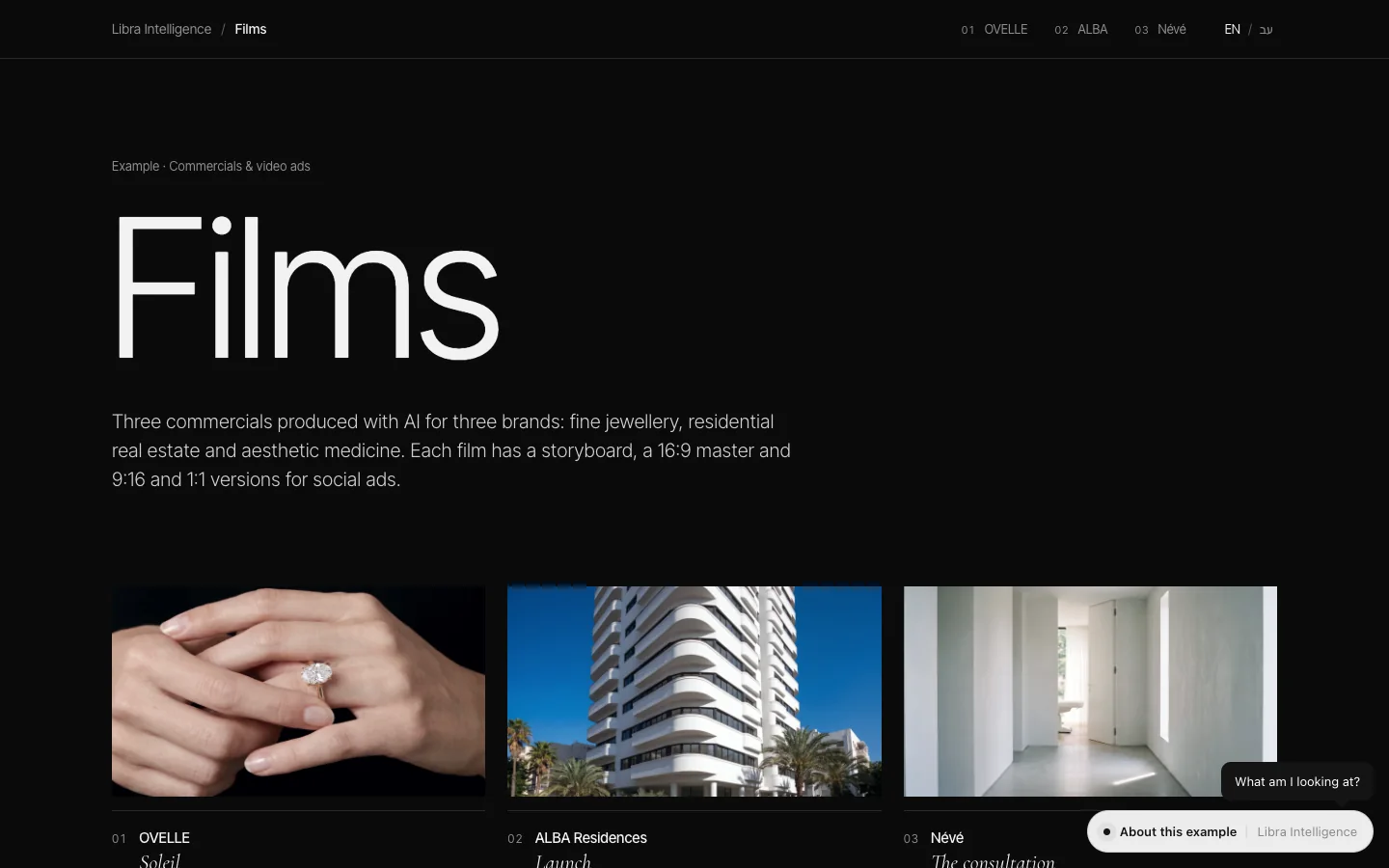
The commercials we made for OVELLE, ALBA and Névé, concepts built for fictional businesses, were all produced this way: fixed character, product sheet, approved storyboard, and only then motion.

The edit: pacing, transitions, sound and captions
The edit is where an AI video stops looking like a pile of clips and starts looking like an ad. A few principles:
- Pacing. Cut on the beat. A shot that runs too long exposes the model’s flaws; a shot that is too short does not register.
- Continuous transitions. Fast but continuous: match cuts (a movement or shape that carries from one shot into the next), whip pans (a fast camera swing that hides the cut), speed ramps (slowing and accelerating within a shot). No black frames, no freeze-holds.
- Sound. Music licensed for commercial use, small effects that add weight (a cap unscrewing, fabric moving), and voice-over when the idea needs it.
- Captions. Most social viewing starts muted. Short captions, large enough to read on a phone, placed outside the areas the platform’s interface covers.
- Formats. 9:16 for Reels, TikTok and Stories, 1:1 or 4:5 for feeds, 16:9 for YouTube and the website. Composition is planned for every format from the start so the product is never cropped out.
Show the product being used, not just the result
The most common mistake in AI ads is a beautiful film that only shows the outcome: perfect hair, glowing skin, a tidy room. The viewer sees a pretty picture and never understands what is being sold. A good ad shows the product touching the person: cream on the face, a brush through the hair, a ring sliding onto a finger, a glass being poured.
A simple structure that works: the situation before, the product in hand, the moment of use, the result, and the product again in the closing frame so people remember what to buy. The moment of use is also the hardest to generate, because it involves hands, contact and a product close to the lens. So it gets the most rounds and the most checking.
What still breaks, and how to catch it
Even with locked references, a fixed list of faults keeps appearing. Most are invisible in a thumbnail or a strip of frames. They only show up when you watch the whole thing.
- Identity drift. The face changes slightly from shot to shot until, by the end, it is someone else.
- Product morphing. A cap that lengthens, label letters that shift as the bottle moves.
- Hands. Fingers that merge, a grip that holds nothing.
- Text. Any text generated inside a clip is suspect. Text and captions are added in the edit.
- Physics. Liquid flowing upward, hair behaving like cloth, shadows that do not follow the light.
- The room changing. The background shifts between clips: a window moves, a wall changes colour. Viewers cannot say what is wrong, but they feel it.
- Dark faces. Models tend to render faces about a stop too dark. Write the light on the face into every prompt and lift dark frames in the grade.
How to catch them: watch the full cut at full speed, on a phone, with sound, at least twice. A strip of frames hides exactly the faults a viewer will notice. Then stop and zoom into every shot that shows a label, a logo or hands. If something is unclear, the shot is regenerated, not hidden in the edit.

Honesty and realistic expectations
An AI video can look like real footage, which makes the limits more important, not less:
- No invented testimonials. An AI character does not say the product changed her life. The ad can present the brand; it cannot fake customers.
- No fabricated before-and-after. If the result is not real, it does not appear in the film as proof.
- The product as it is. Correct colour, size and packaging. The setting can be generated; the product cannot.
- Disclosure. Platforms have rules about labelling AI-generated content, and they change. Check them before each campaign and work openly.
On expectations: an AI ad does not guarantee performance. What it does is make testing ideas cheaper and faster, and that is something you measure rather than assume.

Versions for A/B testing, stages and turnaround
The big advantage of AI commercial production is that another version is relatively cheap. The same film with a different hook, a different opening scene or a different call to action lets you find out what works on your audience instead of guessing. For a test to teach you anything, change one thing at a time and give it enough impressions. The arithmetic is in our guide to A/B testing.
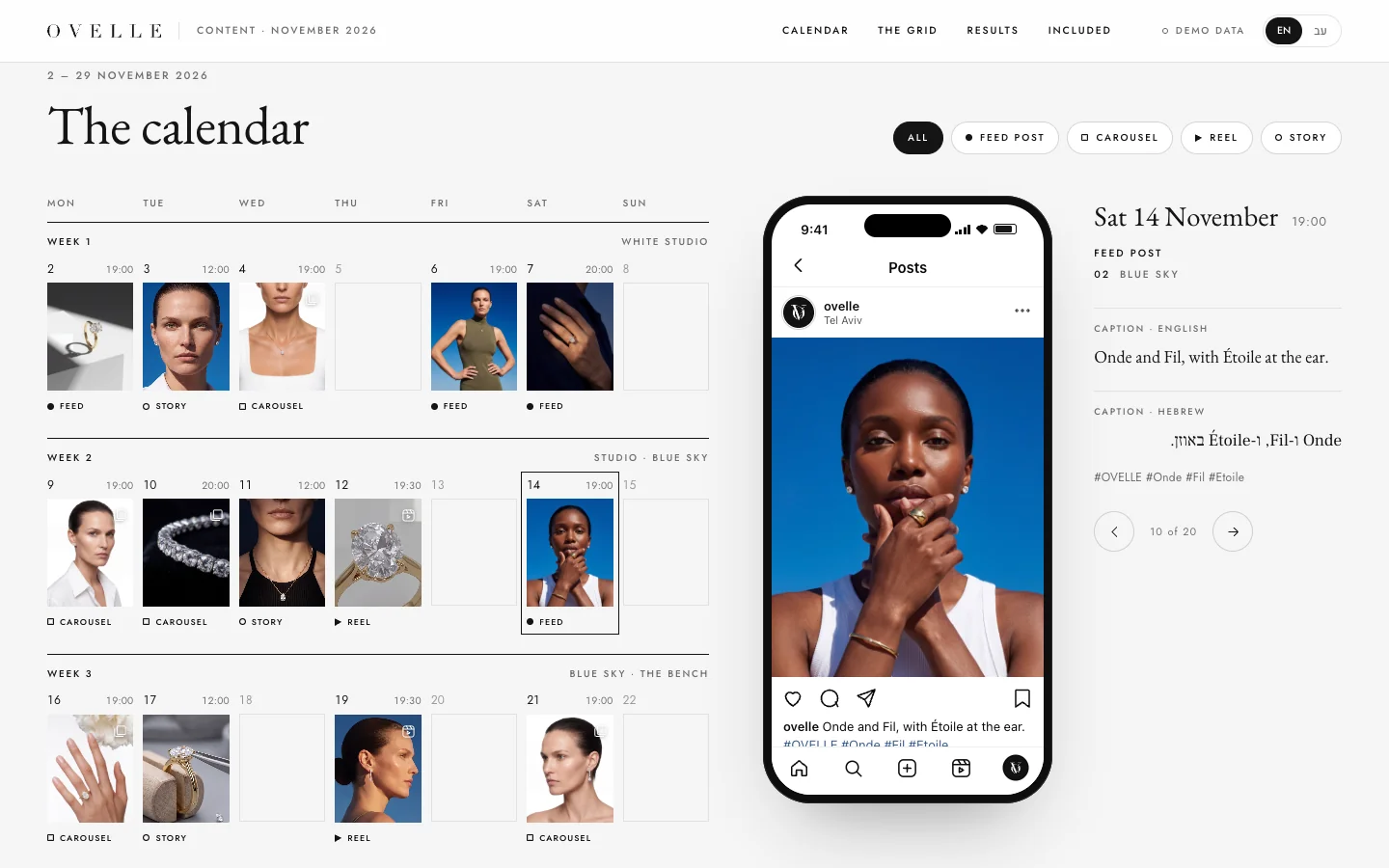
In the Hôtel Marée launch campaign, a fictional boutique hotel in Jaffa we built as a concept, the creative was planned in several versions for each stage of the funnel, and OVELLE’s monthly content shows the same visual language carried into posts and Stories.
| Stage | What you approve | Typical turnaround |
|---|---|---|
| Brief and idea | One idea, audience, platforms | 1 to 2 business days |
| Script | Hook, shot sequence, voice-over text | 1 to 2 business days |
| Character and product sheet | The character’s face, product accuracy | 1 to 3 business days, once per brand |
| Storyboard and stills | Every frame at zoom | 2 to 4 business days |
| Motion | A clip for every shot | 2 to 4 business days |
| Edit and sound | The full cut, watched at full speed | 1 to 3 business days |
| Versions and formats | Alternative hooks, 9:16, 1:1, 16:9 | 1 to 2 business days |
The ranges depend mainly on two things: whether an approved character and product sheet already exist, and how many rounds of comments there are. A first film for a new brand takes longer because the references are being built. From the second film on, the work is much faster. In Libra’s starter content package three videos are delivered within 5 business days, and the 8-video package includes A/B variations.
To start, send a brief with the product, the audience and the platforms, and the answer comes by email with a direction, a price and a date. How to brief a studio helps you organise the material, and the AI content page sets out what is included.
No term matches.
Questions
How long does it take to make an AI video ad?
A single film for a new brand usually takes from several business days to about two weeks, mostly because the character and product sheet have to be built. Once those references exist it is faster; Libra’s starter package delivers three videos within 5 business days.
Can an AI video show my actual product?
Yes, if it is generated from real photos of the product combined into a product sheet that is used as the reference for every shot. Without that reference the model redraws the product and the label changes.
Why do some AI ads look fake?
Usually because the face drifts between shots, the background changes, hands and physics are wrong, or faces are underexposed. A locked character and product, approved stills before motion, and watching the full cut before publishing solve most of it.
What format should an AI ad for Reels be?
Vertical 9:16, with a hook in the first seconds and captions, since most viewing starts muted. Plan 1:1 and 16:9 versions from the start so the product is never cropped.
Do AI video ads have to be labelled?
Platforms have rules on labelling AI-generated content and they change, so check them before each campaign. In every case, avoid invented testimonials and fabricated before-and-after results.
Getting started
Want this for your business?
Send a short brief: three required questions, the rest only if you like. We reply by email with a direction, a written price and a date.