Digital marketing for small business: the whole system, in the order to build it
A complete guide to digital marketing for a small business: website, measurement, SEO and AI search, Google and Meta ads, email, CRO, budget and a 90-day plan.
Digital marketing for a small business is one system, not a list of channels: a website that explains what you do and takes enquiries, measurement that shows where every enquiry came from, and on top of those the channels that bring people in, first the ones where people are already searching (Google Ads, organic search, AI answers), then the ones that create demand (Meta ads, content and social), and finally the ones that keep in touch with people who already came (email and WhatsApp). A small business does not need every channel on day one. It needs to build them in order and add a channel only when the previous one is measured and working.
This guide walks through each part of that system in the order we recommend building it: what each channel is good at, how long it usually takes to show results, what it needs from you, how to split a budget without guessing, which numbers matter and which to ignore, and how to work with a studio or agency without losing control of your own accounts. Each channel has its own article in our journal, and we link to it at every step.
What digital marketing for a small business includes
In practice, when a small or medium business says “digital marketing”, it means eight parts working together:
- The website or landing page, where every channel sends people.
- Measurement: Google Analytics 4, Google Search Console, conversion events, tagged links and a CRM where every enquiry is kept.
- Organic search: ranking in Google, and being cited in AI answers such as ChatGPT.
- Google Ads: ads shown to people searching right now for what you sell.
- Meta ads: Facebook and Instagram, where the creative is most of the work.
- Content and social: what the business publishes itself, without paying for every view.
- Email and WhatsApp: staying in touch with people who already left their details, within the rules on consent.
- Conversion optimisation: improving what happens on the site after a visitor arrives.
The common mistake is to start in the middle: launching Meta ads before there is a site that converts, or paying for SEO before knowing how many enquiries arrive today and from where. Every channel added without a base underneath costs money and teaches nothing.

Where to start: the order to build it in
The order we recommend for most small and medium businesses:
- A website or landing page that says clearly what you offer, to whom, and what the next step is.
- Measurement: analytics, Search Console, conversion events and link tagging, before a single dollar goes on ads.
- Channels that capture existing demand: your Google Business Profile, organic search and Google Ads.
- Channels that create demand: Meta ads and social content.
- Retention: email and WhatsApp for people who have already enquired or bought.
- Conversion optimisation: experiments on the site, once there is enough traffic to learn from them.
The order is not sacred. A fashion label that sells through Instagram will probably start with content and Meta; a law firm will start with Google. But the first two steps are the same for everyone: without a site and without measurement, you cannot tell whether any channel works.
Step 1: the website every channel lands on
Every channel worth paying for ends on your website. A Google ad sends people to a service page, an Instagram post to a product page, an email to an offer page. If that page does not explain within a few seconds what you do, and does not ask the visitor for one clear action, the money spent on the channel is lost at the last step. So check the base first:
- At the top of every page: what you offer and for whom, in one sentence, no slogans.
- One prominent action per page: a form, a booking, a purchase or a WhatsApp message.
- Mobile first: most traffic from social platforms arrives on a phone.
- Reasonable load speed, even with images and video.
- A form that lands in one place where someone answers, ideally a CRM rather than a shared inbox.
- Accessibility to the standard your market requires; most are based on WCAG.
We cover the whole build, from goals to launch, in our guide to building a business website, and typical price ranges in how much a business website costs. For a campaign around one offer, a dedicated landing page measures far better than the home page; we explain its structure in how to build a landing page that converts.
Step 2: measurement before you spend on ads
Measurement is not a monthly report. It is the plumbing that answers one question: which channel did each enquiry and sale come from, and what did each one cost. Without it, every budget decision is a guess. These are the four pieces to set up before the first campaign.
Google Analytics 4 and key events
GA4 records what happens on your site: where visitors came from, which pages they saw and what they did. The most important part of the setup is marking which actions matter to the business. Google calls them key events and describes them as actions that are important to your business, used to evaluate the marketing channels that lead people to take them; you mark an existing event with the star icon in the Events screen of the property’s Admin (Google Analytics Help). For a service business these are usually a form submission, a WhatsApp click and a booking; for a store, a purchase. If you do not mark them, analytics will show traffic and no results.
Google Search Console
Search Console is Google’s free tool that shows how your site appears in search: how many impressions and clicks came from Google, for which queries, to which pages, and which pages Google has crawled and indexed (Google Search Central). You do not need it to appear in Google, but without it you cannot see what you appear for or where there is a technical problem. Connect it the day the site goes live and submit a sitemap.
UTM tags on every link
Every link you publish outside your site, in a post, an email, an Instagram bio or a WhatsApp message, should carry UTM parameters that tell analytics where the visitor came from. Google recommends always using at least utm_source, utm_medium and utm_campaign, and warns that values are case sensitive, so Meta and meta count as two different sources (Google Analytics Help). Agree one naming convention, write it in a shared sheet, and keep to it in every campaign.
A CRM where every enquiry is kept
Analytics knows that someone submitted a form. It does not know whether that enquiry became a customer. For that you need one place where every enquiry is saved with its source, its status and the amount it closed for. In a small business that can start as a tidy spreadsheet and grow into a CRM; we compare the options in choosing a CRM for a small business. Once the source is kept in the CRM too, you can calculate cost per customer and not only cost per lead, which is the difference between a channel that brings many enquiries and one that brings customers.
Step 3: organic search and AI search
People who search Google for “dentist near me” or “employment lawyer” already know what they need. Organic search is how you appear in front of them without paying for each click. It has three parts: a technical base (a fast site Google can crawl), content that answers what people actually search for, and trust (mentions, links and reviews). Results usually take months rather than weeks, so it is worth starting early, even while a paid campaign runs. We cover the whole process, keyword research, service pages and articles, in our guide to SEO for small business.
Your Google Business Profile
For a local business, the Google Business Profile is often the first channel that brings enquiries. Google says local results are based mainly on relevance, distance and prominence, and that there is no way to request or pay for a better local ranking (Google Business Profile Help). What you do control: the right category, current opening hours, real photos, a description of services, and a reply to every review.
Appearing in ChatGPT and other AI answers
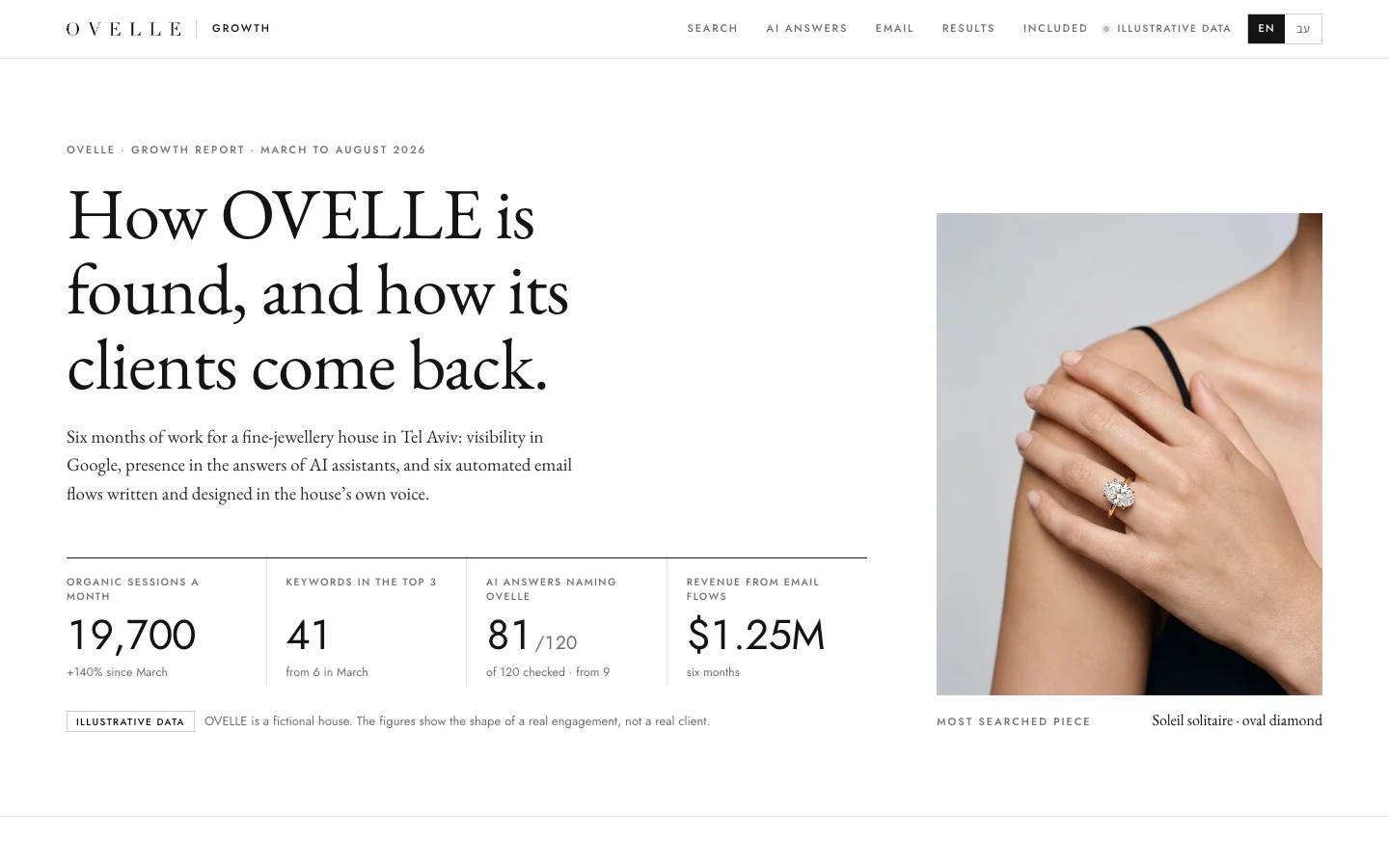
Some searches now go to AI assistants that give one answer instead of a list of links. To be part of that answer, your content needs to answer the question clearly in its first paragraph, include facts that can be quoted, and be mentioned in the places those assistants read. It is an extension of good SEO, not a replacement for it; we explain the differences and what to do in our guide to SEO and GEO for AI search. You can see both sides, Google and AI answers, in the concept we built for OVELLE, a fictional fine-jewellery house, together with the automatic emails that follow each customer.

Step 4: Google Ads
Google Ads shows your ads to people searching right now for what you sell. It is the channel closest to buying intent, and it can bring enquiries within the first days. It is also the easiest place to burn a budget: keywords that are too broad, the wrong location settings, ads that land on the home page instead of the service page, and campaigns optimised for clicks instead of enquiries. Three principles before you start:
- Start with searches that signal clear intent (the service plus a town, “price”, “book”), not broad terms.
- Send each ad group to the page that deals with exactly what was searched.
- Connect the campaign to the key events you defined, so the system learns from what matters to you rather than from clicks.
We cover campaign structure for a local business, negative keywords, location settings and a starting budget in our guide to Google Ads for local business.

Step 5: Facebook and Instagram ads
On Meta, people are not looking for you. They are scrolling, and the ad has to stop them. That is why on Meta the creative, the image, the video and the first line, makes most of the difference between a campaign that works and one that does not. Meta’s ad systems now handle much of the targeting themselves; what stays in your hands is mostly what the ad says and shows, how many versions it has, and how quickly you replace a version that has worn out.
Meta is especially good at creating demand for a product or service people did not know they needed, for brands with a strong visual side, and for bringing back visitors who came to the site and did not enquire. It needs a steady flow of new creative from you, which is why AI-produced content has become part of the method for small businesses. We explain ad structure, formats and how to test several versions at once in our guide to Meta ads creative.
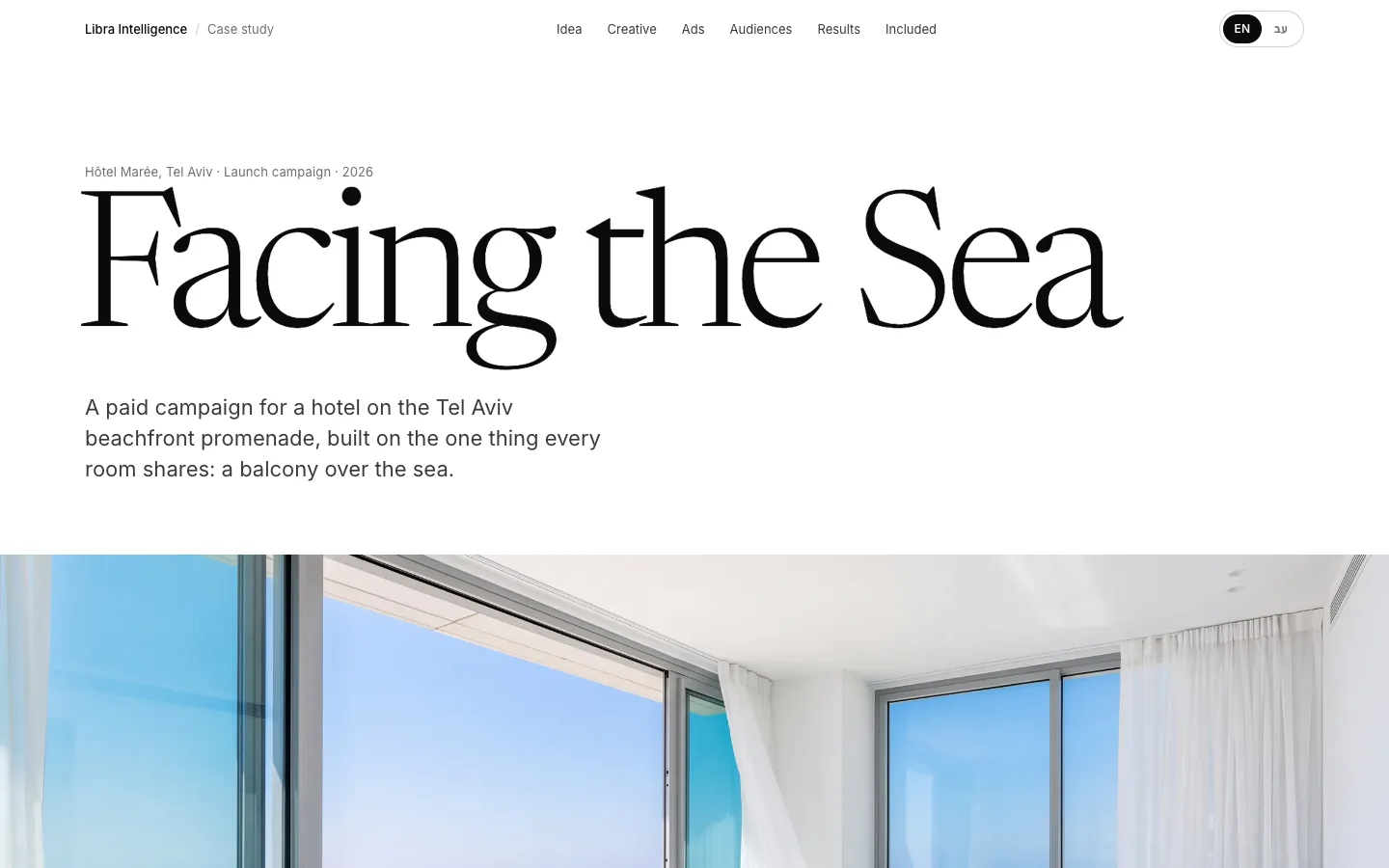
You can see what this looks like in the Hôtel Marée launch campaign, a fictional boutique hotel in Jaffa: the creative, the ads in each platform’s format and the budget week by week, on one board. It is a concept we built to show the work; the hotel does not exist, and the numbers in it are a plan, not results.
Step 6: content and social media
Organic social content does not replace paid ads, but it does two things ads do not: it gives anyone who visits your profile a reason to believe the business is active and serious, and it builds a stock of material you can later promote. What works for a small business is a steady, realistic rhythm, not a presence everywhere. One or two platforms where your audience actually is, with a monthly content calendar, beat five platforms updated whenever there is time.
- A monthly calendar written in advance, with a topic, format and date for every post.
- One visual language: the same colours, type and photographic style.
- A mix of content types: the product or service, behind the scenes, customer questions, results.
- Reuse: one article on the site becomes several posts; one long video becomes several reels.
We cover monthly brand content, what goes into it, how it is produced and how it is measured, in our article on social media content. There is a full month of content, calendar, posts, reels and stories, in the OVELLE monthly content concept. We produce the images and films through our AI content service.
Step 7: email, WhatsApp and the consent rules
The channels where you talk to people who already left their details are usually the cheapest per enquiry, because you do not pay again to reach the same person. In a store, an automatic series of emails after sign-up, after an abandoned cart and after a purchase does much of the work; we cover it in our guide to e-commerce email automation. In many markets, including Israel, WhatsApp is where customers prefer to reach a service business. Sending messages from a system, with templates and automation, requires the WhatsApp Business API; we explain access, providers and pricing in our article on the WhatsApp Business API. We build the connections themselves, from the form to the CRM to WhatsApp, in our AI agents and automation service.
Consent: Israel’s anti-spam rule as an example
Most countries regulate marketing email and messages, and the details differ, so check the rules where your customers are. In Israel, the market we work in, marketing by email, SMS and electronic message falls under section 30A of the Communications (Telecommunications and Broadcasting) Law. The text of the section as published in 2008 (Amendment 40, Knesset website, in Hebrew) sets out:
- No advertising message without the recipient’s explicit prior consent in writing, which includes consent given by electronic message or on a recorded call.
- A narrow exception for a customer who gave their details during a purchase or negotiation, was told they would be used for advertising, was given a chance to refuse and did not, where the message concerns a similar product or service.
- The word for “advertisement” must appear at the start of the message, and in an email in the subject line, together with the sender’s name and contact details.
- Every recipient may refuse at any time in a simple way, and an email must include a valid address for sending the refusal.
- A court may award damages without proof of harm of up to 1,000 shekels per message sent knowingly in breach of the section, and class actions are allowed.
In practice, wherever you sell: a consent box that is not pre-ticked on every form, a record of when and where consent was given, a working unsubscribe link in every message, and clear labelling. The Israeli section has been amended since 2008, so check the current text with a lawyer before a large campaign. This describes the law; it is not legal advice.
Step 8: conversion optimisation
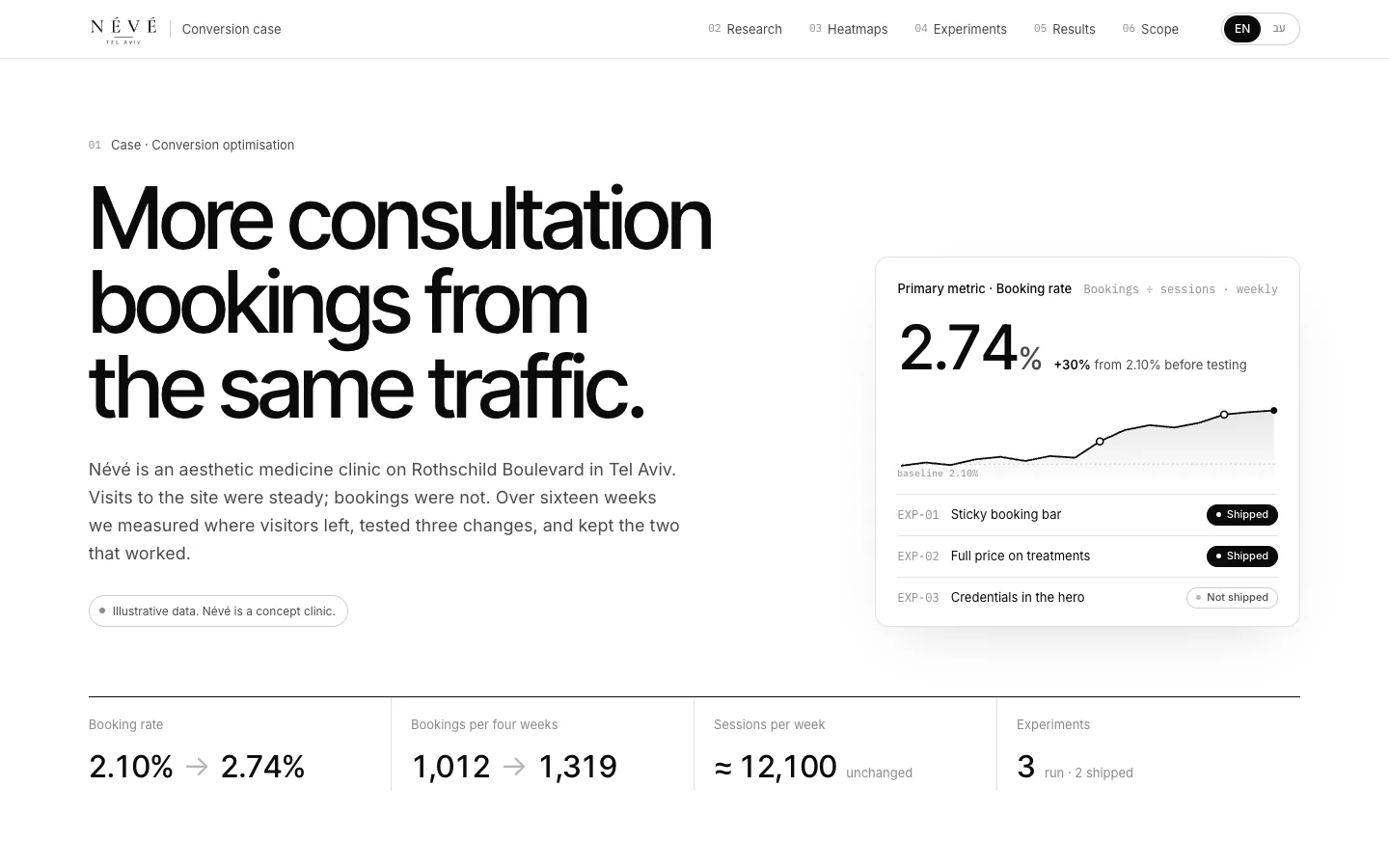
Once there is traffic and measurement, the cheapest lever is improving what happens on the site. If a higher share of visitors sends the form, every channel that brings them becomes cheaper per enquiry without spending more on ads. Conversion optimisation starts with research, what visitors do and where they leave, continues with one hypothesis at a time, and is tested with an A/B test when there is enough traffic for the result to be reliable. On a site with little traffic it is better to fix obvious problems than to run tests that never reach a conclusion. We explain the method in our guide to A/B testing and CRO, and you can follow the whole path, from research and heatmaps to a test, in the Névé conversion concept, built for a fictional aesthetic clinic.
Marketing channels compared
The table summarises each channel by what it is good at, how long it usually takes to show results, and what it needs from you. The timings are a general estimate from our work, not a promise, and they depend on your sector, competition and the state of your site.
| Channel | Good for | Time to results | What it needs from you |
|---|---|---|---|
| Website / landing page | Explaining, persuading and receiving enquiries from every channel | From launch, as the base | Clear copy, images, a decision on one action |
| Measurement (GA4, Search Console, UTM, CRM) | Knowing what works and splitting the budget | Immediate, but needs a few weeks of data | A correct setup once, and a weekly look |
| Google Business Profile | Local businesses, enquiries from Maps | Weeks | Current details, photos, replies to reviews |
| Organic search (SEO) | Existing demand over time, no cost per click | Usually months | Ongoing content, patience, a technical base |
| AI search (GEO) | Being cited in ChatGPT and similar answers | Months, and hard to measure | Content that answers directly, outside mentions |
| Google Ads | People searching right now | Days | A steady budget, landing pages, conversion tracking |
| Meta ads | Creating demand, visual brands, retargeting | Days to weeks | A steady flow of new creative |
| Content and social | Trust, presence, material to promote | Months | A calendar, production, consistency |
| Email and WhatsApp | Repeat customers, closing open enquiries | Weeks from setup | A consented list, automations, compliance |
| Conversion optimisation | Making every other channel cheaper | Weeks per test | Enough traffic, research, reliable measurement |
How to split a digital marketing budget
There is no single right percentage for splitting a budget, and anyone offering a fixed formula without knowing the business is guessing. What we can offer is an order of priorities and principles that help you decide:
- The base first. A site that converts and measurement that works are mostly one-off costs, and without them every dollar on ads is measured badly. If the budget is tight, they come before any campaign.
- Then existing demand. If people already search for what you sell, Google, paid and organic, is usually the first place to put money, because the intent is already there.
- Only then creating demand. Meta and content reach people who were not searching, and they need more trial and error and more creative.
- A steady budget, not spikes. Ad systems learn from data. A budget that jumps up and down every week makes that harder, and makes periods hard to compare.
- A small share for tests. A new channel, audience or creative type, with a spending limit set in advance and a date on which you decide.
- Move money by cost per customer, not cost per click. A channel with expensive clicks can be the cheapest per customer, and the reverse.
- Count what surrounds the media. Creative production, copywriting, tools and subscriptions, and the time of whoever manages it, are part of the cost of every channel.
To set a monthly budget, start from the other end: what an average customer is worth to the business over time, and how much you are willing to pay to win one. That number, not an industry average, decides whether a channel pays. We give rough ranges for the website itself, as seen in the Israeli market, in how much a business website costs.
A 90-day digital marketing plan
A realistic plan for a small business that is starting out, or tidying up marketing that has spread too thin. Copy it as it is and adjust the dates.
Days 1–30: the base and measurement
- Go through the site on a phone: is it clear what you do, and does each page ask for one action.
- Fix the pages that will receive paid traffic, or build a dedicated landing page.
- Install GA4, mark key events and check they are counted.
- Connect Search Console and submit a sitemap.
- Write one UTM convention and tag every existing link in your bio, email signature and WhatsApp.
- Set up a CRM or sheet where every enquiry is saved with its source.
- Update your Google Business Profile.
- Add a consent box for marketing messages, not pre-ticked, to every form.
Days 31–60: one paid channel and content
- Open one paid channel, usually Google if there is existing demand, with a steady budget.
- Write or improve the main service pages for organic search.
- Prepare a monthly calendar for one or two platforms and start posting at a steady pace.
- Set up one automatic email or message series, for example for an unanswered enquiry or a new customer.
- Check once a week: enquiries by source, cost per enquiry, and what happened to each enquiry.
Days 61–90: a second channel and improvement
- Add a second channel, usually Meta, with three to five creative versions.
- Turn on retargeting for people who visited the site and did not enquire.
- Find the step where most visitors leave and fix it.
- Compare cost per customer between channels and move budget according to the numbers.
- Write down what you learned and what changes next quarter.
Metrics that matter, and vanity metrics
A vanity metric is a number that looks good in a report and does not tell you whether the business is making money. It is not worthless, but it should never decide a budget. The table sets them side by side:
| Metric that matters | Why | Vanity metric | Why not on its own |
|---|---|---|---|
| Enquiries or sales by channel | Shows where the money comes from | Impressions | Being shown is not being noticed |
| Cost per enquiry and per customer | Shows whether a channel pays | Cost per click | Cheap clicks can bring people who never buy |
| Site conversion rate | Shows whether the site does its job | Visitors | Many visitors and no enquiries is a problem, not a success |
| Share of enquiries that become customers | Tests lead quality and the sales follow-up | Number of leads | Irrelevant leads cost time |
| Repeat customers and customer value | Tells you how much you can spend to win a customer | Followers and likes | A large audience that does not buy pays no salaries |
| Response time to an enquiry | An unanswered enquiry is money gone | Email open rate | Opens do not say who clicked or bought |
A simple working rule: every monthly report starts with enquiries, customers and the cost of each, by channel. Impressions, followers and likes go at the end, if at all.
Working with a studio or agency
Most small businesses do not keep a full marketing team, so part of the work goes to a studio, an agency or freelancers. That works well when it is clear who is responsible for what and how it is measured. Before signing, make sure of these:
- The accounts are yours. The Google Ads account, Meta Business Manager, GA4, Search Console and the domain are registered to your business, and the supplier is given access. Not the other way round.
- A goal in business terms: enquiries, sales or cost per customer, not only “reach” or “awareness”.
- A report you can read: what was spent, what came back, what was tried and what changes next month.
- Fees kept separate from media spend, so you know how much went to the platforms and how much to the work.
- Who produces the creative and content, and how many new versions are included each month.
- Exit terms: what happens to the accounts, the creative and the data if you stop working together.
Signs to stop: a promise of first place on Google or a set number of leads, an ad account opened in the supplier’s name, a report that shows only impressions and clicks, and reluctance to give you view access. If you are not yet sure what to ask for, our guide to briefing a studio helps you put it in order before you approach anyone.
A channel you do not measure is an expense. A channel you measure is a decision.
What we build at Libra
At Libra we build the base that marketing sits on: websites, landing pages and stores with measurement set up from day one, content and structure suited to Google and AI search, and pages built to convert; all of it through our websites, landing pages and stores service. Alongside it we produce creative for campaigns and social in AI content, and connect forms, CRM, email and WhatsApp in automation. You can look through the concepts we built with fictional businesses first.
If you want us to build or put this base in order for your business, send a brief with what already exists: the site, the channels running today and what you know about the numbers. We reply by email with a direction, a written price and a date.
No term matches.
More on Growth
- SEO for small business: what to do, in what order, and what nobody can promiseHow SEO works for a small business: how Google crawls and ranks, keyword research, service pages, technical basics, local SEO, links, measurement and timelines.
- Google Ads for local business: building a search campaign that brings enquiriesGoogle Search campaigns for a local service business: structure, match types, negative keywords, location settings, ads, landing pages, tracking and budget.
- Meta ads creative: how to make Facebook and Instagram ads that stop the scrollCreative for Facebook and Instagram ads: Meta’s sizes and ratios, the first seconds of video, text, versions to test, Advantage+, AI creative and ad categories.
- How to appear in ChatGPT answers and Google: SEO and GEO without the mythsWhat GEO means, how AI engines such as ChatGPT and Google’s AI Overviews pick their sources, what Google itself says, and what to do on your site this week.
- CRO and A/B testing: the maths behind the decisionWhat CRO is, how to write a hypothesis, how many visitors an A/B test needs before the result means anything, and why you stop only at the end. With a working clinic example.
A short picker
What fits you?
What is closest to what you need?
Where are you now?
Questions
What is digital marketing for a small business?
It is a system of a website, measurement and the channels that bring people to it: organic search, Google Ads, Meta ads, social content, and email and WhatsApp for existing customers. The goal is enquiries and sales you can measure by channel.
Where should a small business start with digital marketing?
Start with a clear website or landing page and measurement (GA4, Search Console, UTM tags and a CRM), then one channel that captures existing demand, such as Google. Add a second channel only when the first is measured and working.
How long does digital marketing take to work?
Google and Meta ads can bring enquiries within days; organic search and content usually take months. It depends on your sector, competition and the state of your site, so it helps to run one fast channel and one long-term channel side by side.
How much should a small business spend on digital marketing?
There is no single right amount. Start from what a customer is worth to you and how much you will pay to win one, fund the base (site and measurement) first, then existing demand, and keep a steady budget with a small share for tests.
Is Google Ads or Facebook better for a small business?
Google suits businesses whose customers already search for what they sell; Meta suits creating demand and visual products. For most local businesses Google is the starting point and Meta the second channel.
Can I send marketing emails without consent?
In most markets, generally not. In Israel, for example, section 30A of the Communications Law requires explicit prior consent, with a narrow exception for customers who gave their details during a purchase and did not refuse, and every message must be labelled and offer a simple way to opt out.
What should I check before hiring a marketing agency?
That every account is registered to your business, that the goal is measured in enquiries or cost per customer, that fees are separate from media spend, and that it is clear what happens to the accounts and creative if you part ways.
Getting started
Want this for your business?
Send a short brief: three required questions, the rest only if you like. We reply by email with a direction, a written price and a date.