Clinic website design: the pages a clinic needs, what it may publish, and how patients book
What a clinic website needs: treatment pages, a team page with credentials, the process, booking, medical advertising rules, health data in forms, and a checklist.
Part of the guide: How to build a business website, step by step

A clinic website has to answer three questions before a patient gets in touch: what the treatment is and who it suits, who performs it, and how to book. That means a page for each treatment, a team page with training and licence details, a clear account of the process, FAQs and a simple way to book a consultation. On top of that, two things an ordinary business site never has to think about: the rules on medical advertising, which often restrict patient photos, prices and promises, and the protection of health information that arrives through the forms.
The general process of building a site, from goals to launch, is in our guide to building a business website. This article covers what is specific to clinics: aesthetic medicine, dental, physiotherapy, therapy and private practices. We use Israel, the market we work in, as the worked example for the regulatory parts, and the Névé clinic website, a concept we built for a fictional aesthetic clinic with treatment pages, a method, a medical team and three-step consultation booking, as the design example.
What pages does a clinic website need?
A small clinic does not need dozens of pages. It needs a few page templates that each do one clear job, and one treatment template repeated for every treatment:
| Page | What goes on it | What to watch |
|---|---|---|
| Home | What the clinic does, for whom, where, and the way to book | A first sentence that describes the clinic in facts, not a slogan |
| One page per treatment | What it is, who it suits and who it does not, how it is done, duration, recovery, risks | Separate pages, because every treatment is a separate search |
| Team | Name, role, training, recognised specialty, licence number, photo | Specialist titles only where officially recognised |
| The process | What happens at the first visit, the treatment and after | Reduces anxiety and filters out enquiries that do not fit |
| Pricing policy | How prices are set and what the consultation includes | Some regulators restrict publishing prices (see below) |
| FAQs | Pain, recovery, results, cancellations, suitability | Short, careful answers with no promises |
| Booking | Short form, online scheduling, WhatsApp, phone | Few fields and no unnecessary medical detail |
| Privacy and accessibility | Privacy policy and accessibility statement | Real documents, not just footer links |

What should a treatment page say?
The treatment page is the page patients read most, and the one that brings them in from search. Someone looking up a treatment wants to understand the treatment before hearing about the clinic. A structure that works for almost any treatment:
- What it is, in two or three lines, in a patient’s language rather than a clinician’s.
- Who it suits and who it does not. A page that says when a treatment is not right reads as more trustworthy and filters enquiries.
- How it is done: duration, anaesthetic or not, number of sessions.
- Afterwards: recovery, do’s and don’ts, when change is visible, in ranges rather than promises.
- Risks and side effects, stated plainly.
- Who performs it, linked to the team page.
- FAQs for this treatment only, and one action at the end: book a consultation.
Pages like this also carry organic search, because they answer the questions people actually type. We cover keyword research and on-page work in our guide to SEO for small businesses.
What can a clinic publish on its website?
This is where a clinic website differs from every other business site. Most countries regulate advertising by doctors and other health professionals, and a clinic website usually counts as advertising. The rules differ by country and profession, so check with your regulator or counsel. As a concrete example, in Israel doctors’ advertising falls under the Physicians (Prohibited Advertising) Regulations, 2008, which among other things prohibit:
- Using the name, photo or image of patients, or of people presented as patients. That goes straight to before-and-after galleries and patient quotes.
- Numerical data on treatment success without Ministry of Health approval, and guarantees of success.
- Praise of the doctor’s skill, knowledge or competence, and specialist titles that are not officially recognised.
- Publishing fees and prices for treatment, and offering discounts, raffles, prizes or benefits in connection with medical treatment.
- Photographs of intimate body parts.
The same regulations carve out factual information whose purpose is medical education, so a treatment page that explains what a procedure does is not the same as an ad that praises results. Where the line falls in a given case, and what applies to clinics that also employ other professions, is a question for a lawyer who knows the field. We are not lawyers, and this is a starting point for questions, not legal advice. Other markets can be looser or stricter; the point is to check before designing a gallery around before-and-after photos.
How do you build trust without reviews?
Ordinary business sites build trust with testimonials and numbers. On a clinic site some of those tools are limited, and that is not a loss. Trust on a medical site comes from elsewhere:
- Real people: a real photo of the doctor or practitioner, training, where they trained and a licence number that can be checked.
- The place: photographs of the clinic itself, the treatment room and the waiting area, not stock images.
- Transparency: what happens at the consultation, what it costs, and what happens if the patient decides not to go ahead.
- Address, hours and contact details identical on the site, the Google Business Profile and everywhere else.
- Useful articles that explain rather than sell.
What not to do: testimonials written on patients’ behalf, anonymous quotes nobody can check, or “thousands of happy patients” with no source. Regulation aside, that is exactly what a wary patient spots.
Forms, WhatsApp and health data
Every form on a clinic website can receive health information, even when you did not ask for it. A patient who writes about a condition, medication or previous treatment in a notes field has sent sensitive data. Most privacy laws treat health data as a special category. In Israel, Amendment 13 to the Privacy Protection Law, in force since 14 August 2025 (IAPP summary), defines “information of special sensitivity” and includes a person’s state of health in it (overview by the Israel Tech Policy Institute). What that means for the website:
- The enquiry form asks for a name, a way to reply and the treatment of interest, not a medical questionnaire. Medical history is collected at the visit or in the patient record system.
- No open “tell us about your condition” field, and where there is a free-text field, a note beside it asking people not to send medical details.
- Enquiries land in a system with permissions, not a shared inbox the whole team reads.
- Analytics and advertising pixels do not load on pages where patients enter details, or at least do not send what is typed there.
- A privacy policy that says plainly what is collected, why, where it is stored and who sees it.
The exact obligations depend on the size of the clinic, the data it holds and the country, so check them with a privacy adviser. The rule for the website is simple: a form collects only what is needed to get back to the patient.

How do patients book from the website?
There are three main ways to book from a clinic website, and most clinics combine them:
- A consultation request form: the patient leaves details and the clinic replies. Simple, and right for treatments that need assessment before a slot is set.
- Direct online scheduling: the patient picks a practitioner, appointment type and free slot. Right for fixed-length appointments, and it needs a connection to the scheduling system the clinic already uses. We cover the calendar logic, including rooms, buffers and reminders, in our article on booking apps for clinics.
- WhatsApp and phone: many patients want to ask a question first. An AI agent can answer general questions, book the slot and hand anything medical to a person, as we describe in our article on AI phone agents for clinics.
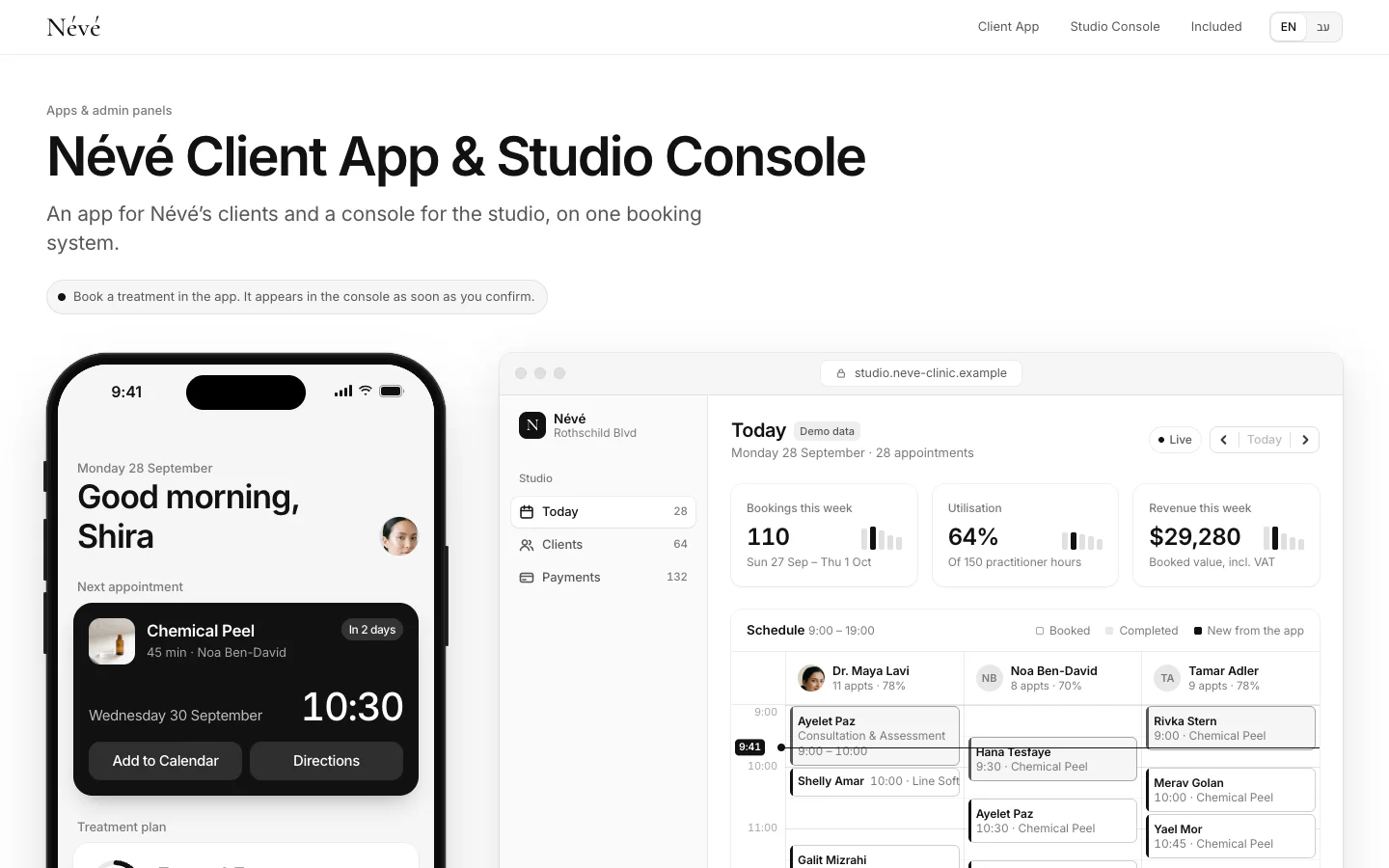
In the Névé example, booking a consultation takes three steps: treatment, time and details. What the patient books appears at once in the clinic’s app and admin system, so nobody copies details from an email into a calendar.

How do you know the website is working?
The measure of a clinic website is not traffic but how many suitable enquiries arrived and how many became consultations. That means recording every enquiry with its source: organic search, an ad, Instagram or a referral. If the clinic advertises on Google, each campaign should land on a treatment page or dedicated landing page, not the home page; see our guide to Google Ads for local businesses.
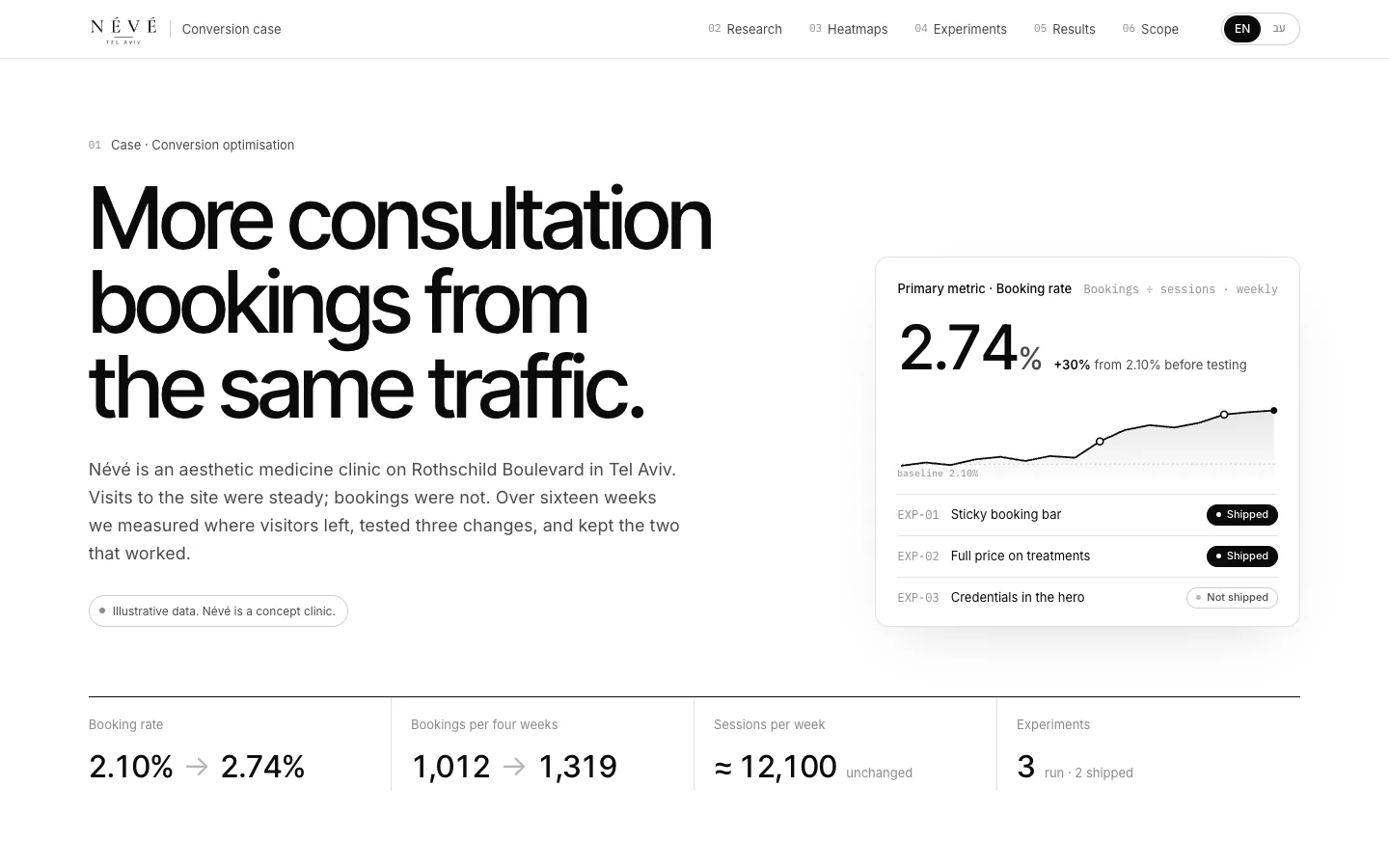
With enough traffic, you can improve methodically: find where people drop out of the booking form, form a hypothesis and test it. The Névé conversion optimisation concept shows that process from research and heatmaps to A/B tests, and our article on A/B testing and CRO explains when a test is even possible at a small business’s traffic.
Accessibility on a clinic website
A clinic has a double reason to take accessibility seriously: it serves the public, and some of its patients come precisely because of a disability. A form that cannot be completed by keyboard, low-contrast text or a video without captions shuts patients out. We cover the requirements, testing and accessibility statements, with Israel’s IS 5568 as the case study, in our guide to website accessibility.
Clinic website checklist before launch
- Every treatment has its own page, with suitability, process, recovery and risks.
- Every team profile shows training, role and licence number, with specialist titles only where recognised.
- No patient photos, patient quotes, prices or promises that have not been checked against the advertising rules that apply to you.
- The form asks only for a name, a way to reply and the treatment, next to a clear privacy policy.
- Enquiries land in a system with permissions, each saved with its source.
- Analytics tools do not collect what patients type into forms.
- Booking has been tested on a phone, through to the confirmation email or message.
- Address, hours and phone number match the Google Business Profile.
- The site has passed an accessibility review and has an accessibility statement.
How much does a clinic website cost?
A clinic website is a business website, so it sits in the same ranges we see in Israel for a site designed and built for the business: roughly $2,000–$11,000 as a rough conversion, not a price list, and agencies in the US or Western Europe often charge more. What moves the price for a clinic is the number of treatments and who writes those pages, photography of the clinic and team, a connection to a scheduling system or CRM, and a second language. The full breakdown is in our article on website cost.
At Libra we build clinic websites from the brand through to booking, including the treatment copy, and an app and admin system where one is needed; the service is described on our websites, landing pages and stores page. Send a brief with the type of clinic, the treatments and what exists today, and we will reply by email with a direction, a written price and a date.
No term matches.
Questions
What should a clinic website include?
A page for each treatment, a team page with training and licence details, an explanation of the process, FAQs, a simple way to book, a privacy policy and an accessibility statement. Address, hours and phone should match the Google Business Profile.
Can a clinic post before-and-after photos on its website?
It depends on where the clinic operates and who practises there. In Israel, the Physicians (Prohibited Advertising) Regulations prohibit using the name, photo or image of patients or people presented as patients, so check with counsel before publishing any.
Can a clinic publish its prices online?
Some regulators restrict it; in Israel, doctors may not publish treatment fees or offer discounts and benefits in connection with treatment. A clinic can still explain how prices are set and what the consultation includes.
Should patients be able to book online?
Yes, either directly into the clinic’s scheduling system for fixed-length appointments or through a consultation request when a treatment needs assessment first. Many clinics also offer WhatsApp, because patients often want to ask a question before booking.
What information should a clinic contact form collect?
Only what is needed to reply: a name, a way to reply and the treatment of interest. Health information is a special category under most privacy laws and is better collected at the visit or in the patient record system.
How much does a clinic website cost?
In the market we work in, a site designed and built for the business typically costs roughly $2,000–$11,000 as a rough conversion. For a clinic it depends on the number of treatments, copywriting, photography, the booking integration and languages.
Getting started
Want this for your business?
Send a short brief: three required questions, the rest only if you like. We reply by email with a direction, a written price and a date.