Digital marketing for a small business: the right order with a small budget and no marketing team
Digital marketing for a small business with no marketing team: Google profile, a fast site with one action, local SEO, search ads, email, reviews and tracking.
Part of the guide: Digital marketing for small business: the whole system, in the order to build it
Digital marketing for a small business starts with the places where people are already looking for you, and only then moves to places where you have to persuade them. The order that usually works: a Google Business Profile, a fast website with one clear action, local SEO, Google search ads for queries from people ready to buy, Facebook and Instagram for businesses that photograph well, email and WhatsApp to existing customers, reviews, and tracking that ties it together. Each step builds on the one before, and together they fit into a routine of a few hours a week.
We cover the full picture, every channel, budget splits and a 90-day plan, in our complete guide to digital marketing for business. This page is narrower. It is for a small business where the owner, or one employee, does the marketing alongside the actual work, and the budget does not stretch to testing everything at once. So the question here is not what is possible, but what to do first and what to leave for later.
The order, in short
| Channel | Fits a small business that… | When results show | What to measure |
|---|---|---|---|
| Google Business Profile | Has a location or a service area | Once the profile is verified and complete | Enquiries, direction requests, website clicks |
| Website with one action | Any business | Immediately, once other channels send traffic | Conversion rate per page |
| Local organic search | Sells services people search for | Months | Search Console queries, organic enquiries |
| Search ads | Sells something people search for when they need it | Days; the first month is learning | Cost per enquiry |
| Facebook and Instagram | Is visual: food, beauty, design, products, hospitality | Weeks, depending on the creative | Cost per enquiry or purchase |
| Email and WhatsApp | Has repeat customers | From the first send | Returning customers, unsubscribes |
| Reviews | Any business | Builds up over time | New reviews per month |
That is the order, top to bottom. What the table leaves out is measurement: it is not a channel, and it gets set up together with the website, because without it there is no way to tell whether paid ads are worth the money.
Step 1: Google Business Profile
When someone searches for a service near them, Google often shows a map and a list of businesses before the regular results. Google says local ranking rests mainly on relevance, distance and prominence, and that there is no way to request or pay for a better local ranking (Google Business Profile Help). What you control is how complete and accurate the profile is:
- The business name as it appears on your sign and website. Google’s Business Profile guidelines ask for the real-world name customers know, without added keywords.
- An accurate primary category, and extra categories only if they are genuinely part of the business.
- Hours, service area, phone and website link, with holiday hours kept current.
- Services or products, each with a short description.
- Real photos: the storefront, the inside, the work, the team where it fits. Your own photos, not stock.
Once the profile is complete, the ongoing work is replying to reviews, adding photos now and then, and checking the details are still right. It is the cheapest part of marketing a local business, which is why it comes first.
Step 2: a fast website with one action
A small business does not need a big website. It needs one where every visitor understands within seconds what the business does, where, and what to do next. One action means choosing the single thing a visitor should do, leave details, book, order or send a message, and making every page lead to it. If three actions matter equally, none of them stands out.
- A page for each main service, not one page that tries to describe everything.
- A price or price range where possible, and what it depends on.
- Real proof: work you have done, reviews with names and dates, licences and certificates.
- Speed on a phone. Google’s Core Web Vitals define “good” as LCP within 2.5 seconds, INP within 200 milliseconds and CLS of 0.1 or less (web.dev). On small-business sites the usual cause of slowness is heavy images and plugins that piled up over time.
How to build a page that converts, what goes in the headline and where the form sits, is in our guide to a landing page that converts. What such a site costs and what moves the price is in our article on website cost.

Step 3: local organic search
SEO for a small business is not hundreds of blog posts. It is pages that answer exactly what customers search for: the service, the town or area, and the questions they ask on the phone before they buy. A few rules:
- A title and description for each page with the service and the place, written the way people type them.
- An area page only where you really work, with content that differs per area. Dozens of identical pages with the town name swapped are what Google’s spam policies describe as doorway pages.
- Questions and answers at the end of service pages, each answer standing on its own.
- Real local links: suppliers, partners, trade associations, local press.
- Search Console connected from day one, to see which searches the site appears for.
Organic search takes time, usually months rather than weeks, so start early even though the payoff comes late. The full method is in our guide to SEO for business.

Step 4: paid ads, search first
Google search ads, only for clear intent
On a small budget, search ads work when they are limited to people already looking to buy. “Emergency plumber near me” is someone who needs a plumber today. “How to fix a leaking tap” is someone trying not to call one. A small business pays for the first and skips the second.
- Few, focused keywords: the service plus a word that signals intent, such as price, book, near me, or the town name.
- Location: only the area you actually serve.
- Negative keywords: “free”, “course”, “jobs”, “how to”, and whatever the search terms report shows is irrelevant.
- Ads that land on the matching service page, not the home page.
- A daily budget you can afford to lose for a month of learning. The first month buys information: which searches bring enquiries and which only bring clicks.
Campaign structure, location settings and the reports that matter for a local business are in our guide to Google Ads for a local business.
Facebook and Instagram, for businesses that photograph well
Meta ads reach people who were not searching for you. That works when a picture or a video can stop someone mid-scroll: a restaurant, a salon, an interior designer, a product, a renovation. It works less well for a service people only need when something breaks, and there search is the better place to stay.
- The creative is the targeting. Meta decides who sees an ad based on how people respond to it, so the image and the first second of video matter more than audience settings.
- Warm audiences first: site visitors, followers, people who messaged you. That is where the first money goes.
- One objective per campaign: leads, messages or purchases, not “awareness”.
- Three to five genuinely different creatives, not one image in three colours.
How to build ad creative, which formats and what to test first, is in our guide to Facebook and Instagram ad creative.
Step 5: the customers you already have
A past customer is the cheapest audience a small business has, and most businesses never contact them again. Three things:
Email and WhatsApp, with consent
Marketing messages are regulated almost everywhere, so check the rules where your customers are. In Israel, section 30A of the Communications Law prohibits sending an advertisement by email, SMS, fax or automatic dialling without the recipient’s explicit prior consent, and the recipient can withdraw it at any time (the amendment as enacted, in Hebrew). Collect consent separately, on a form or at the till, and record when and how it was given. After that, a little goes a long way: one email a month with something useful or new, and a reminder when it is time to come back. Service messages on WhatsApp, such as an appointment confirmation, are a different category from marketing messages, with different rules and pricing; see our article on the WhatsApp Business API.
Reviews
Ask every customer who finished for a review, with a direct link, not only the ones who seem happy. Under Google Maps’ content policy you may not offer incentives such as discounts, gifts or payment in exchange for reviews, and you may not discourage negative reviews or ask only satisfied customers. Reply to every review, including the negative ones, briefly and to the point.
Step 6: measurement
A small business does not need a complicated dashboard. It needs to know where this month’s enquiries came from. The basics:
- GA4 with key events. Google describes key events as actions that are important to your business, used to evaluate which channels lead people to take them (Google Analytics Help). For a small business these are usually a form submission, a tap on the phone number, a tap on WhatsApp and a booking.
- UTM tags on every link you publish outside the site: bio, email, posts. Google recommends always using at least utm_source, utm_medium and utm_campaign (Google Analytics Help).
- Conversions in Google Ads and Meta from the same events, so the platforms learn from enquiries rather than clicks.
- One question for every new customer: “how did you hear about us?” It catches what the tools miss, such as a friend’s recommendation.
The numbers that matter are cost per enquiry and cost per customer, not likes or impressions. Once there is enough traffic you can raise conversion with experiments; see our guide to A/B testing and conversion optimisation.

What to skip at the start
- Being on every network. One channel kept up to date beats four abandoned ones.
- Publishing articles in bulk before your service pages are good.
- Brand awareness and banner ads that are never measured against enquiries.
- Influencer partnerships before the website and profile are ready for the traffic.
- Buying followers, likes or reviews. It damages the account and trust, and for reviews it breaks Google’s policy.
- A stack of monthly subscriptions. A Google profile, GA4, Search Console, an email tool and a simple CRM usually cover it.
- A long contract up front with a marketing supplier, before measurement shows what works.
A monthly routine you can keep
Small-business marketing rarely fails for lack of strategy. It fails because it stops after two months. A routine one owner or one employee can keep, in a few hours a week:
- Every week: reply to reviews and messages, check that every enquiry got an answer, post one photo or update.
- Every week, if you run ads: go through the search terms report, add negative keywords, and check the budget is not running out early.
- Once a month: send one email to customers who opted in, improve one page on the site, and check in Search Console which searches went up or down.
- Once a month: one table: enquiries from each channel, how many became customers, and what each channel cost. A channel that brings no customers after three months of doing it properly gets stopped or changed.
- Once a quarter: refresh photos on the profile and the site, and check that prices, hours and services are still right everywhere.

Examples from the studio
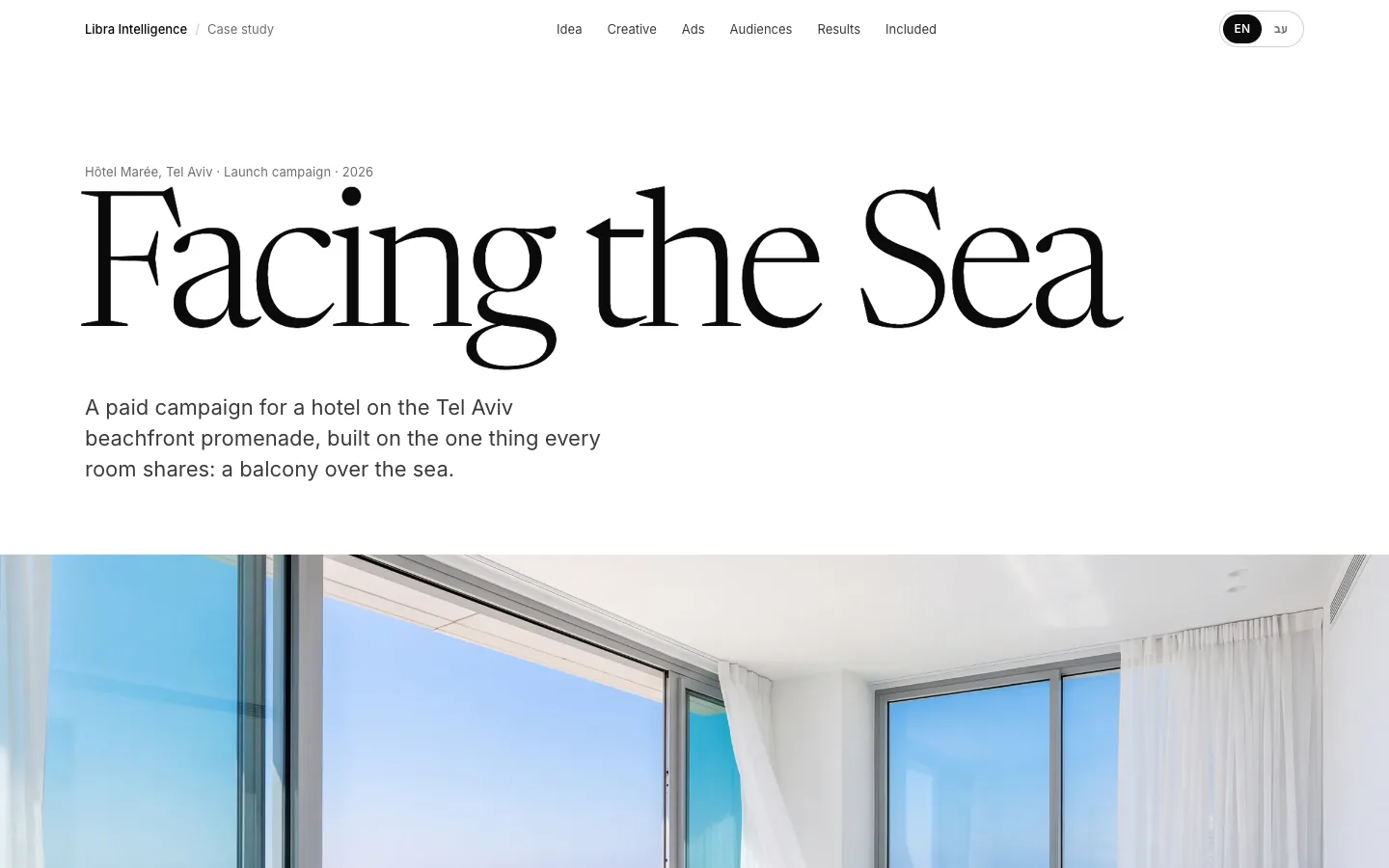
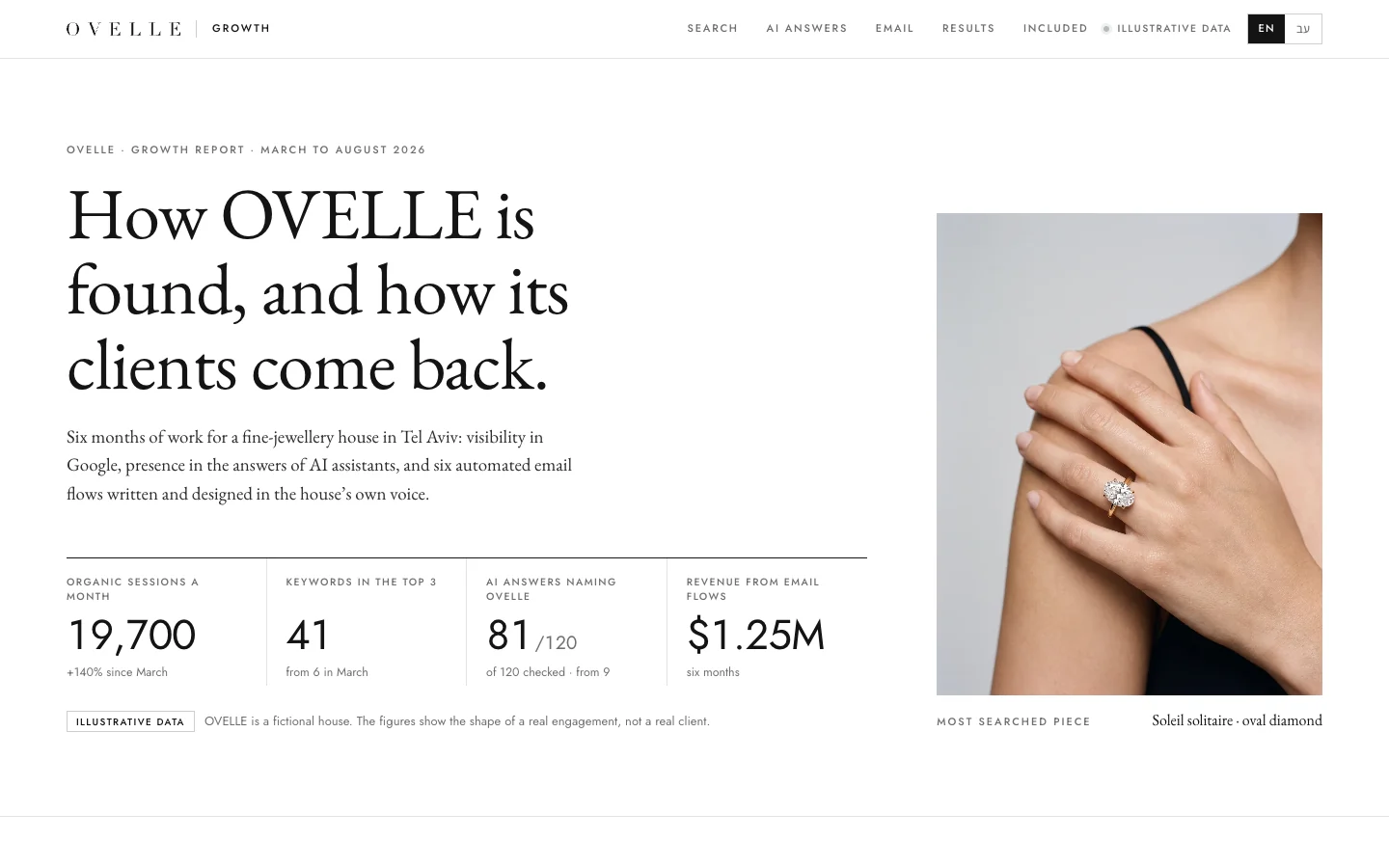
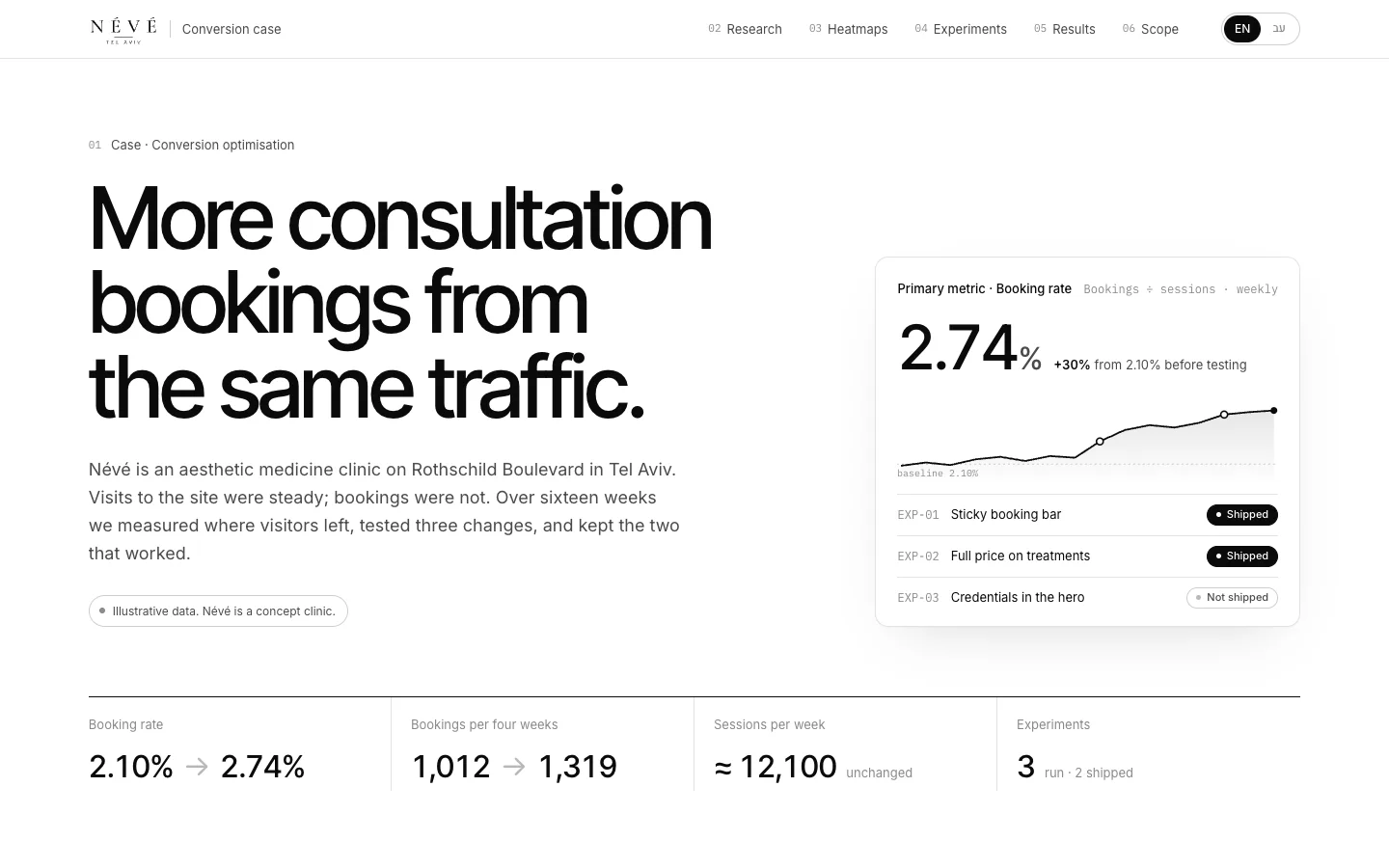
The OVELLE growth report, shown at the top of this page, is what work on Google visibility, AI answers and automated email looks like, with illustrative figures. The Névé conversion project shows how an existing site is improved through research and experiments, and the ALBA landing page is a page where every section leads to one action. These are concepts we built with fictional businesses.
Small-business digital marketing at Libra
We build what marketing stands on: a fast website with one action, service pages for local search, measurement set up in GA4 and the ad platforms, and campaigns on Google and Meta, in Hebrew and English. Our website work is described on websites, landing pages and stores. If you run a small business and want to know what to do first, send a brief with what you sell, where, and what already exists. We reply by email with a direction, a written price and a date.
No term matches.
Questions
What is the first step in digital marketing for a small business?
For a business with a location or service area, a complete and accurate Google Business Profile: the name as on your sign, the right category, hours, services and real photos. It is free, and for a local business it is often the first channel that brings enquiries.
How much should a small business spend on digital marketing?
There is no single number. A Google profile, organic search and email to existing customers cost mostly time. For ads, start with a budget you can afford to lose during a month of learning, and increase only the channel that measurement shows brings customers at a price that pays.
Does a small business need to be on every social network?
No. One channel kept up regularly, where your customers actually are, beats several abandoned accounts. A business whose product is not visual can largely skip social content and focus on search.
Google Ads or Facebook ads for a small business?
Google Ads suits a service people search for when they need it, because it reaches them at the moment of search. Facebook and Instagram suit a business whose product or result looks good in a picture. Most small businesses start with one of them, not both.
How do I know if my marketing is working?
Set up GA4 key events for the actions that matter, such as a form, a phone tap or a WhatsApp tap, add UTM tags to every outside link, and ask every new customer how they heard about you. Once a month, compare enquiries and customers from each channel with what it cost.
Can I send promotions to customers by email or WhatsApp?
Only within the rules where your customers are. In Israel, section 30A of the Communications Law requires the recipient’s explicit prior consent for advertising by email, SMS and similar means, and it can be withdrawn at any time. Collect consent separately and keep a record of it.
Getting started
Want this for your business?
Send a short brief: three required questions, the rest only if you like. We reply by email with a direction, a written price and a date.