Aesthetic clinic marketing: what Israeli law allows, and how to build the website, Google presence and booking around it
Aesthetic clinic marketing in Israel: what the physicians’ ad rules prohibit, imagery without procedures, treatment pages, Google, ads, booking and privacy.
Part of the guide: Digital marketing for small business: the whole system, in the order to build it
Marketing an aesthetic clinic starts with the law, because it takes a large part of the usual marketing toolkit off the table. In Israel, where we work, the Physicians (Prohibited Advertising) Regulations prohibit, among other things, advertising treatment prices, promotions and discounts, any identifying information about patients even with their consent, images of patients or people presented as patients, and guarantees of success. What remains works well: a website with a factual page per treatment, a complete Google Business Profile, content that explains treatments honestly, imagery of the space rather than the procedure, simple booking and reminders, and careful handling of patient data.
What Israeli law says about advertising an aesthetic clinic
The basis is section 11 of the Physicians Ordinance (in Hebrew): a licensed physician may not advertise their practice in a way that could mislead, harms the dignity of the profession or breaches the regulations. The same section says that a person who is not a physician may not advertise medical practice, or a physician’s practice, in a way that would be prohibited if the physician did it. So the rules bind the clinic, the ad agency and whoever builds the website, not only the doctor. The State Comptroller’s report on aesthetic treatments noted that responsibility for advertising lies with the physician even when a non-medical body, such as an aesthetics institute where the physician works, publishes it (State Comptroller, Annual Report 69B, 2019, p. 778, in Hebrew).
The detail is in the Physicians (Prohibited Advertising) Regulations, 2008 (in Hebrew). These are the provisions that bear directly on marketing an aesthetic clinic:
| Topic | What the regulations say | What it means for marketing |
|---|---|---|
| Prices | Reg. 3(1): publishing fees and prices for treatment is prohibited advertising | No price lists in ads, posts or website pages |
| Promotions and discounts | Reg. 3(4): no promotions, discounts, raffles, prizes, gifts or any benefit connected with medical treatment | No discounted packages, no “second session half price”, no social media giveaways |
| Patient information | Reg. 3(3): no use of any information about a past or present patient that could identify them, even with consent | No named testimonials, no patient stories, no tagging patients |
| Images of patients and doctors | Reg. 2(2)(b): no name, photo or likeness of patients or of people who appear to be patients or doctors, unless it is stated explicitly and prominently that they are not | Before-and-after photos of patients are a real risk; a model needs a prominent note that she is not a patient |
| Celebrities | Reg. 2(2)(a): no name, photo or likeness of well-known people | No “the celebrity we treated” |
| Guarantees and figures | Reg. 2(1): no guarantee of success, no numerical success data without Ministry of Health approval, no praise of the doctor’s skill | No “guaranteed results”, no success rates, no “the best doctor in the field” |
| Fear | Reg. 3(2): no encouraging non-essential treatment by creating fear or anxiety | No messages that frame age or appearance as a problem that must be fixed |
| Channels | Reg. 2(3): no telemarketing or sales agents, no pop-up ads, no internet ads on sites aimed at minors, no advertising in breach of section 30A of the Communications Law; size limits on press ads and billboards | No cold calls to leads, no pop-ups, nothing aimed at minors, marketing messages only with consent |
The exception for educational content
Regulation 4 says that regulations 2(2) and 2(3), the limits on the form of advertising and on channels, do not apply to factual information whose purpose is spreading medical knowledge and education. Note what it does not cover: it does not lift regulation 2(1), on misleading content and guarantees, or regulation 3, which holds prices, discounts and patient information. A page explaining what a treatment does is different from an ad praising results, but even an educational page cannot carry an offer.
Specialist titles
The same Comptroller report states that “aesthetic medicine” is not a recognised medical specialty in Israel, and that doctors presenting themselves as specialists in aesthetic medicine or “dermo-aesthetics” are advertising unlawfully and misleading the public (p. 777). On the website and in ads, show the title and specialty actually approved, not one that sounds good.
Who else, and what else
- Dentists fall under separate regulations, the Dentists (Prohibited Advertising) Regulations (in Hebrew). A clinic with both doctors and dentists needs to check both.
- A clinic without doctors, for example cosmeticians only, is still subject to the general law on misleading advertising, and if it advertises treatments that amount to medical practice, to section 11 as well. Where the line falls in a given case is a question for a lawyer.
- Complaints: the Ministry of Health has a service page for complaints about misleading medical advertising (in Hebrew). According to the Comptroller, the committee sends warning letters, and disciplinary sanctions can reach suspension of a licence.

Imagery: the space, not the procedure
Law aside, a clinic’s images decide whether someone feels safe enough to book a consultation. A needle, gloves, a syringe near a face or a doctor in a white coat next to a machine are pictures of a procedure, and they push people away more than they invite them in. What works:
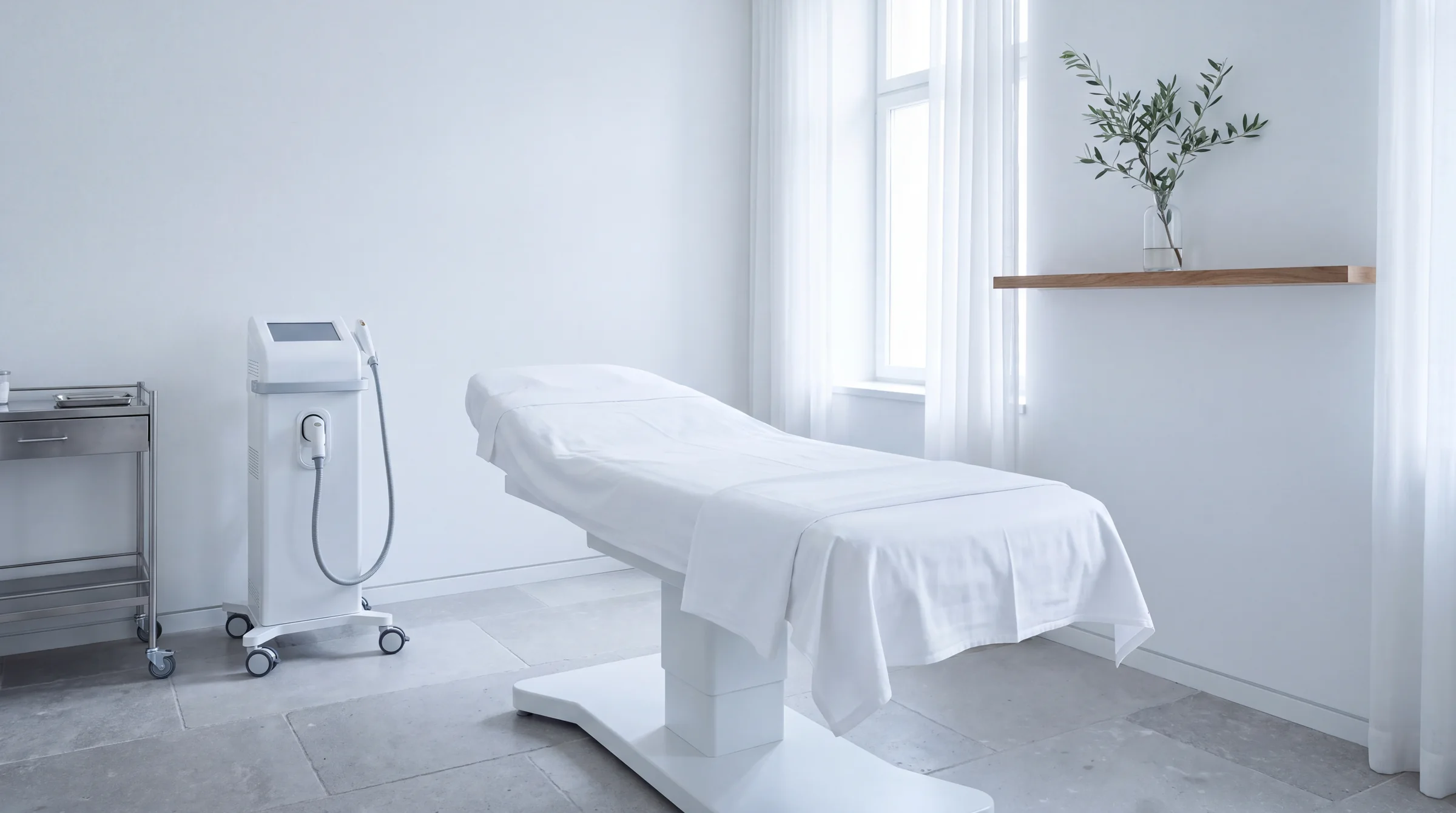
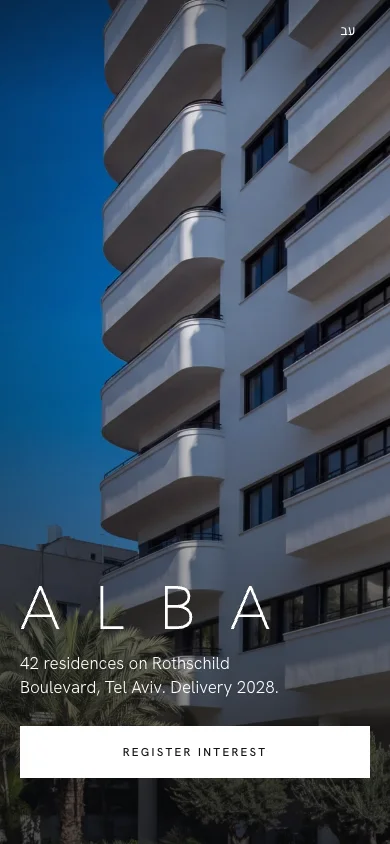
- The space. The treatment room, the waiting room, daylight from the window, the materials. Like the room at the top of this page.
- Still lifes. A vial, a folded towel, a branch in a glass vase, the texture of stone or linen.
- The patient alone. One calm figure, no practitioner’s hand in the frame, no procedure. With a model, regulation 2(2)(b) calls for an explicit, prominent note that she is not a patient.
- The team as typography. Full name, degree, recognised specialty, licence number, where they trained. Clean lines of text instead of portraits in white coats, which also removes the need to label figures who look like doctors.
Photography should be bright and clean, in daylight. AI-generated imagery can suit the space and still lifes, but not figures presented as patients or as results; we cover the ground rules in our article on AI images and copyright.
The website: a page per treatment
People looking for an aesthetic treatment search for the treatment, not the clinic. So the site is built from a separate page per treatment, each answering the same questions in the same order:
7 steps
What the treatment is
and what it does, in plain words.
Who it suits, and who it does not
Including situations where you will not treat.
How it is done
: duration, anaesthesia if any, the usual number of sessions.
Recovery
: what to expect in the following days.
Risks and side effects
According to the Comptroller’s report, the Israel Medical Association’s code of ethics prohibits publishing a treatment’s benefits without the possible complications.

Who performs it
: name, title and licence.
The next step
: booking a consultation, as the one action.
No price list, no before-and-after gallery and no patient quotes. The overall structure, pages, forms and accessibility, is in our guide to clinic website design.
Google: Business Profile, reviews and content
According to Google Business Profile Help, local ranking rests mainly on relevance, distance and prominence, and cannot be bought. What you can do: a complete profile with the clinic’s name as on its sign, an accurate category, hours, a list of treatments with factual descriptions, and photos of the space rather than procedures.
Google reviews are written by patients, not the clinic, but two rules apply. Google Maps’ content policy prohibits offering incentives for reviews, and in Israel regulation 3(4) prohibits benefits connected with treatment anyway. The second concerns replies: a reply that confirms the writer was treated, or names the treatment, discloses information about a patient. Reply without confirming or detailing anything, and invite them to continue privately.
Alongside the profile, content that explains treatments honestly is what brings organic searches: the difference between two treatments, how long recovery takes, why not everyone is a candidate. Such content generally falls within the educational information of regulation 4, as long as it stays factual and makes no promises. How to build pages that rank is in our guide to SEO for business.
Ads on Google and Meta
Paid advertising is allowed within the same rules: no price, no discount, no patients, no guarantees, and no pop-ups or sites aimed at minors. The platforms add their own rules. Under Meta’s health and wellness policy, ads for cosmetic procedures and surgery must be targeted to people 18 or older, and ads for personal health products must not imply negative self-perception of body image. Meta allows some before-and-after imagery for cosmetic procedures, but an ad approved by Meta is not an ad approved by the law: the Israeli regulations are stricter.
On Google, search ads for the treatment name and area reach people who are already looking. The ad lands on the treatment page, and the goal is a consultation. Settings for a local business are in our guide to Google Ads for a local business.
Booking, reminders and enquiries
Most enquiries to a clinic are logistical: when is there a slot, how long does it take, where to park, what to bring. A system that answers them quickly, day and night, leaves the team the conversations that really need a person.
- Online booking in three steps at most, with automatic confirmation and a reminder. How to build a clinic app and admin system is in our article on a clinic booking app.
- An AI agent on WhatsApp that answers logistical questions from the clinic’s own information, books consultations, and hands every medical question to a person. It does not diagnose, recommend treatment or offer discounts. See our article on WhatsApp AI agents.
- An AI phone agent for hours when nobody can answer, with the same hand-over rules; see our article on AI phone agents.
- Marketing messages only to people who opted in, under section 30A of the Communications Law, which regulation 2(3) refers to explicitly.
Note regulation 2(3)(a): telemarketing and sales agents are prohibited. Someone who left their details gets an answer to their enquiry, not a sales call.
Patient data and privacy
Every form on a clinic website can receive health information, even when you did not ask for it: a patient who mentions a medication or a previous treatment in a notes field has sent sensitive data. In Israel, the Privacy Protection (Data Security) Regulations list medical information among the data types that raise a database’s required security level, and Amendment 13 to the Privacy Protection Law, in force since 14 August 2025, expanded the Privacy Protection Authority’s enforcement powers, including monetary sanctions (IAPP overview). What follows for marketing:
- Short forms: name, phone, the treatment of interest. No free-text field that invites medical detail.
- Pixels and tags receive the fact that a form was sent, never its content.
- Permissions: each team member sees only what they need.
- Patient lists do not go to ad platforms without legal review first.
Examples from the studio
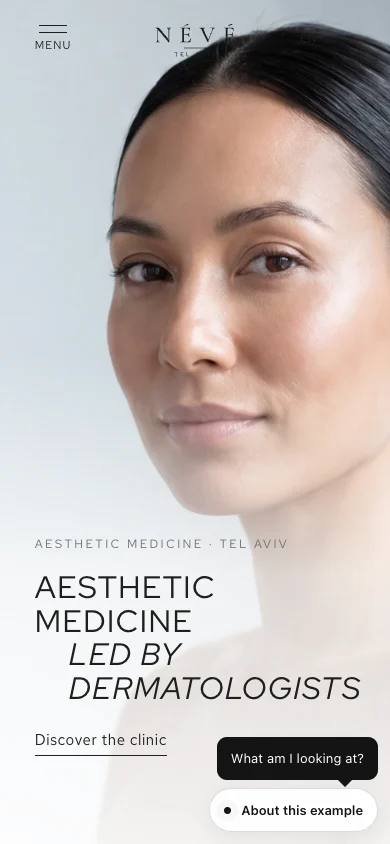
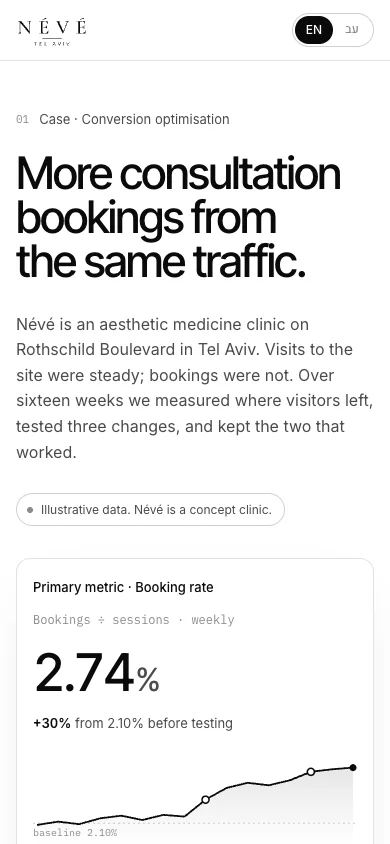
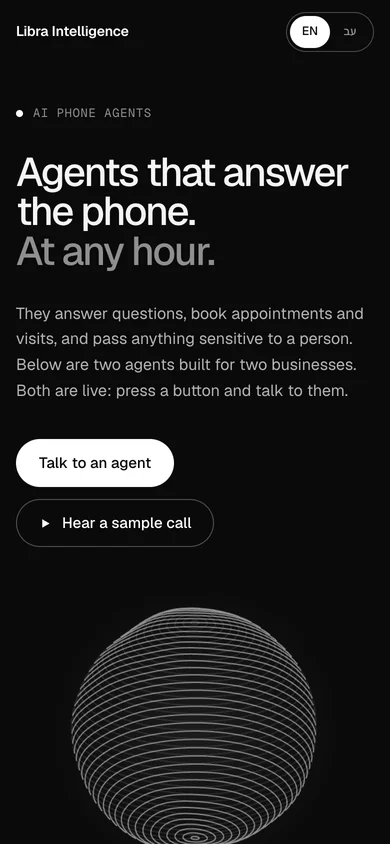
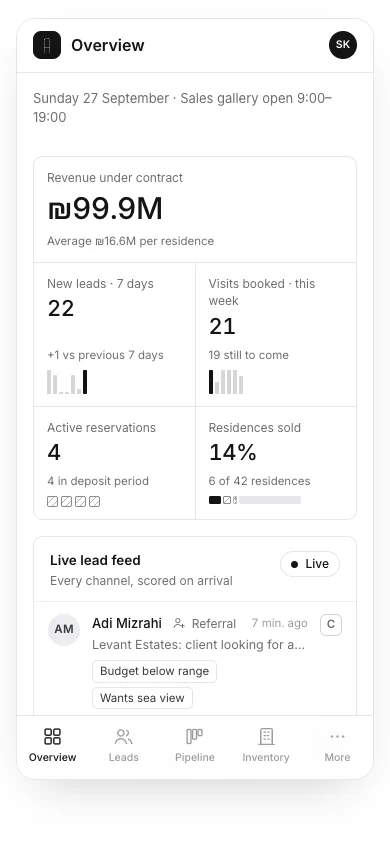
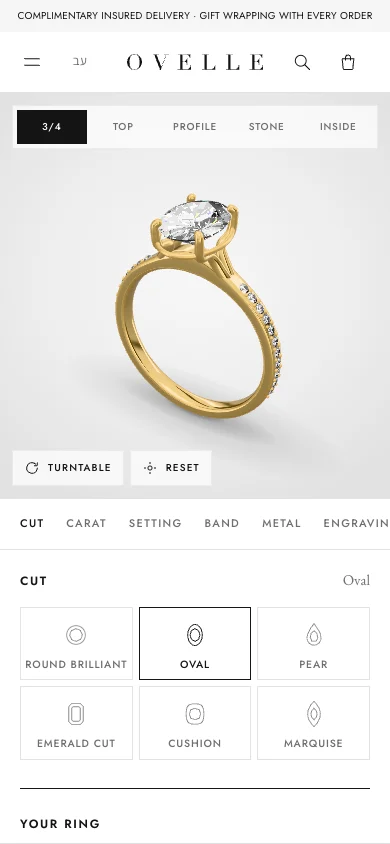
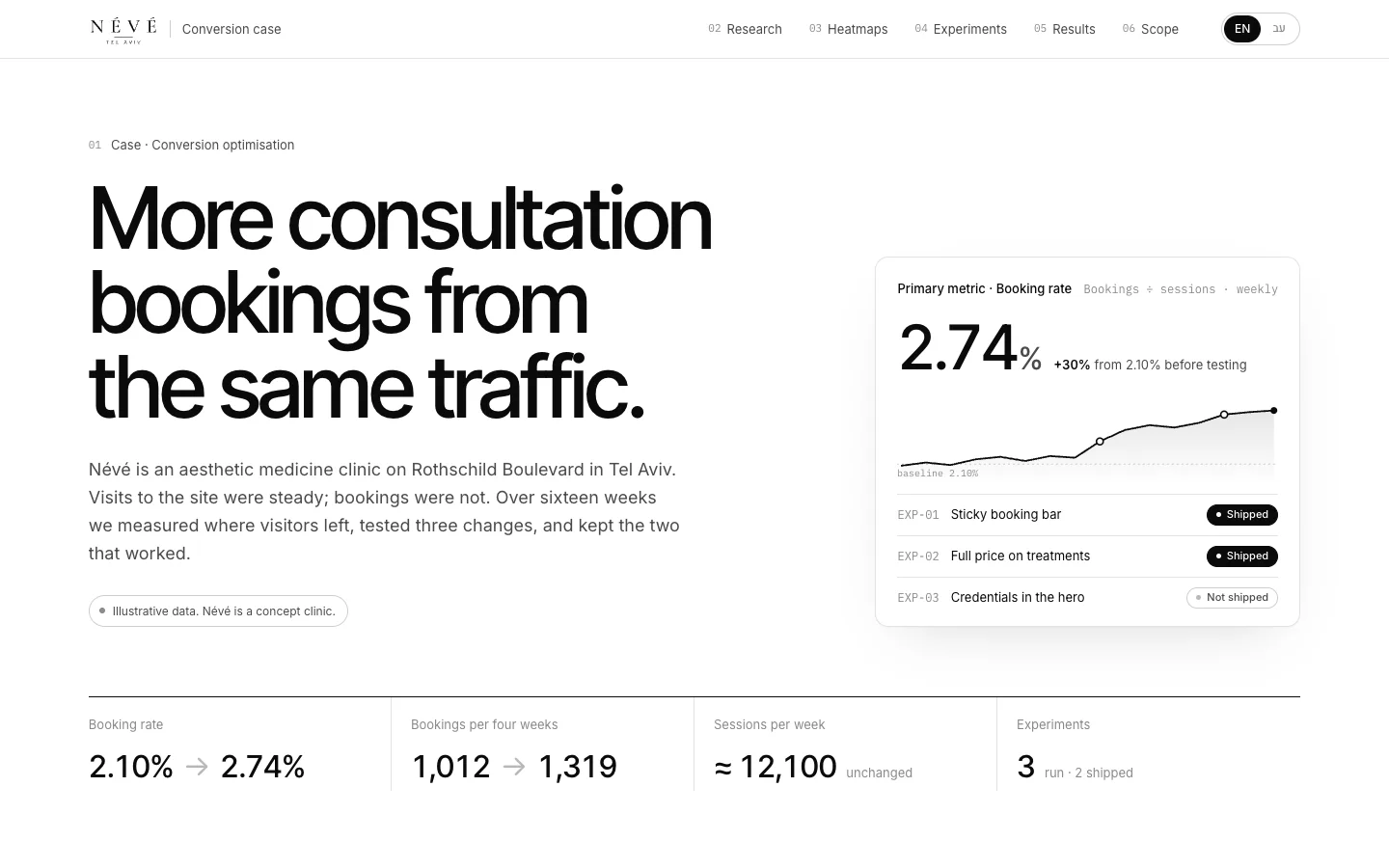
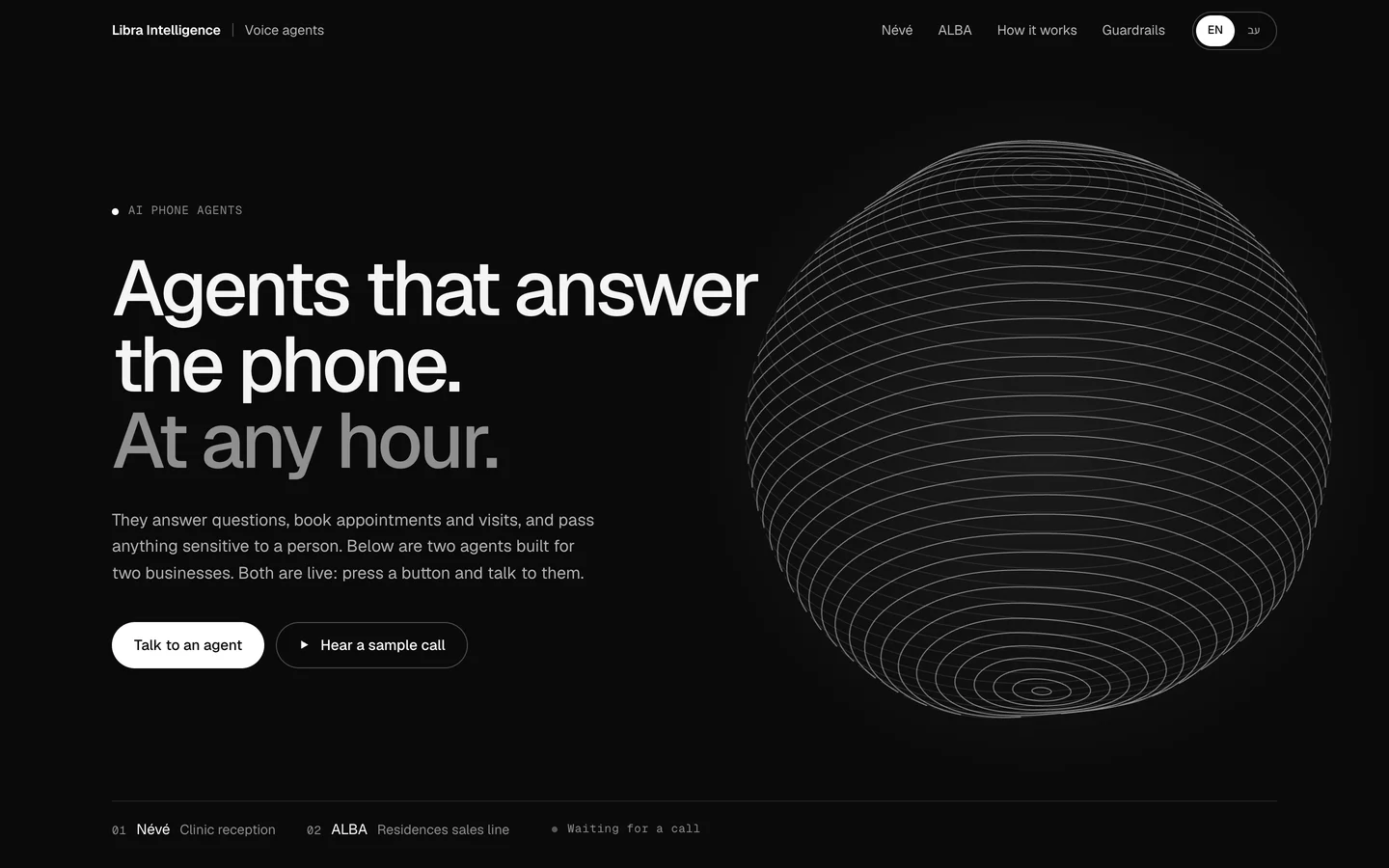
The Névé website is an aesthetic clinic site built on the visual language described above: the space, still lifes, and the team presented by name and training, like the treatment room at the top of this page. The Névé conversion project shows how the consultation-booking path is improved, and the AI phone agents show calls answered, appointments booked and anything sensitive handed to a person. These are concepts we built with fictional businesses.
Aesthetic clinic marketing at Libra
For aesthetic clinics we build a website with a page per treatment, photography and content in the language of the space, the Google profile, campaigns within the advertising rules, online booking, and AI agents for WhatsApp and the phone, in Hebrew and English. Our work for clinics is described on aesthetic clinics, and our website work on websites, landing pages and stores. Content and campaigns should also be checked by the clinic’s lawyer. Send a brief with your treatments, your team and what exists today. We reply by email with a direction, a written price and a date.
No term matches.
Questions
Can an aesthetic clinic in Israel advertise its prices?
Regulation 3(1) of the Physicians (Prohibited Advertising) Regulations makes publishing fees and prices for treatment prohibited advertising. It applies to advertising a physician’s practice even when the clinic or an agency publishes it. Check a specific case with a lawyer.
Can a clinic post before-and-after photos of patients?
In Israel the regulations prohibit using a patient’s photo or likeness and any information that could identify a patient, even with consent. Before-and-after photos of real patients are therefore a real risk, even where Meta allows them. Check with a lawyer before publishing any.
Are discounts and promotions on aesthetic treatments allowed?
In Israel, regulation 3(4) prohibits advertising promotions, discounts, raffles, prizes, gifts or any benefit connected with medical treatment. That includes discounted packages, social media giveaways and a gift for referring a friend.
Do the rules apply when the clinic or an agency advertises, not the doctor?
Yes. Section 11 of the Physicians Ordinance says a non-physician may not advertise a physician’s practice in a way that would be prohibited if the physician did it, and the State Comptroller noted that the physician remains responsible when an aesthetics institute advertises.
What imagery suits an aesthetic clinic website?
The space, still lifes, and a patient alone with no procedure and no practitioner’s hands in frame, clearly labelled if she is a model. Present the team in text: name, degree, recognised specialty and licence number. No needles, gloves or doctors in white coats.
Can Meta ads for cosmetic treatments target any age?
No. Under Meta’s health and wellness policy, ads for cosmetic procedures and surgery must be targeted to people 18 or older. In Israel the physicians’ regulations also prohibit internet advertising on sites aimed at minors.
Getting started
Want this for your business?
Send a short brief: three required questions, the rest only if you like. We reply by email with a direction, a written price and a date.