Law firm website design: practice areas, lawyer profiles, advertising rules and confidential enquiries
What a law firm website needs: practice area pages, lawyer profiles, articles, a confidential enquiry form, bar advertising rules and AI on the firm’s knowledge.
Part of the guide: How to build a business website, step by step

A law firm website has to show quickly what the firm does, who will handle the matter, and how to get in touch discreetly. The core is a page for each practice area, a page for each lawyer, articles that explain the law in that area, and an enquiry form that asks for no more than it needs. All of it sits under the advertising rules of the bar or regulator where the firm practises, and those rules differ sharply between countries: the same sentence about fees can be required in one jurisdiction and prohibited in another.
The general process of building a website is in our guide to building a business website. This article covers what is specific to law firms, from a sole practitioner to a multi-department firm, with Israel, the market we work in, as the worked example for the rules. The design examples are for Varon Kessel, a fictional firm for which we built two concepts: an AI assistant that answers from the firm’s own documents and a digital annual review.
What pages does a law firm website need?
| Page | What goes on it | What to watch |
|---|---|---|
| Home | What the firm does, for whom, and how to get in touch | A factual opening line: practice areas and clients, not a slogan |
| Practice area | The matters handled, how the process runs, who leads | One page per area, and sometimes per type of matter within it |
| Lawyer profiles | Name, role, education, year of admission, areas, languages, publications | A page per lawyer, not just a grid of photos |
| Articles and updates | Explanations of legal questions and changes in the law | Content that explains, never promises an outcome |
| About | History, partners, way of working, languages | Facts that can be checked |
| Contact | Short form, phone, email, address and hours | A form that does not invite the whole story |
| Privacy and accessibility | Privacy policy and accessibility statement | The enquiry form is personal data too |
| Regulatory information | Whatever your regulator requires on the site | Varies by jurisdiction; see below |
Practice area pages
Clients do not search for “a law firm”. They search for a lawyer for something specific: a divorce, a commercial lease, a founders’ agreement, a negligence claim. So practice area pages are the most important part of the site, for readers and for search. A good one says:
- Exactly which matters the firm handles in the area, and which it does not.
- What the process looks like from the first enquiry, in stages and broad timeframes.
- Which documents to bring to a first meeting.
- Who at the firm leads the area, linked to their profile.
- Common client questions in the area, with short, careful answers.
A firm with many areas benefits from two levels: a page for the broad area, such as employment law, and pages for the specific matters people search for within it. That is the structure search engines read best; keyword research and on-page work are covered in our guide to SEO for small businesses.
Lawyer profile pages
In legal services the client is buying a person, so the lawyer’s profile is usually the second page opened after the practice area. A grid of photos and names is not enough. Each lawyer needs a page with education, year of admission, practice areas, languages, publications, teaching and previous roles, and a real professional photograph. These are the kinds of details bar rules generally allow, and exactly what a client wants to check.
What can a law firm publish on its website?
Before writing a word, find out which rules apply. They vary more than most firms expect. Two examples from opposite directions:
- Israel: lawyers’ advertising falls under the Israel Bar Association (Advertising) Rules, 2001. They allow free text offering legal services only if it makes no reference to fees; a website may name clients only if each has declared in writing that they understood they were free to refuse and that the service was not conditional on it; recommendations, thank-you letters and ratings in ranking guides are allowed if presented without creating a misleading impression; a lawyer’s website may not carry, directly or indirectly, advertising for others; online enquiry forms are allowed subject to privacy law; and copies of advertising and newsletters must be kept for three years.
- England and Wales: the SRA Transparency Rules point the other way on price. Firms offering certain services, such as residential conveyancing, probate or some employment tribunal claims, must publish cost information on their website, along with their complaints procedure and the SRA’s digital badge.
So a “transparent pricing” page that a UK firm is required to publish could breach the rules for an Israeli one. Other jurisdictions sit elsewhere between the two. The final wording of each page should be approved by the lawyers themselves, and checked with the bar’s ethics guidance where in doubt. We build the site; the ethical call belongs to the lawyer who signs it.
A confidential enquiry form
People usually contact a lawyer at a sensitive moment, and the website form is the first place they may write too much. A form that invites “describe your case” can receive details about the other side, an offence or a medical condition before anyone has checked for a conflict of interest. A few simple decisions prevent that:
- The form asks for a name, a way to reply and the area of the matter, with at most one line on the subject.
- Beside it, a note asking people not to send documents or sensitive details yet, and saying that the enquiry itself does not create a lawyer-client relationship. The firm should write the exact wording itself.
- The name of the other party is collected early and separately, so conflicts can be checked before more details arrive.
- Enquiries land in a system with permissions by department, not an inbox everyone reads.
- No advertising pixels or session-recording tools on pages where people enter details.
- A privacy policy that says what is collected, where it is stored and who sees it.
Articles and updates: the content that brings clients
For law firms, articles are not an extra; they are the main way to appear in search. Someone searching what to do when an employer does not pay wages reads an explanation, and if it is clear, they contact whoever wrote it. A good article answers one question, is dated, is signed by a lawyer linked to their profile, and cites the legislation or case law it relies on.
Keep newsletter sign-up explicit; in Israel, for example, the rules allow a newsletter to clients and others who asked for it. The same content can also surface in AI answers when it is written so it can be quoted; we explain how in our guide to SEO and GEO.
Serving clients in more than one language
Firms that work with foreign investors, relocating families, international companies or overseas property buyers need a second language written for that audience, not a translation. An overseas client asks different questions: how the procedure works in your country, whether they can sign remotely, which languages the team speaks, and how fees compare with what they know. The same advertising rules apply in every language. We cover the technical side, including separate URLs per language, right-to-left scripts and hreflang, in our guide to bilingual Hebrew and English websites.
An AI assistant on the firm’s knowledge
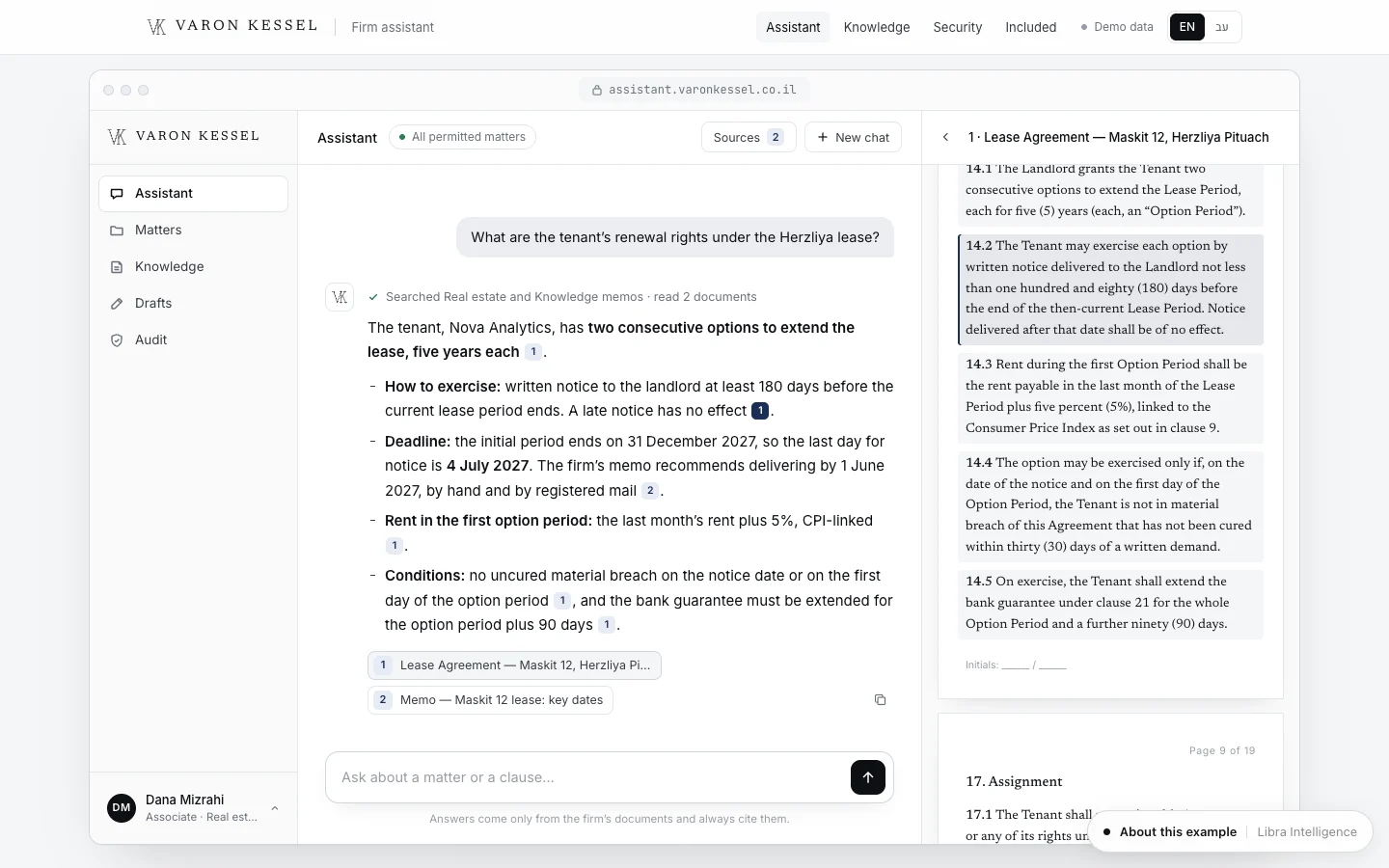
A firm has years of opinions, agreements, memos and collected case law. An AI assistant that answers from those documents, showing its sources in every answer, saves lawyers search time. In the Varon Kessel concept, every answer points to the document and clause it came from, and permissions by department decide what each lawyer can see.
Most firms should start with an internal assistant rather than a chat on the public site, because a wrong legal answer to a non-client is a needless risk. On the site itself, a narrow assistant can handle general questions: areas, languages, how to get in touch. We explain the method, document preparation and testing in our article on AI assistants trained on company documents.
Annual reviews and designed publications
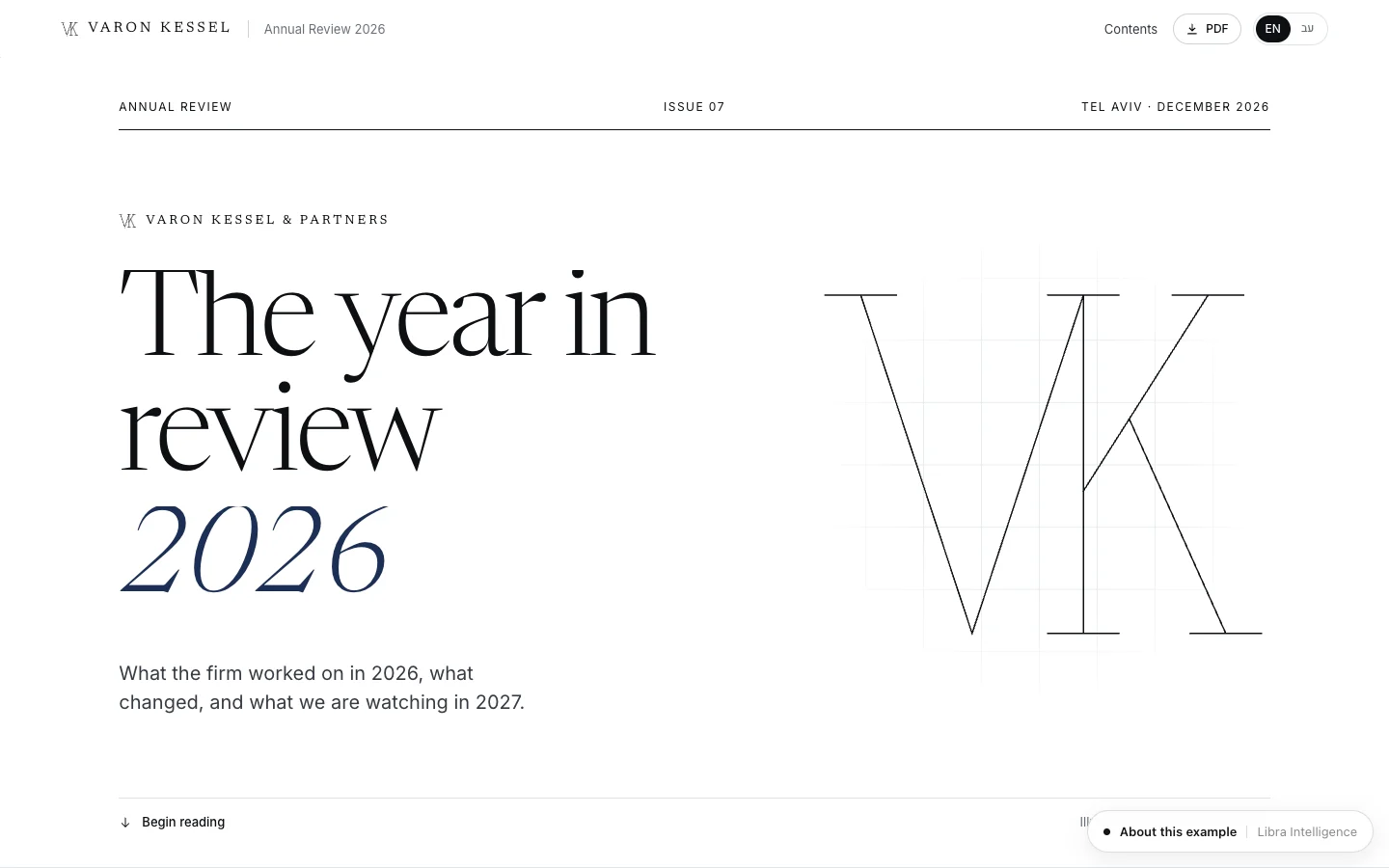
Mid-size and large firms publish annual reviews, client guides or legal updates as PDFs. Built as web pages as well, they read on a phone, show up in search and let you link to a single chapter. The Varon Kessel annual review is a concept of that kind: chapters, data and people, as a digital edition and a designed PDF.
Law firm website checklist
- Every practice area has its own page, with the matters handled, the process and who leads.
- Every lawyer has a profile with education, year of admission, areas and languages.
- Fees, client names, testimonials and rankings appear only as your regulator allows.
- No wording promises an outcome.
- Any regulatory information your regulator requires is on the site.
- The form is short, warns against sending sensitive details, and lands in a system with permissions.
- There is a privacy policy and an accessibility statement.
- Past versions of pages and newsletters are kept for as long as your rules require.
- Each language version was written for its audience and approved by a lawyer.
How much does a law firm website cost?
A law firm website sits in the ranges we see in Israel for a site designed and built for the business: roughly $2,000–$11,000 as a rough conversion, not a price list, and agencies in the US or UK often charge more. What moves the price is the number of practice areas and lawyers, who writes the copy, a second language, a CRM connection and an articles system. An AI assistant on the firm’s documents is a separate project. The full breakdown is in our article on website cost.
At Libra we build law firm websites from the identity through to the articles, as well as assistants on the firm’s knowledge and designed publications; the service is described on our websites, landing pages and stores page. Send a brief with the practice areas, the number of lawyers and the languages, and we will reply by email with a direction, a written price and a date.
No term matches.
Questions
What should a law firm website include?
A page for each practice area, a profile for each lawyer, articles, a short enquiry form, contact details, a privacy policy and an accessibility statement, plus any regulatory information your regulator requires. All of it is subject to the advertising rules where the firm practises.
Can a law firm publish its fees on its website?
It depends on the jurisdiction. In England and Wales the SRA requires cost information for certain services, while Israel’s Bar advertising rules allow free text about legal services only without reference to fees.
Can a law firm list its clients on its website?
Usually only with their consent. In Israel, the Bar rules allow naming clients on the firm’s website only if each has declared in writing that they were free to refuse and that the service was not conditional on it.
Are client testimonials allowed on a lawyer’s website?
Rules differ by jurisdiction. Israel’s Bar rules allow recommendations, thank-you letters and ratings if presented without creating a misleading impression, and nothing on the site should imply a guaranteed result.
How do you keep a law firm contact form confidential?
Ask only for a name, a way to reply and the area of the matter, warn people not to send sensitive details yet, and route enquiries into a system with permissions. Keep advertising pixels off the pages where details are entered.
Should a law firm have an AI chatbot on its website?
Start with an internal assistant that answers from the firm’s documents and shows its sources. On the public site, keep any assistant to general questions such as practice areas, languages and how to get in touch.
Getting started
Want this for your business?
Send a short brief: three required questions, the rest only if you like. We reply by email with a direction, a written price and a date.